

Part B | 12.8
368 Part B Tools and Methods in Marine Biotechnology
12.8 High-Temperature and/or High-Pressure Bioreactors (HP-/HTBR)
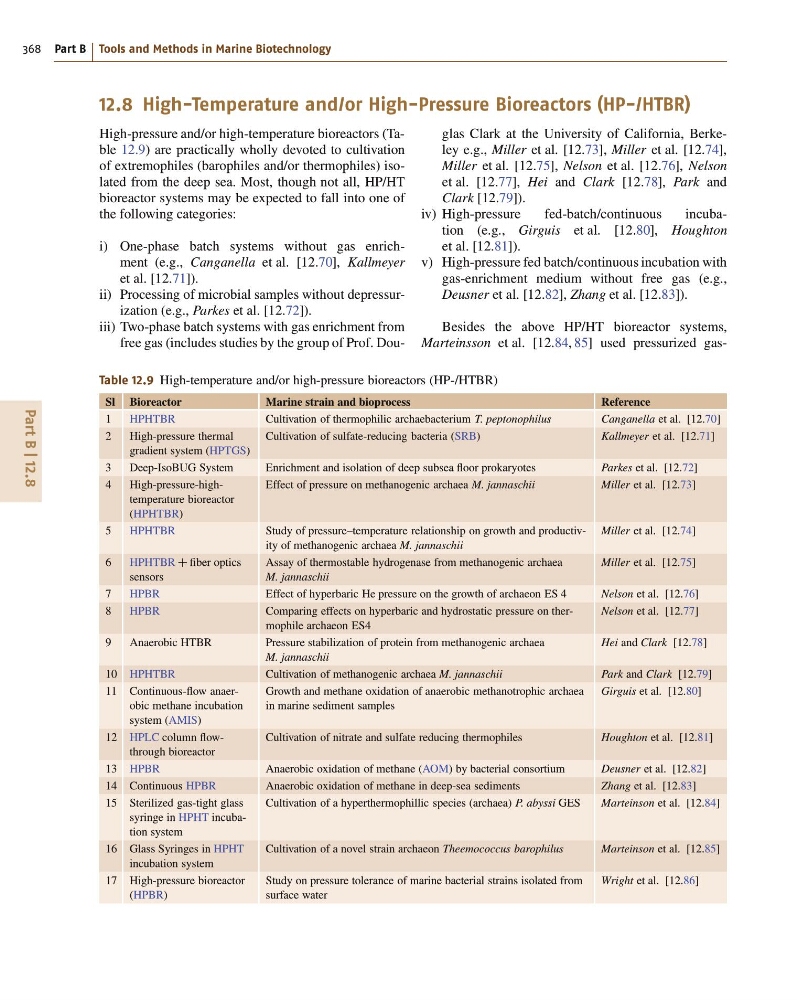
High-pressure and/or high-temperature bioreactors (Table 12.9) are practically wholly devoted to cultivation
of extremophiles (barophiles and/or thermophiles) isolated from the deep sea. Most, though not all, HP/HT
bioreactor systems may be expected to fall into one of
the following categories:
i) One-phase batch systems without gas enrichment (e.g., Canganella et al. [12.70], Kallmeyer
et al. [12.71]).
ii) Processing of microbial samples without depressurization (e.g., Parkes et al. [12.72]).
iii) Two-phase batch systems with gas enrichment from
free gas (includes studies by the group of Prof. DouTable 12.9 High-temperature and/or high-pressure bioreactors (HP-/HTBR)
Sl Bioreactor
Marine strain and bioprocess
Reference
1
HPHTBR
Cultivation of thermophilic archaebacterium T. peptonophilus
Canganella et al. [12.70]
2
High-pressure thermal
gradient system (HPTGS)
Cultivation of sulfate-reducing bacteria (SRB)
Kallmeyer et al. [12.71]
3
Deep-IsoBUG System
Enrichment and isolation of deep subsea floor prokaryotes
Parkes et al. [12.72]
4
High-pressure-hightemperature bioreactor
(HPHTBR)
Effect of pressure on methanogenic archaea M. jannaschii
Miller et al. [12.73]
5
HPHTBR
Study of pressure–temperature relationship on growth and productivity of methanogenic archaea M. jannaschii
Miller et al. [12.74]
6
HPHTBR C fiber optics
sensors
Assay of thermostable hydrogenase from methanogenic archaea
M. jannaschii
Miller et al. [12.75]
7
HPBR
Effect of hyperbaric He pressure on the growth of archaeon ES 4
Nelson et al. [12.76]
8
HPBR
Comparing effects on hyperbaric and hydrostatic pressure on thermophile archaeon ES4
Nelson et al. [12.77]
9
Anaerobic HTBR
Pressure stabilization of protein from methanogenic archaea
M. jannaschii
Hei and Clark [12.78]
10 HPHTBR
Cultivation of methanogenic archaea M. jannaschii
Park and Clark [12.79]
11 Continuous-flow anaerobic methane incubation
system (AMIS)
Growth and methane oxidation of anaerobic methanotrophic archaea
in marine sediment samples
Girguis et al. [12.80]
12 HPLC column flowthrough bioreactor
Cultivation of nitrate and sulfate reducing thermophiles
Houghton et al. [12.81]
13 HPBR
Anaerobic oxidation of methane (AOM) by bacterial consortium
Deusner et al. [12.82]
14 Continuous HPBR
Anaerobic oxidation of methane in deep-sea sediments
Zhang et al. [12.83]
15 Sterilized gas-tight glass
syringe in HPHT incubation system
Cultivation of a hyperthermophillic species (archaea) P. abyssi GES
Marteinson et al. [12.84]
16 Glass Syringes in HPHT
incubation system
Cultivation of a novel strain archaeon Theemococcus barophilus
Marteinson et al. [12.85]
17 High-pressure bioreactor
(HPBR)
Study on pressure tolerance of marine bacterial strains isolated from
surface water
Wright et al. [12.86]
glas Clark at the University of California, Berkeley e.g., Miller et al. [12.73], Miller et al. [12.74],
Miller et al. [12.75], Nelson et al. [12.76], Nelson
et al. [12.77], Hei and Clark [12.78], Park and
Clark [12.79]).
iv) High-pressure
fed-batch/continuous
incubation (e.g., Girguis et al. [12.80], Houghton
et al. [12.81]).
v) High-pressure fed batch/continuous incubation with
gas-enrichment medium without free gas (e.g.,
Deusner et al. [12.82], Zhang et al. [12.83]).
Besides the above HP/HT bioreactor systems,
Marteinsson et al. [12.84, 85] used pressurized gas-
368 Part B Tools and Methods in Marine Biotechnology
12.8 High-Temperature and/or High-Pressure Bioreactors (HP-/HTBR)
High-pressure and/or high-temperature bioreactors (Table 12.9) are practically wholly devoted to cultivation
of extremophiles (barophiles and/or thermophiles) isolated from the deep sea. Most, though not all, HP/HT
bioreactor systems may be expected to fall into one of
the following categories:
i) One-phase batch systems without gas enrichment (e.g., Canganella et al. [12.70], Kallmeyer
et al. [12.71]).
ii) Processing of microbial samples without depressurization (e.g., Parkes et al. [12.72]).
iii) Two-phase batch systems with gas enrichment from
free gas (includes studies by the group of Prof. DouTable 12.9 High-temperature and/or high-pressure bioreactors (HP-/HTBR)
Sl Bioreactor
Marine strain and bioprocess
Reference
1
HPHTBR
Cultivation of thermophilic archaebacterium T. peptonophilus
Canganella et al. [12.70]
2
High-pressure thermal
gradient system (HPTGS)
Cultivation of sulfate-reducing bacteria (SRB)
Kallmeyer et al. [12.71]
3
Deep-IsoBUG System
Enrichment and isolation of deep subsea floor prokaryotes
Parkes et al. [12.72]
4
High-pressure-hightemperature bioreactor
(HPHTBR)
Effect of pressure on methanogenic archaea M. jannaschii
Miller et al. [12.73]
5
HPHTBR
Study of pressure–temperature relationship on growth and productivity of methanogenic archaea M. jannaschii
Miller et al. [12.74]
6
HPHTBR C fiber optics
sensors
Assay of thermostable hydrogenase from methanogenic archaea
M. jannaschii
Miller et al. [12.75]
7
HPBR
Effect of hyperbaric He pressure on the growth of archaeon ES 4
Nelson et al. [12.76]
8
HPBR
Comparing effects on hyperbaric and hydrostatic pressure on thermophile archaeon ES4
Nelson et al. [12.77]
9
Anaerobic HTBR
Pressure stabilization of protein from methanogenic archaea
M. jannaschii
Hei and Clark [12.78]
10 HPHTBR
Cultivation of methanogenic archaea M. jannaschii
Park and Clark [12.79]
11 Continuous-flow anaerobic methane incubation
system (AMIS)
Growth and methane oxidation of anaerobic methanotrophic archaea
in marine sediment samples
Girguis et al. [12.80]
12 HPLC column flowthrough bioreactor
Cultivation of nitrate and sulfate reducing thermophiles
Houghton et al. [12.81]
13 HPBR
Anaerobic oxidation of methane (AOM) by bacterial consortium
Deusner et al. [12.82]
14 Continuous HPBR
Anaerobic oxidation of methane in deep-sea sediments
Zhang et al. [12.83]
15 Sterilized gas-tight glass
syringe in HPHT incubation system
Cultivation of a hyperthermophillic species (archaea) P. abyssi GES
Marteinson et al. [12.84]
16 Glass Syringes in HPHT
incubation system
Cultivation of a novel strain archaeon Theemococcus barophilus
Marteinson et al. [12.85]
17 High-pressure bioreactor
(HPBR)
Study on pressure tolerance of marine bacterial strains isolated from
surface water
Wright et al. [12.86]
glas Clark at the University of California, Berkeley e.g., Miller et al. [12.73], Miller et al. [12.74],
Miller et al. [12.75], Nelson et al. [12.76], Nelson
et al. [12.77], Hei and Clark [12.78], Park and
Clark [12.79]).
iv) High-pressure
fed-batch/continuous
incubation (e.g., Girguis et al. [12.80], Houghton
et al. [12.81]).
v) High-pressure fed batch/continuous incubation with
gas-enrichment medium without free gas (e.g.,
Deusner et al. [12.82], Zhang et al. [12.83]).
Besides the above HP/HT bioreactor systems,
Marteinsson et al. [12.84, 85] used pressurized gas-