

Part B | 12.7
366 Part B Tools and Methods in Marine Biotechnology
mixing zones. The 2:5 cm spherical polyethylene carriers used in the second stage had a fill ratio of 25%,
a surface area of 278 m
2 m
3 , a void fraction of 90%,
and a specific gravity of 0:89. Effective surface area for
biofilm attachment was estimated at 35% of the total surface area (i. e., 97 m
2
=m
3 ) since no growth was
observed on the outer parts of the moving carriers. Carriers were kept submerged by a conical welded stainless
steel wire mesh (5 mm openings, wire diameter of
0:56 mm) and mixing was ensured by the downflow
jet of a 9:5 mm glass-filled polyethylene eductor positioned vertically over the conical grid. The single-jet
configuration was designed to generate adequate hydrodynamic shear to prevent carrier fouling and to create
a hydraulic movement minimizing the surface diffusion
of oxygen in the MBBR. High sulfate concentration in
seawater complicates denitrification in attached-growth
processes. Natural, anoxic marine environments where
sulfate reduction occurs are associated with N 2 O production. However, the study demonstrated that a pilotscale sMBBR could efficiently denitrify seawater/saline
water with a high sulfate concentration.
In seawater aquariums, nitrates are produced in
the biological aerobic treatment units by nitrification
of excreted ammonia, which is toxic in its unionized
form. The recommended level of nitrates in an artificial seawater ecosystem is 50 mg NO 3 -N L
1 , which
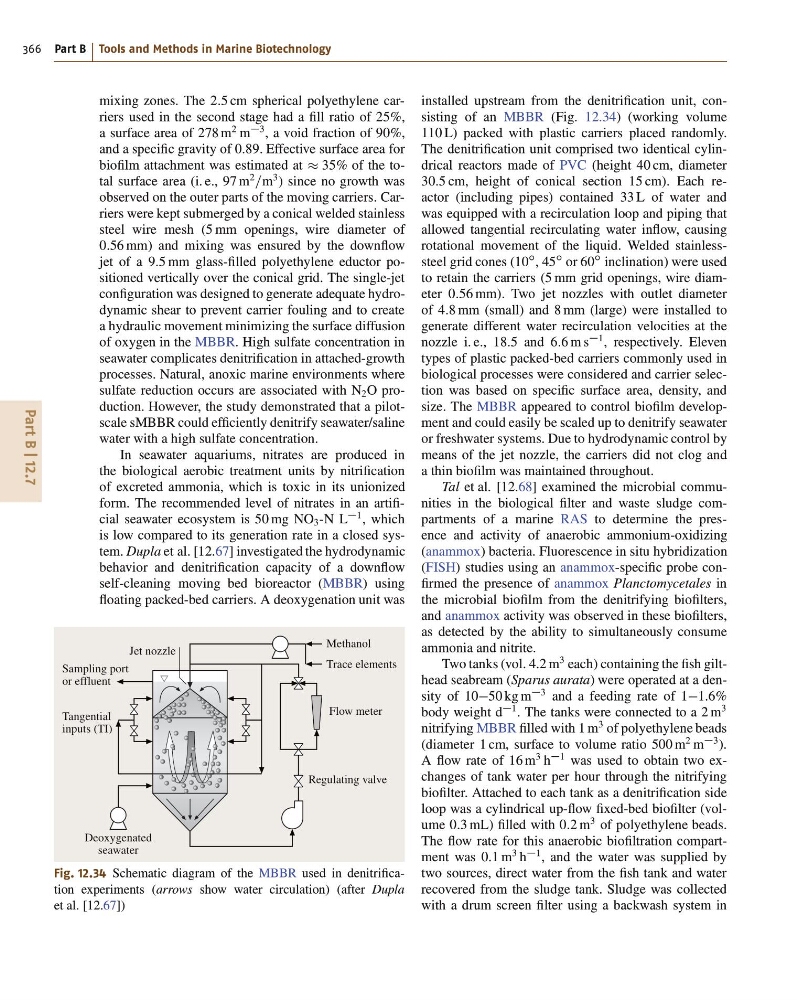
is low compared to its generation rate in a closed system. Dupla et al. [12.67] investigated the hydrodynamic
behavior and denitrification capacity of a downflow
self-cleaning moving bed bioreactor (MBBR) using
floating packed-bed carriers. A deoxygenation unit was
Tangential
inputs (TI)
Sampling port
or effluent
Jet nozzle
Deoxygenated
seawater
Regulating valve
Methanol
Trace elements
Flow meter
Fig. 12.34 Schematic diagram of the MBBR used in denitrification experiments (arrows show water circulation) (after Dupla
et al. [12.67])
installed upstream from the denitrification unit, consisting of an MBBR (Fig. 12.34) (working volume
110 L) packed with plastic carriers placed randomly.
The denitrification unit comprised two identical cylindrical reactors made of PVC (height 40 cm, diameter
30:5 cm, height of conical section 15 cm). Each reactor (including pipes) contained 33 L of water and
was equipped with a recirculation loop and piping that
allowed tangential recirculating water inflow, causing
rotational movement of the liquid. Welded stainlesssteel grid cones (10
ı , 45
ı or 60
ı inclination) were used
to retain the carriers (5 mm grid openings, wire diameter 0:56 mm). Two jet nozzles with outlet diameter
of 4:8 mm (small) and 8 mm (large) were installed to
generate different water recirculation velocities at the
nozzle i. e., 18:5 and 6:6 m s
1 , respectively. Eleven
types of plastic packed-bed carriers commonly used in
biological processes were considered and carrier selection was based on specific surface area, density, and
size. The MBBR appeared to control biofilm development and could easily be scaled up to denitrify seawater
or freshwater systems. Due to hydrodynamic control by
means of the jet nozzle, the carriers did not clog and
a thin biofilm was maintained throughout.
Tal et al. [12.68] examined the microbial communities in the biological filter and waste sludge compartments of a marine RAS to determine the presence and activity of anaerobic ammonium-oxidizing
(anammox) bacteria. Fluorescence in situ hybridization
(FISH) studies using an anammox-specific probe confirmed the presence of anammox Planctomycetales in
the microbial biofilm from the denitrifying biofilters,
and anammox activity was observed in these biofilters,
as detected by the ability to simultaneously consume
ammonia and nitrite.
Two tanks (vol. 4:2 m
3 each) containing the fish gilthead seabream (Sparus aurata) were operated at a density of 1050 kg m
3 and a feeding rate of 11:6%
body weight d
1 . The tanks were connected to a 2 m
3
nitrifying MBBR filled with 1 m
3 of polyethylene beads
(diameter 1 cm, surface to volume ratio 500 m
2 m
3 ).
A flow rate of 16 m
3 h
1 was used to obtain two exchanges of tank water per hour through the nitrifying
biofilter. Attached to each tank as a denitrification side
loop was a cylindrical up-flow fixed-bed biofilter (volume 0:3 mL) filled with 0:2 m
3 of polyethylene beads.
The flow rate for this anaerobic biofiltration compartment was 0:1 m
3 h
1 , and the water was supplied by
two sources, direct water from the fish tank and water
recovered from the sludge tank. Sludge was collected
with a drum screen filter using a backwash system in
366 Part B Tools and Methods in Marine Biotechnology
mixing zones. The 2:5 cm spherical polyethylene carriers used in the second stage had a fill ratio of 25%,
a surface area of 278 m
2 m
3 , a void fraction of 90%,
and a specific gravity of 0:89. Effective surface area for
biofilm attachment was estimated at 35% of the total surface area (i. e., 97 m
2
=m
3 ) since no growth was
observed on the outer parts of the moving carriers. Carriers were kept submerged by a conical welded stainless
steel wire mesh (5 mm openings, wire diameter of
0:56 mm) and mixing was ensured by the downflow
jet of a 9:5 mm glass-filled polyethylene eductor positioned vertically over the conical grid. The single-jet
configuration was designed to generate adequate hydrodynamic shear to prevent carrier fouling and to create
a hydraulic movement minimizing the surface diffusion
of oxygen in the MBBR. High sulfate concentration in
seawater complicates denitrification in attached-growth
processes. Natural, anoxic marine environments where
sulfate reduction occurs are associated with N 2 O production. However, the study demonstrated that a pilotscale sMBBR could efficiently denitrify seawater/saline
water with a high sulfate concentration.
In seawater aquariums, nitrates are produced in
the biological aerobic treatment units by nitrification
of excreted ammonia, which is toxic in its unionized
form. The recommended level of nitrates in an artificial seawater ecosystem is 50 mg NO 3 -N L
1 , which
is low compared to its generation rate in a closed system. Dupla et al. [12.67] investigated the hydrodynamic
behavior and denitrification capacity of a downflow
self-cleaning moving bed bioreactor (MBBR) using
floating packed-bed carriers. A deoxygenation unit was
Tangential
inputs (TI)
Sampling port
or effluent
Jet nozzle
Deoxygenated
seawater
Regulating valve
Methanol
Trace elements
Flow meter
Fig. 12.34 Schematic diagram of the MBBR used in denitrification experiments (arrows show water circulation) (after Dupla
et al. [12.67])
installed upstream from the denitrification unit, consisting of an MBBR (Fig. 12.34) (working volume
110 L) packed with plastic carriers placed randomly.
The denitrification unit comprised two identical cylindrical reactors made of PVC (height 40 cm, diameter
30:5 cm, height of conical section 15 cm). Each reactor (including pipes) contained 33 L of water and
was equipped with a recirculation loop and piping that
allowed tangential recirculating water inflow, causing
rotational movement of the liquid. Welded stainlesssteel grid cones (10
ı , 45
ı or 60
ı inclination) were used
to retain the carriers (5 mm grid openings, wire diameter 0:56 mm). Two jet nozzles with outlet diameter
of 4:8 mm (small) and 8 mm (large) were installed to
generate different water recirculation velocities at the
nozzle i. e., 18:5 and 6:6 m s
1 , respectively. Eleven
types of plastic packed-bed carriers commonly used in
biological processes were considered and carrier selection was based on specific surface area, density, and
size. The MBBR appeared to control biofilm development and could easily be scaled up to denitrify seawater
or freshwater systems. Due to hydrodynamic control by
means of the jet nozzle, the carriers did not clog and
a thin biofilm was maintained throughout.
Tal et al. [12.68] examined the microbial communities in the biological filter and waste sludge compartments of a marine RAS to determine the presence and activity of anaerobic ammonium-oxidizing
(anammox) bacteria. Fluorescence in situ hybridization
(FISH) studies using an anammox-specific probe confirmed the presence of anammox Planctomycetales in
the microbial biofilm from the denitrifying biofilters,
and anammox activity was observed in these biofilters,
as detected by the ability to simultaneously consume
ammonia and nitrite.
Two tanks (vol. 4:2 m
3 each) containing the fish gilthead seabream (Sparus aurata) were operated at a density of 1050 kg m
3 and a feeding rate of 11:6%
body weight d
1 . The tanks were connected to a 2 m
3
nitrifying MBBR filled with 1 m
3 of polyethylene beads
(diameter 1 cm, surface to volume ratio 500 m
2 m
3 ).
A flow rate of 16 m
3 h
1 was used to obtain two exchanges of tank water per hour through the nitrifying
biofilter. Attached to each tank as a denitrification side
loop was a cylindrical up-flow fixed-bed biofilter (volume 0:3 mL) filled with 0:2 m
3 of polyethylene beads.
The flow rate for this anaerobic biofiltration compartment was 0:1 m
3 h
1 , and the water was supplied by
two sources, direct water from the fish tank and water
recovered from the sludge tank. Sludge was collected
with a drum screen filter using a backwash system in