

Part B | 12.3
344 Part B Tools and Methods in Marine Biotechnology
Stainless
steel mesh
Medium flow
Gas flow
O-ring
Draft tube
Draft tube
Inner gas
(for medium flow)
NO analysis
Exhaust
(A) Parallelflow-type
(B) Counterflow-type
Outer gas
(for NO removal)
Outer tube
30 mm
26 mm
50 mm
2 m
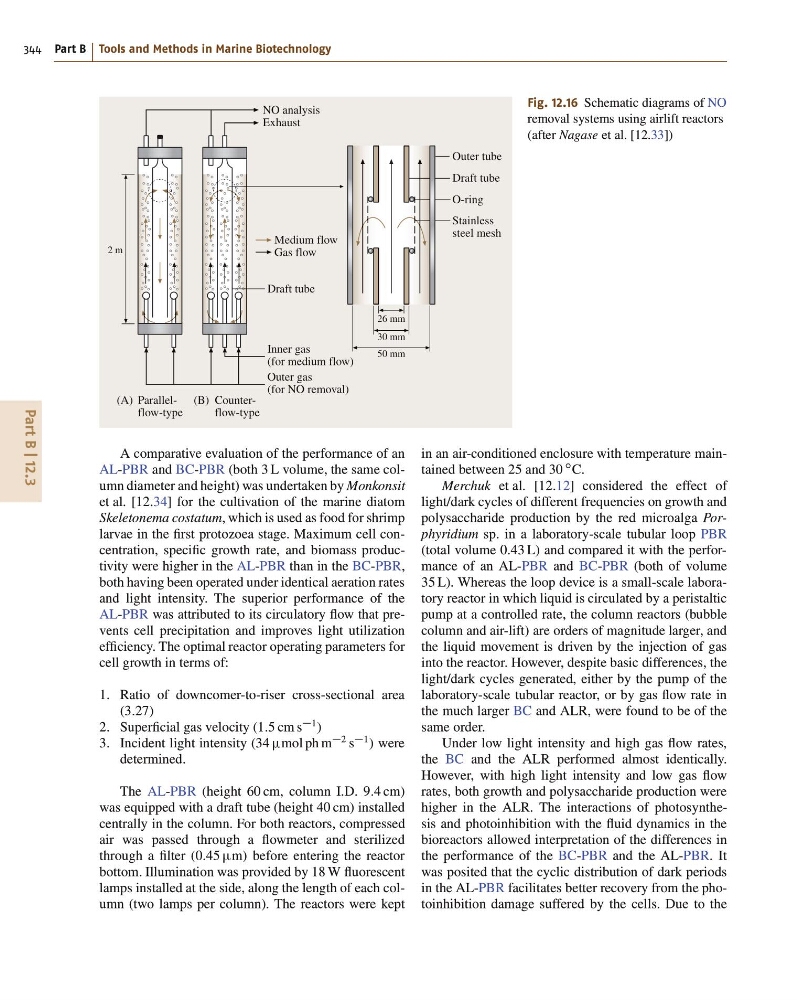
Fig. 12.16 Schematic diagrams of NO
removal systems using airlift reactors
(after Nagase et al. [12.33])
A comparative evaluation of the performance of an
AL-PBR and BC-PBR (both 3 L volume, the same column diameter and height) was undertaken by Monkonsit
et al. [12.34] for the cultivation of the marine diatom
Skeletonema costatum, which is used as food for shrimp
larvae in the first protozoea stage. Maximum cell concentration, specific growth rate, and biomass productivity were higher in the AL-PBR than in the BC-PBR,
both having been operated under identical aeration rates
and light intensity. The superior performance of the
AL-PBR was attributed to its circulatory flow that prevents cell precipitation and improves light utilization
efficiency. The optimal reactor operating parameters for
cell growth in terms of:
1. Ratio of downcomer-to-riser cross-sectional area
(3:27)
2. Superficial gas velocity (1:5 cm s
1 )
3. Incident light intensity (34 mol ph m
2 s
1 ) were
determined.
The AL-PBR (height 60 cm, column I.D. 9:4 cm)
was equipped with a draft tube (height 40 cm) installed
centrally in the column. For both reactors, compressed
air was passed through a flowmeter and sterilized
through a filter (0:45 m) before entering the reactor
bottom. Illumination was provided by 18 W fluorescent
lamps installed at the side, along the length of each column (two lamps per column). The reactors were kept
in an air-conditioned enclosure with temperature maintained between 25 and 30
ı C.
Merchuk et al. [12.12] considered the effect of
light/dark cycles of different frequencies on growth and
polysaccharide production by the red microalga Porphyridium sp. in a laboratory-scale tubular loop PBR
(total volume 0:43 L) and compared it with the performance of an AL-PBR and BC-PBR (both of volume
35 L). Whereas the loop device is a small-scale laboratory reactor in which liquid is circulated by a peristaltic
pump at a controlled rate, the column reactors (bubble
column and air-lift) are orders of magnitude larger, and
the liquid movement is driven by the injection of gas
into the reactor. However, despite basic differences, the
light/dark cycles generated, either by the pump of the
laboratory-scale tubular reactor, or by gas flow rate in
the much larger BC and ALR, were found to be of the
same order.
Under low light intensity and high gas flow rates,
the BC and the ALR performed almost identically.
However, with high light intensity and low gas flow
rates, both growth and polysaccharide production were
higher in the ALR. The interactions of photosynthesis and photoinhibition with the fluid dynamics in the
bioreactors allowed interpretation of the differences in
the performance of the BC-PBR and the AL-PBR. It
was posited that the cyclic distribution of dark periods
in the AL-PBR facilitates better recovery from the photoinhibition damage suffered by the cells. Due to the
344 Part B Tools and Methods in Marine Biotechnology
Stainless
steel mesh
Medium flow
Gas flow
O-ring
Draft tube
Draft tube
Inner gas
(for medium flow)
NO analysis
Exhaust
(A) Parallelflow-type
(B) Counterflow-type
Outer gas
(for NO removal)
Outer tube
30 mm
26 mm
50 mm
2 m
Fig. 12.16 Schematic diagrams of NO
removal systems using airlift reactors
(after Nagase et al. [12.33])
A comparative evaluation of the performance of an
AL-PBR and BC-PBR (both 3 L volume, the same column diameter and height) was undertaken by Monkonsit
et al. [12.34] for the cultivation of the marine diatom
Skeletonema costatum, which is used as food for shrimp
larvae in the first protozoea stage. Maximum cell concentration, specific growth rate, and biomass productivity were higher in the AL-PBR than in the BC-PBR,
both having been operated under identical aeration rates
and light intensity. The superior performance of the
AL-PBR was attributed to its circulatory flow that prevents cell precipitation and improves light utilization
efficiency. The optimal reactor operating parameters for
cell growth in terms of:
1. Ratio of downcomer-to-riser cross-sectional area
(3:27)
2. Superficial gas velocity (1:5 cm s
1 )
3. Incident light intensity (34 mol ph m
2 s
1 ) were
determined.
The AL-PBR (height 60 cm, column I.D. 9:4 cm)
was equipped with a draft tube (height 40 cm) installed
centrally in the column. For both reactors, compressed
air was passed through a flowmeter and sterilized
through a filter (0:45 m) before entering the reactor
bottom. Illumination was provided by 18 W fluorescent
lamps installed at the side, along the length of each column (two lamps per column). The reactors were kept
in an air-conditioned enclosure with temperature maintained between 25 and 30
ı C.
Merchuk et al. [12.12] considered the effect of
light/dark cycles of different frequencies on growth and
polysaccharide production by the red microalga Porphyridium sp. in a laboratory-scale tubular loop PBR
(total volume 0:43 L) and compared it with the performance of an AL-PBR and BC-PBR (both of volume
35 L). Whereas the loop device is a small-scale laboratory reactor in which liquid is circulated by a peristaltic
pump at a controlled rate, the column reactors (bubble
column and air-lift) are orders of magnitude larger, and
the liquid movement is driven by the injection of gas
into the reactor. However, despite basic differences, the
light/dark cycles generated, either by the pump of the
laboratory-scale tubular reactor, or by gas flow rate in
the much larger BC and ALR, were found to be of the
same order.
Under low light intensity and high gas flow rates,
the BC and the ALR performed almost identically.
However, with high light intensity and low gas flow
rates, both growth and polysaccharide production were
higher in the ALR. The interactions of photosynthesis and photoinhibition with the fluid dynamics in the
bioreactors allowed interpretation of the differences in
the performance of the BC-PBR and the AL-PBR. It
was posited that the cyclic distribution of dark periods
in the AL-PBR facilitates better recovery from the photoinhibition damage suffered by the cells. Due to the