

Novel Bioreactors for Culturing Marine Organisms 12.2 Photobioreactors (PBR)-Tubular, Plate/Panel and Stirred Tank Configurations 333
Part B | 12.2
density culture (i. e., with optimal cell density > 10 g
DCW/L) of the marine green alga Chlorococcum littorale, which shows extended linear growth under light
limiting conditions and grows very vigorously in the
presence of extremely high CO 2 levels. The remarkably
high CO 2 fixation rate reported with this alga is due to
the ultrahigh cell density attained in this PBR which has
a narrow light path in which intensive turbulent flow is
generated by streaming compressed air through perforated tubing into the culture suspension (that produces
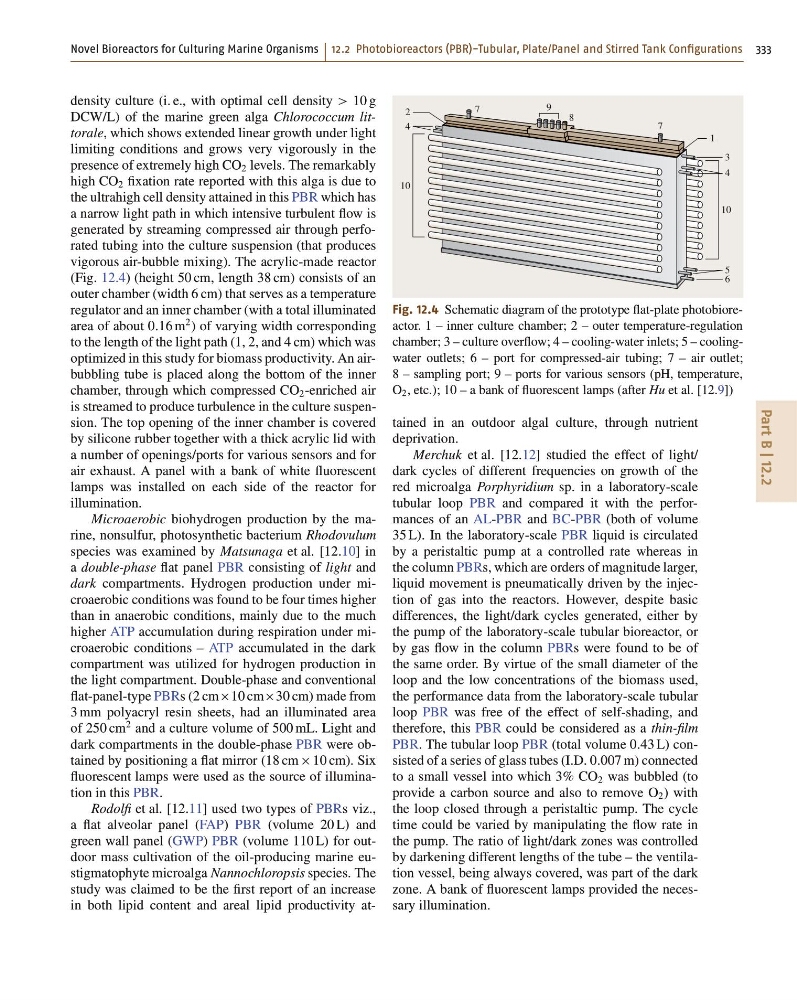
vigorous air-bubble mixing). The acrylic-made reactor
(Fig. 12.4) (height 50 cm, length 38 cm) consists of an
outer chamber (width 6 cm) that serves as a temperature
regulator and an inner chamber (with a total illuminated
area of about 0:16 m
2 ) of varying width corresponding
to the length of the light path (1, 2, and 4 cm) which was
optimized in this study for biomass productivity. An airbubbling tube is placed along the bottom of the inner
chamber, through which compressed CO 2 -enriched air
is streamed to produce turbulence in the culture suspension. The top opening of the inner chamber is covered
by silicone rubber together with a thick acrylic lid with
a number of openings/ports for various sensors and for
air exhaust. A panel with a bank of white fluorescent
lamps was installed on each side of the reactor for
illumination.
Microaerobic biohydrogen production by the marine, nonsulfur, photosynthetic bacterium Rhodovulum
species was examined by Matsunaga et al. [12.10] in
a double-phase flat panel PBR consisting of light and
dark compartments. Hydrogen production under microaerobic conditions was found to be four times higher
than in anaerobic conditions, mainly due to the much
higher ATP accumulation during respiration under microaerobic conditions – ATP accumulated in the dark
compartment was utilized for hydrogen production in
the light compartment. Double-phase and conventional
flat-panel-type PBRs (2 cm10 cm30 cm) made from
3 mm polyacryl resin sheets, had an illuminated area
of 250 cm
2 and a culture volume of 500 mL. Light and
dark compartments in the double-phase PBR were obtained by positioning a flat mirror (18 cm 10 cm). Six
fluorescent lamps were used as the source of illumination in this PBR.
Rodolfi et al. [12.11] used two types of PBRs viz.,
a flat alveolar panel (FAP) PBR (volume 20 L) and
green wall panel (GWP) PBR (volume 110 L) for outdoor mass cultivation of the oil-producing marine eustigmatophyte microalga Nannochloropsis species. The
study was claimed to be the first report of an increase
in both lipid content and areal lipid productivity at2
4
10
7
9
8
7
1
4
5
3
6
10
Fig. 12.4 Schematic diagram of the prototype flat-plate photobioreactor. 1 – inner culture chamber; 2 – outer temperature-regulation
chamber; 3 – culture overflow; 4 – cooling-water inlets; 5 – coolingwater outlets; 6 – port for compressed-air tubing; 7 – air outlet;
8 – sampling port; 9 – ports for various sensors (pH, temperature,
O 2 , etc.); 10 – a bank of fluorescent lamps (after Hu et al. [12.9])
tained in an outdoor algal culture, through nutrient
deprivation.
Merchuk et al. [12.12] studied the effect of light/
dark cycles of different frequencies on growth of the
red microalga Porphyridium sp. in a laboratory-scale
tubular loop PBR and compared it with the performances of an AL-PBR and BC-PBR (both of volume
35 L). In the laboratory-scale PBR liquid is circulated
by a peristaltic pump at a controlled rate whereas in
the column PBRs, which are orders of magnitude larger,
liquid movement is pneumatically driven by the injection of gas into the reactors. However, despite basic
differences, the light/dark cycles generated, either by
the pump of the laboratory-scale tubular bioreactor, or
by gas flow in the column PBRs were found to be of
the same order. By virtue of the small diameter of the
loop and the low concentrations of the biomass used,
the performance data from the laboratory-scale tubular
loop PBR was free of the effect of self-shading, and
therefore, this PBR could be considered as a thin-film
PBR. The tubular loop PBR (total volume 0:43 L) consisted of a series of glass tubes (I.D. 0:007 m) connected
to a small vessel into which 3% CO 2 was bubbled (to
provide a carbon source and also to remove O 2 ) with
the loop closed through a peristaltic pump. The cycle
time could be varied by manipulating the flow rate in
the pump. The ratio of light/dark zones was controlled
by darkening different lengths of the tube – the ventilation vessel, being always covered, was part of the dark
zone. A bank of fluorescent lamps provided the necessary illumination.
Part B | 12.2
density culture (i. e., with optimal cell density > 10 g
DCW/L) of the marine green alga Chlorococcum littorale, which shows extended linear growth under light
limiting conditions and grows very vigorously in the
presence of extremely high CO 2 levels. The remarkably
high CO 2 fixation rate reported with this alga is due to
the ultrahigh cell density attained in this PBR which has
a narrow light path in which intensive turbulent flow is
generated by streaming compressed air through perforated tubing into the culture suspension (that produces
vigorous air-bubble mixing). The acrylic-made reactor
(Fig. 12.4) (height 50 cm, length 38 cm) consists of an
outer chamber (width 6 cm) that serves as a temperature
regulator and an inner chamber (with a total illuminated
area of about 0:16 m
2 ) of varying width corresponding
to the length of the light path (1, 2, and 4 cm) which was
optimized in this study for biomass productivity. An airbubbling tube is placed along the bottom of the inner
chamber, through which compressed CO 2 -enriched air
is streamed to produce turbulence in the culture suspension. The top opening of the inner chamber is covered
by silicone rubber together with a thick acrylic lid with
a number of openings/ports for various sensors and for
air exhaust. A panel with a bank of white fluorescent
lamps was installed on each side of the reactor for
illumination.
Microaerobic biohydrogen production by the marine, nonsulfur, photosynthetic bacterium Rhodovulum
species was examined by Matsunaga et al. [12.10] in
a double-phase flat panel PBR consisting of light and
dark compartments. Hydrogen production under microaerobic conditions was found to be four times higher
than in anaerobic conditions, mainly due to the much
higher ATP accumulation during respiration under microaerobic conditions – ATP accumulated in the dark
compartment was utilized for hydrogen production in
the light compartment. Double-phase and conventional
flat-panel-type PBRs (2 cm10 cm30 cm) made from
3 mm polyacryl resin sheets, had an illuminated area
of 250 cm
2 and a culture volume of 500 mL. Light and
dark compartments in the double-phase PBR were obtained by positioning a flat mirror (18 cm 10 cm). Six
fluorescent lamps were used as the source of illumination in this PBR.
Rodolfi et al. [12.11] used two types of PBRs viz.,
a flat alveolar panel (FAP) PBR (volume 20 L) and
green wall panel (GWP) PBR (volume 110 L) for outdoor mass cultivation of the oil-producing marine eustigmatophyte microalga Nannochloropsis species. The
study was claimed to be the first report of an increase
in both lipid content and areal lipid productivity at2
4
10
7
9
8
7
1
4
5
3
6
10
Fig. 12.4 Schematic diagram of the prototype flat-plate photobioreactor. 1 – inner culture chamber; 2 – outer temperature-regulation
chamber; 3 – culture overflow; 4 – cooling-water inlets; 5 – coolingwater outlets; 6 – port for compressed-air tubing; 7 – air outlet;
8 – sampling port; 9 – ports for various sensors (pH, temperature,
O 2 , etc.); 10 – a bank of fluorescent lamps (after Hu et al. [12.9])
tained in an outdoor algal culture, through nutrient
deprivation.
Merchuk et al. [12.12] studied the effect of light/
dark cycles of different frequencies on growth of the
red microalga Porphyridium sp. in a laboratory-scale
tubular loop PBR and compared it with the performances of an AL-PBR and BC-PBR (both of volume
35 L). In the laboratory-scale PBR liquid is circulated
by a peristaltic pump at a controlled rate whereas in
the column PBRs, which are orders of magnitude larger,
liquid movement is pneumatically driven by the injection of gas into the reactors. However, despite basic
differences, the light/dark cycles generated, either by
the pump of the laboratory-scale tubular bioreactor, or
by gas flow in the column PBRs were found to be of
the same order. By virtue of the small diameter of the
loop and the low concentrations of the biomass used,
the performance data from the laboratory-scale tubular
loop PBR was free of the effect of self-shading, and
therefore, this PBR could be considered as a thin-film
PBR. The tubular loop PBR (total volume 0:43 L) consisted of a series of glass tubes (I.D. 0:007 m) connected
to a small vessel into which 3% CO 2 was bubbled (to
provide a carbon source and also to remove O 2 ) with
the loop closed through a peristaltic pump. The cycle
time could be varied by manipulating the flow rate in
the pump. The ratio of light/dark zones was controlled
by darkening different lengths of the tube – the ventilation vessel, being always covered, was part of the dark
zone. A bank of fluorescent lamps provided the necessary illumination.