

Bioprocess Engineering of Phototrophic Marine Organisms 9.3 Basic Elements of Photobioreactor Design and Operation 275
Part B | 9.3
Culture
out
Culture in
Lamp or
light source
a)
b)
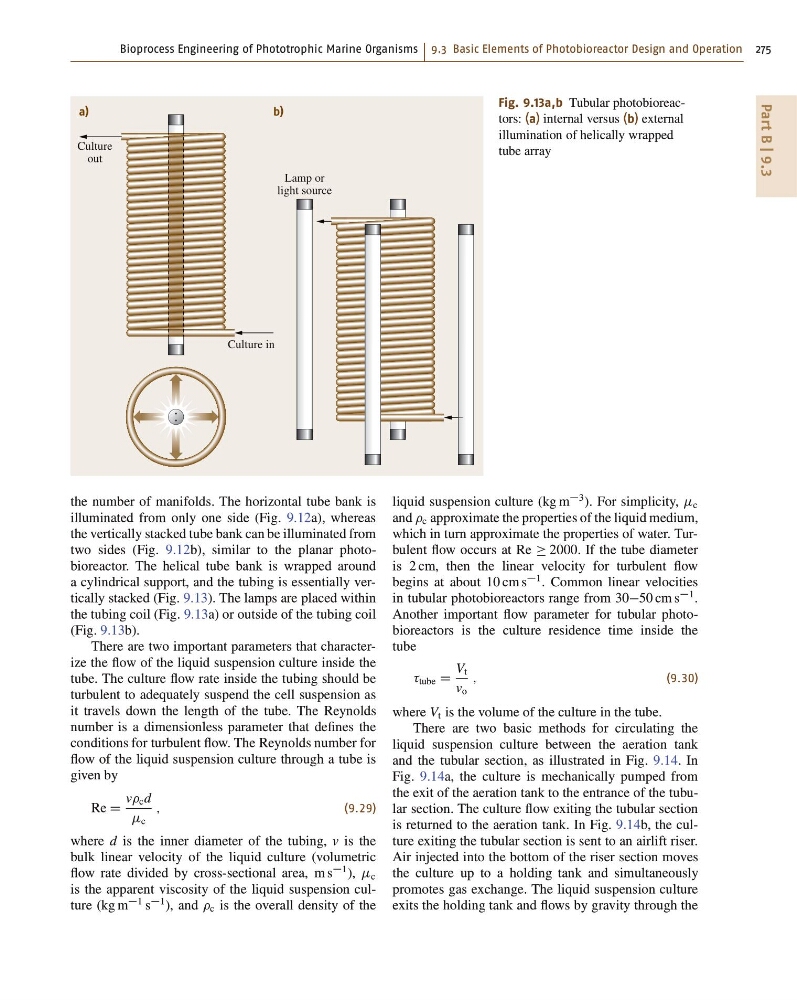
Fig. 9.13a,b Tubular photobioreactors: (a) internal versus (b) external
illumination of helically wrapped
tube array
the number of manifolds. The horizontal tube bank is
illuminated from only one side (Fig. 9.12a), whereas
the vertically stacked tube bank can be illuminated from
two sides (Fig. 9.12b), similar to the planar photobioreactor. The helical tube bank is wrapped around
a cylindrical support, and the tubing is essentially vertically stacked (Fig. 9.13). The lamps are placed within
the tubing coil (Fig. 9.13a) or outside of the tubing coil
(Fig. 9.13b).
There are two important parameters that characterize the flow of the liquid suspension culture inside the
tube. The culture flow rate inside the tubing should be
turbulent to adequately suspend the cell suspension as
it travels down the length of the tube. The Reynolds
number is a dimensionless parameter that defines the
conditions for turbulent flow. The Reynolds number for
flow of the liquid suspension culture through a tube is
given by
Re D
v c d
c
;
(9.29)
where d is the inner diameter of the tubing, v is the
bulk linear velocity of the liquid culture (volumetric
flow rate divided by cross-sectional area, m s
1 ), c
is the apparent viscosity of the liquid suspension culture (kg m
1 s
1 ), and c is the overall density of the
liquid suspension culture (kg m
3 ). For simplicity, c
and c approximate the properties of the liquid medium,
which in turn approximate the properties of water. Turbulent flow occurs at Re 2000. If the tube diameter
is 2 cm, then the linear velocity for turbulent flow
begins at about 10 cm s
1 . Common linear velocities
in tubular photobioreactors range from 3050 cm s
1 .
Another important flow parameter for tubular photobioreactors is the culture residence time inside the
tube
tube D
V t
v o
;
(9.30)
where V t is the volume of the culture in the tube.
There are two basic methods for circulating the
liquid suspension culture between the aeration tank
and the tubular section, as illustrated in Fig. 9.14. In
Fig. 9.14a, the culture is mechanically pumped from
the exit of the aeration tank to the entrance of the tubular section. The culture flow exiting the tubular section
is returned to the aeration tank. In Fig. 9.14b, the culture exiting the tubular section is sent to an airlift riser.
Air injected into the bottom of the riser section moves
the culture up to a holding tank and simultaneously
promotes gas exchange. The liquid suspension culture
exits the holding tank and flows by gravity through the
Part B | 9.3
Culture
out
Culture in
Lamp or
light source
a)
b)
Fig. 9.13a,b Tubular photobioreactors: (a) internal versus (b) external
illumination of helically wrapped
tube array
the number of manifolds. The horizontal tube bank is
illuminated from only one side (Fig. 9.12a), whereas
the vertically stacked tube bank can be illuminated from
two sides (Fig. 9.12b), similar to the planar photobioreactor. The helical tube bank is wrapped around
a cylindrical support, and the tubing is essentially vertically stacked (Fig. 9.13). The lamps are placed within
the tubing coil (Fig. 9.13a) or outside of the tubing coil
(Fig. 9.13b).
There are two important parameters that characterize the flow of the liquid suspension culture inside the
tube. The culture flow rate inside the tubing should be
turbulent to adequately suspend the cell suspension as
it travels down the length of the tube. The Reynolds
number is a dimensionless parameter that defines the
conditions for turbulent flow. The Reynolds number for
flow of the liquid suspension culture through a tube is
given by
Re D
v c d
c
;
(9.29)
where d is the inner diameter of the tubing, v is the
bulk linear velocity of the liquid culture (volumetric
flow rate divided by cross-sectional area, m s
1 ), c
is the apparent viscosity of the liquid suspension culture (kg m
1 s
1 ), and c is the overall density of the
liquid suspension culture (kg m
3 ). For simplicity, c
and c approximate the properties of the liquid medium,
which in turn approximate the properties of water. Turbulent flow occurs at Re 2000. If the tube diameter
is 2 cm, then the linear velocity for turbulent flow
begins at about 10 cm s
1 . Common linear velocities
in tubular photobioreactors range from 3050 cm s
1 .
Another important flow parameter for tubular photobioreactors is the culture residence time inside the
tube
tube D
V t
v o
;
(9.30)
where V t is the volume of the culture in the tube.
There are two basic methods for circulating the
liquid suspension culture between the aeration tank
and the tubular section, as illustrated in Fig. 9.14. In
Fig. 9.14a, the culture is mechanically pumped from
the exit of the aeration tank to the entrance of the tubular section. The culture flow exiting the tubular section
is returned to the aeration tank. In Fig. 9.14b, the culture exiting the tubular section is sent to an airlift riser.
Air injected into the bottom of the riser section moves
the culture up to a holding tank and simultaneously
promotes gas exchange. The liquid suspension culture
exits the holding tank and flows by gravity through the