

Part B | 9.2
262 Part B Tools and Methods in Marine Biotechnology
Carbohydrates
polysaccharides
fatty acids, lipids
Amino acids
proteins & enzymes
porphyrins
Nucleic acids
RNA & DNA
NADPH, ATP
phospholipids
NH 4
+
The phototrophic cell
CO 2 (aqueous)
NO 3
–
HPO 4
2–
Photons
H 2 O
O 2
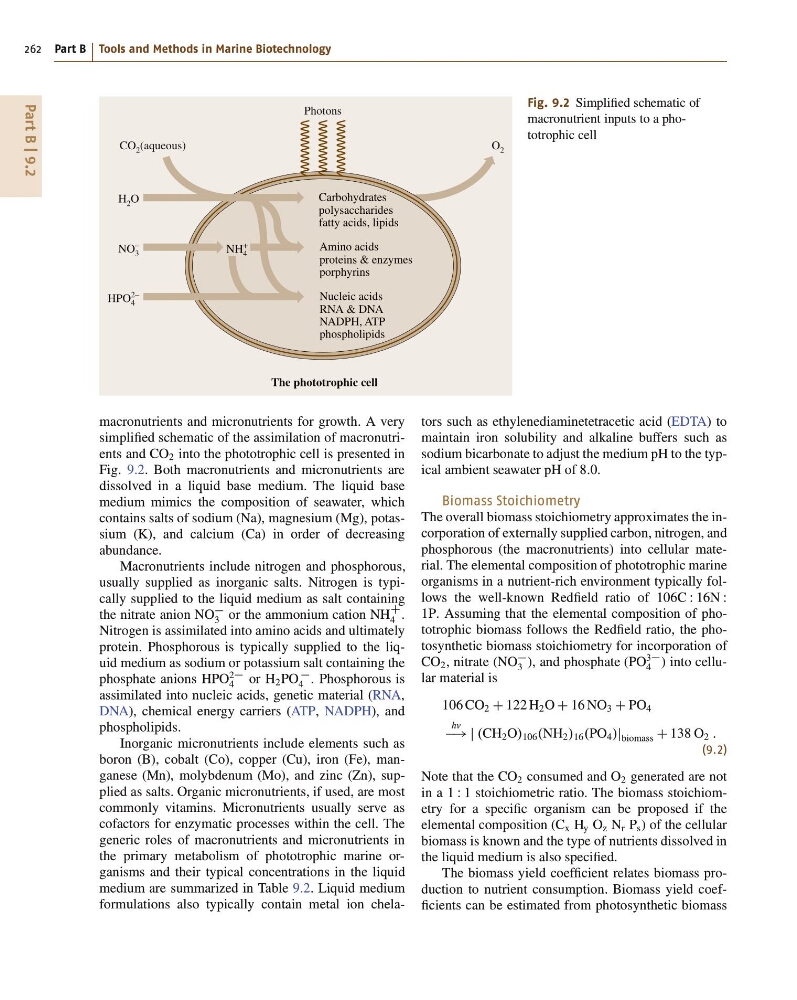
Fig. 9.2 Simplified schematic of
macronutrient inputs to a phototrophic cell
macronutrients and micronutrients for growth. A very
simplified schematic of the assimilation of macronutrients and CO 2 into the phototrophic cell is presented in
Fig. 9.2. Both macronutrients and micronutrients are
dissolved in a liquid base medium. The liquid base
medium mimics the composition of seawater, which
contains salts of sodium (Na), magnesium (Mg), potassium (K), and calcium (Ca) in order of decreasing
abundance.
Macronutrients include nitrogen and phosphorous,
usually supplied as inorganic salts. Nitrogen is typically supplied to the liquid medium as salt containing
the nitrate anion NO
3 or the ammonium cation NH
C
4 .
Nitrogen is assimilated into amino acids and ultimately
protein. Phosphorous is typically supplied to the liquid medium as sodium or potassium salt containing the
phosphate anions HPO
2
4
or H 2 PO
4 . Phosphorous is
assimilated into nucleic acids, genetic material (RNA,
DNA), chemical energy carriers (ATP, NADPH), and
phospholipids.
Inorganic micronutrients include elements such as
boron (B), cobalt (Co), copper (Cu), iron (Fe), manganese (Mn), molybdenum (Mo), and zinc (Zn), supplied as salts. Organic micronutrients, if used, are most
commonly vitamins. Micronutrients usually serve as
cofactors for enzymatic processes within the cell. The
generic roles of macronutrients and micronutrients in
the primary metabolism of phototrophic marine organisms and their typical concentrations in the liquid
medium are summarized in Table 9.2. Liquid medium
formulations also typically contain metal ion chelators such as ethylenediaminetetracetic acid (EDTA) to
maintain iron solubility and alkaline buffers such as
sodium bicarbonate to adjust the medium pH to the typical ambient seawater pH of 8:0.
Biomass Stoichiometry
The overall biomass stoichiometry approximates the incorporation of externally supplied carbon, nitrogen, and
phosphorous (the macronutrients) into cellular material. The elemental composition of phototrophic marine
organisms in a nutrient-rich environment typically follows the well-known Redfield ratio of 106C W 16N W
1P. Assuming that the elemental composition of phototrophic biomass follows the Redfield ratio, the photosynthetic biomass stoichiometry for incorporation of
CO 2 , nitrate (NO
3 ), and phosphate (PO
3
4 ) into cellular material is
106 CO 2 C 122 H 2 O C 16 NO 3 C PO 4
hv
! j .CH 2 O/ 106 .NH 2 / 16 .PO 4 /j biomass C 138 O 2 :
(9.2)
Note that the CO 2 consumed and O 2 generated are not
in a 1 W 1 stoichiometric ratio. The biomass stoichiometry for a specific organism can be proposed if the
elemental composition (C x H y O z N r P s ) of the cellular
biomass is known and the type of nutrients dissolved in
the liquid medium is also specified.
The biomass yield coefficient relates biomass production to nutrient consumption. Biomass yield coefficients can be estimated from photosynthetic biomass
262 Part B Tools and Methods in Marine Biotechnology
Carbohydrates
polysaccharides
fatty acids, lipids
Amino acids
proteins & enzymes
porphyrins
Nucleic acids
RNA & DNA
NADPH, ATP
phospholipids
NH 4
+
The phototrophic cell
CO 2 (aqueous)
NO 3
–
HPO 4
2–
Photons
H 2 O
O 2
Fig. 9.2 Simplified schematic of
macronutrient inputs to a phototrophic cell
macronutrients and micronutrients for growth. A very
simplified schematic of the assimilation of macronutrients and CO 2 into the phototrophic cell is presented in
Fig. 9.2. Both macronutrients and micronutrients are
dissolved in a liquid base medium. The liquid base
medium mimics the composition of seawater, which
contains salts of sodium (Na), magnesium (Mg), potassium (K), and calcium (Ca) in order of decreasing
abundance.
Macronutrients include nitrogen and phosphorous,
usually supplied as inorganic salts. Nitrogen is typically supplied to the liquid medium as salt containing
the nitrate anion NO
3 or the ammonium cation NH
C
4 .
Nitrogen is assimilated into amino acids and ultimately
protein. Phosphorous is typically supplied to the liquid medium as sodium or potassium salt containing the
phosphate anions HPO
2
4
or H 2 PO
4 . Phosphorous is
assimilated into nucleic acids, genetic material (RNA,
DNA), chemical energy carriers (ATP, NADPH), and
phospholipids.
Inorganic micronutrients include elements such as
boron (B), cobalt (Co), copper (Cu), iron (Fe), manganese (Mn), molybdenum (Mo), and zinc (Zn), supplied as salts. Organic micronutrients, if used, are most
commonly vitamins. Micronutrients usually serve as
cofactors for enzymatic processes within the cell. The
generic roles of macronutrients and micronutrients in
the primary metabolism of phototrophic marine organisms and their typical concentrations in the liquid
medium are summarized in Table 9.2. Liquid medium
formulations also typically contain metal ion chelators such as ethylenediaminetetracetic acid (EDTA) to
maintain iron solubility and alkaline buffers such as
sodium bicarbonate to adjust the medium pH to the typical ambient seawater pH of 8:0.
Biomass Stoichiometry
The overall biomass stoichiometry approximates the incorporation of externally supplied carbon, nitrogen, and
phosphorous (the macronutrients) into cellular material. The elemental composition of phototrophic marine
organisms in a nutrient-rich environment typically follows the well-known Redfield ratio of 106C W 16N W
1P. Assuming that the elemental composition of phototrophic biomass follows the Redfield ratio, the photosynthetic biomass stoichiometry for incorporation of
CO 2 , nitrate (NO
3 ), and phosphate (PO
3
4 ) into cellular material is
106 CO 2 C 122 H 2 O C 16 NO 3 C PO 4
hv
! j .CH 2 O/ 106 .NH 2 / 16 .PO 4 /j biomass C 138 O 2 :
(9.2)
Note that the CO 2 consumed and O 2 generated are not
in a 1 W 1 stoichiometric ratio. The biomass stoichiometry for a specific organism can be proposed if the
elemental composition (C x H y O z N r P s ) of the cellular
biomass is known and the type of nutrients dissolved in
the liquid medium is also specified.
The biomass yield coefficient relates biomass production to nutrient consumption. Biomass yield coefficients can be estimated from photosynthetic biomass