

Part B | 9.1
260 Part B Tools and Methods in Marine Biotechnology
Step 1
Product
discovery
Step 2A
Cell culture
development
Strain selection/
genetic manipulation
Step 2
Step 3
Step 3A
Product elicitation
strategies
Step 4
Cell harvesting
& product extraction
Step 5
Product
purification
MARINE
BIOTECHNOLOGY
MARINE
BIOPROCESS ENGINEERING
Phototrophic
marine organism
Final
product
Photobioreactor
development for
biomass production
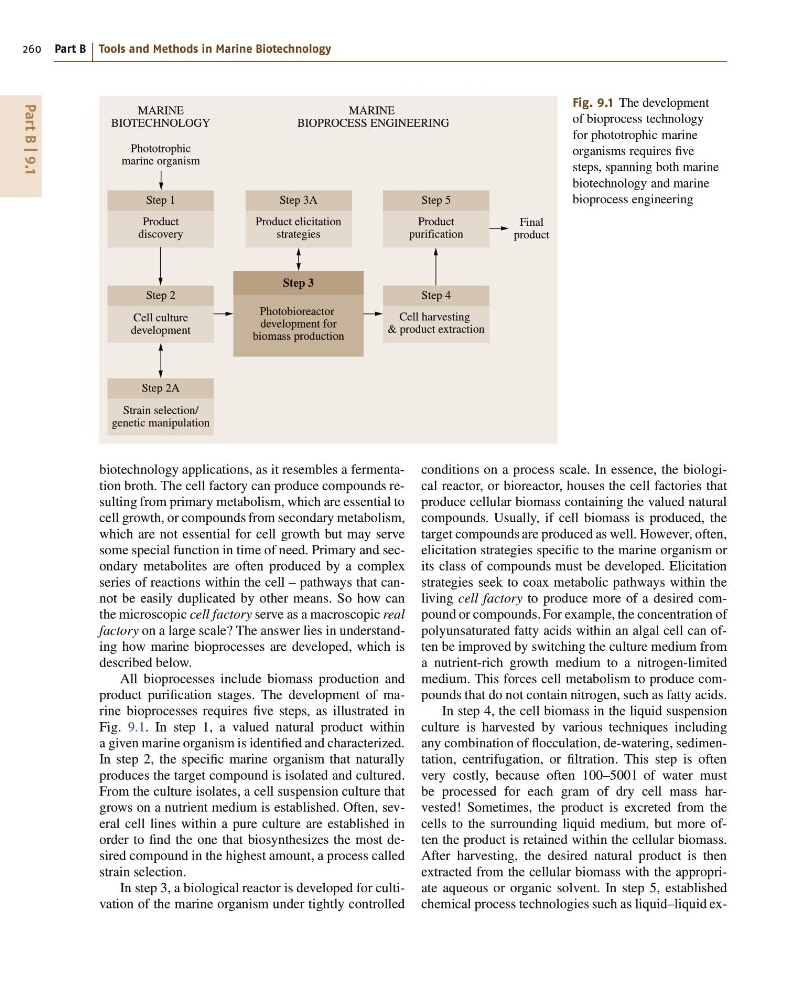
Fig. 9.1 The development
of bioprocess technology
for phototrophic marine
organisms requires five
steps, spanning both marine
biotechnology and marine
bioprocess engineering
biotechnology applications, as it resembles a fermentation broth. The cell factory can produce compounds resulting from primary metabolism, which are essential to
cell growth, or compounds from secondary metabolism,
which are not essential for cell growth but may serve
some special function in time of need. Primary and secondary metabolites are often produced by a complex
series of reactions within the cell – pathways that cannot be easily duplicated by other means. So how can
the microscopic cell factory serve as a macroscopic real
factory on a large scale? The answer lies in understanding how marine bioprocesses are developed, which is
described below.
All bioprocesses include biomass production and
product purification stages. The development of marine bioprocesses requires five steps, as illustrated in
Fig. 9.1. In step 1, a valued natural product within
a given marine organism is identified and characterized.
In step 2, the specific marine organism that naturally
produces the target compound is isolated and cultured.
From the culture isolates, a cell suspension culture that
grows on a nutrient medium is established. Often, several cell lines within a pure culture are established in
order to find the one that biosynthesizes the most desired compound in the highest amount, a process called
strain selection.
In step 3, a biological reactor is developed for cultivation of the marine organism under tightly controlled
conditions on a process scale. In essence, the biological reactor, or bioreactor, houses the cell factories that
produce cellular biomass containing the valued natural
compounds. Usually, if cell biomass is produced, the
target compounds are produced as well. However, often,
elicitation strategies specific to the marine organism or
its class of compounds must be developed. Elicitation
strategies seek to coax metabolic pathways within the
living cell factory to produce more of a desired compound or compounds. For example, the concentration of
polyunsaturated fatty acids within an algal cell can often be improved by switching the culture medium from
a nutrient-rich growth medium to a nitrogen-limited
medium. This forces cell metabolism to produce compounds that do not contain nitrogen, such as fatty acids.
In step 4, the cell biomass in the liquid suspension
culture is harvested by various techniques including
any combination of flocculation, de-watering, sedimentation, centrifugation, or filtration. This step is often
very costly, because often 100–500 l of water must
be processed for each gram of dry cell mass harvested! Sometimes, the product is excreted from the
cells to the surrounding liquid medium, but more often the product is retained within the cellular biomass.
After harvesting, the desired natural product is then
extracted from the cellular biomass with the appropriate aqueous or organic solvent. In step 5, established
chemical process technologies such as liquid–liquid ex-
260 Part B Tools and Methods in Marine Biotechnology
Step 1
Product
discovery
Step 2A
Cell culture
development
Strain selection/
genetic manipulation
Step 2
Step 3
Step 3A
Product elicitation
strategies
Step 4
Cell harvesting
& product extraction
Step 5
Product
purification
MARINE
BIOTECHNOLOGY
MARINE
BIOPROCESS ENGINEERING
Phototrophic
marine organism
Final
product
Photobioreactor
development for
biomass production
Fig. 9.1 The development
of bioprocess technology
for phototrophic marine
organisms requires five
steps, spanning both marine
biotechnology and marine
bioprocess engineering
biotechnology applications, as it resembles a fermentation broth. The cell factory can produce compounds resulting from primary metabolism, which are essential to
cell growth, or compounds from secondary metabolism,
which are not essential for cell growth but may serve
some special function in time of need. Primary and secondary metabolites are often produced by a complex
series of reactions within the cell – pathways that cannot be easily duplicated by other means. So how can
the microscopic cell factory serve as a macroscopic real
factory on a large scale? The answer lies in understanding how marine bioprocesses are developed, which is
described below.
All bioprocesses include biomass production and
product purification stages. The development of marine bioprocesses requires five steps, as illustrated in
Fig. 9.1. In step 1, a valued natural product within
a given marine organism is identified and characterized.
In step 2, the specific marine organism that naturally
produces the target compound is isolated and cultured.
From the culture isolates, a cell suspension culture that
grows on a nutrient medium is established. Often, several cell lines within a pure culture are established in
order to find the one that biosynthesizes the most desired compound in the highest amount, a process called
strain selection.
In step 3, a biological reactor is developed for cultivation of the marine organism under tightly controlled
conditions on a process scale. In essence, the biological reactor, or bioreactor, houses the cell factories that
produce cellular biomass containing the valued natural
compounds. Usually, if cell biomass is produced, the
target compounds are produced as well. However, often,
elicitation strategies specific to the marine organism or
its class of compounds must be developed. Elicitation
strategies seek to coax metabolic pathways within the
living cell factory to produce more of a desired compound or compounds. For example, the concentration of
polyunsaturated fatty acids within an algal cell can often be improved by switching the culture medium from
a nutrient-rich growth medium to a nitrogen-limited
medium. This forces cell metabolism to produce compounds that do not contain nitrogen, such as fatty acids.
In step 4, the cell biomass in the liquid suspension
culture is harvested by various techniques including
any combination of flocculation, de-watering, sedimentation, centrifugation, or filtration. This step is often
very costly, because often 100–500 l of water must
be processed for each gram of dry cell mass harvested! Sometimes, the product is excreted from the
cells to the surrounding liquid medium, but more often the product is retained within the cellular biomass.
After harvesting, the desired natural product is then
extracted from the cellular biomass with the appropriate aqueous or organic solvent. In step 5, established
chemical process technologies such as liquid–liquid ex-