

Part A | 8.6
234 Part A Marine Flora and Fauna
Metagenome or PCR
amplicon-based DNA
sequence analysis
DNA hybridizationbased screen
Marine sample
DNA isolation
Leads
Sequence, expression, and functional analysis
Metagenomic
library
Functional screen
for enzyme activity
Fig. 8.5 Metagenomic
strategies
a)
b)
c)
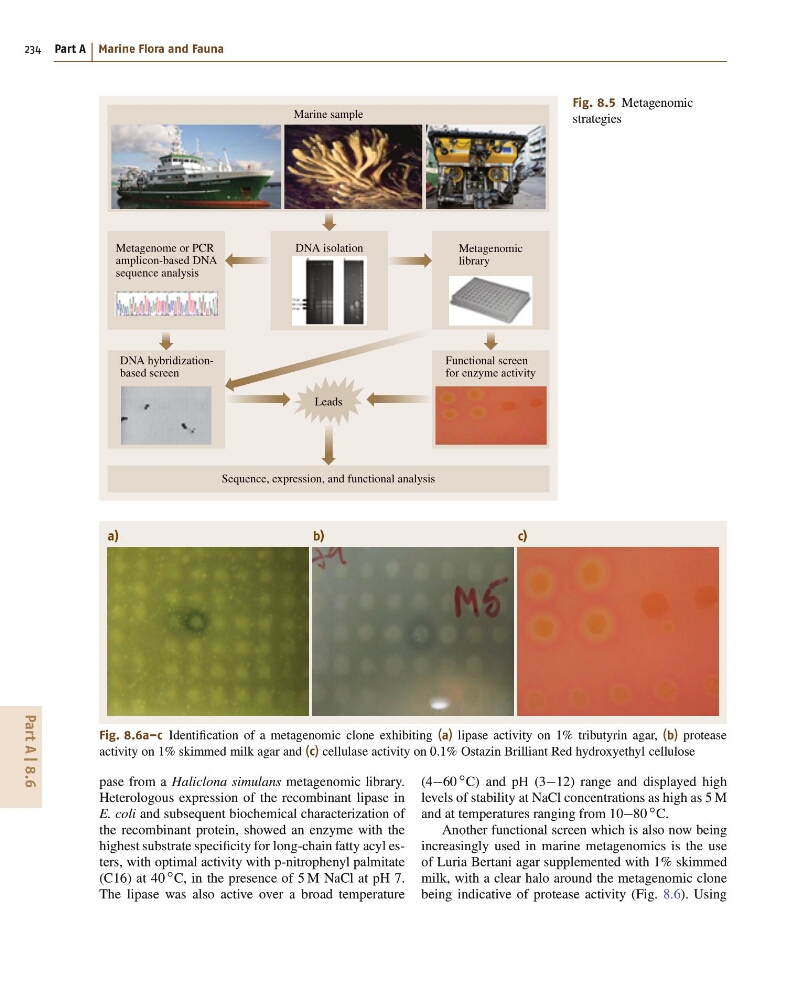
Fig. 8.6a–c Identification of a metagenomic clone exhibiting (a) lipase activity on 1% tributyrin agar, (b) protease
activity on 1% skimmed milk agar and (c) cellulase activity on 0:1% Ostazin Brilliant Red hydroxyethyl cellulose
pase from a Haliclona simulans metagenomic library.
Heterologous expression of the recombinant lipase in
E. coli and subsequent biochemical characterization of
the recombinant protein, showed an enzyme with the
highest substrate specificity for long-chain fatty acyl esters, with optimal activity with p-nitrophenyl palmitate
(C16) at 40
ı C, in the presence of 5 M NaCl at pH 7.
The lipase was also active over a broad temperature
(460
ı C) and pH (312) range and displayed high
levels of stability at NaCl concentrations as high as 5 M
and at temperatures ranging from 1080
ı C.
Another functional screen which is also now being
increasingly used in marine metagenomics is the use
of Luria Bertani agar supplemented with 1% skimmed
milk, with a clear halo around the metagenomic clone
being indicative of protease activity (Fig. 8.6). Using
234 Part A Marine Flora and Fauna
Metagenome or PCR
amplicon-based DNA
sequence analysis
DNA hybridizationbased screen
Marine sample
DNA isolation
Leads
Sequence, expression, and functional analysis
Metagenomic
library
Functional screen
for enzyme activity
Fig. 8.5 Metagenomic
strategies
a)
b)
c)
Fig. 8.6a–c Identification of a metagenomic clone exhibiting (a) lipase activity on 1% tributyrin agar, (b) protease
activity on 1% skimmed milk agar and (c) cellulase activity on 0:1% Ostazin Brilliant Red hydroxyethyl cellulose
pase from a Haliclona simulans metagenomic library.
Heterologous expression of the recombinant lipase in
E. coli and subsequent biochemical characterization of
the recombinant protein, showed an enzyme with the
highest substrate specificity for long-chain fatty acyl esters, with optimal activity with p-nitrophenyl palmitate
(C16) at 40
ı C, in the presence of 5 M NaCl at pH 7.
The lipase was also active over a broad temperature
(460
ı C) and pH (312) range and displayed high
levels of stability at NaCl concentrations as high as 5 M
and at temperatures ranging from 1080
ı C.
Another functional screen which is also now being
increasingly used in marine metagenomics is the use
of Luria Bertani agar supplemented with 1% skimmed
milk, with a clear halo around the metagenomic clone
being indicative of protease activity (Fig. 8.6). Using