

Marine Sponges – Molecular Biology and Biotechnology 8.2 Sponge-Associated Microorganisms 225
Part A | 8.2
Table 8.3 Sponge species from which pyrosequencing of
bacterial 16S rRNA genes has been reported
Sponge species
Reference Sponge species
Reference
Ianthella basta
[8.119]
Aplysina
aerophoba
[8.93]
Ircinia ramosa
[8.119]
Aplysina
cavernicola
[8.93]
Rhopaloides
odorabile
[8.119]
Ircinia
variabilis
[8.93]
Hyrtios erectus
[8.118]
Petrosia
ficiformis
[8.93]
Stylissa carteri
[8.118]
Pseudocorticium
jarrei
[8.93]
Xestospongia
testudinaria
[8.118]
Axinella corrugata
[8.122]
Raspailia
ramosa
[8.120]
Arenosclera
brasiliensis
[8.121]
Stelligera
stuposa
[8.120]
view of publicly available sponge-associated 16S rRNA
sequences [8.117] analyzed a dataset of 7500 sequences. However, pyrosequencing analyses have generated > 700 000 sponge-derived bacterial 16S rRNA
gene sequences which were not included in that
study. These datasets have investigated various aspects of sponge-bacterial associations, including bacterial community structures [8.118–121], seasonal variations in community composition [8.122], bacterialarchaeal relative abundances [8.118], vertical symbiont
transmission [8.119], and core variable and speciesspecific bacterial communities from a range of sponge
species [8.84]. These pyrosequencing studies have thus
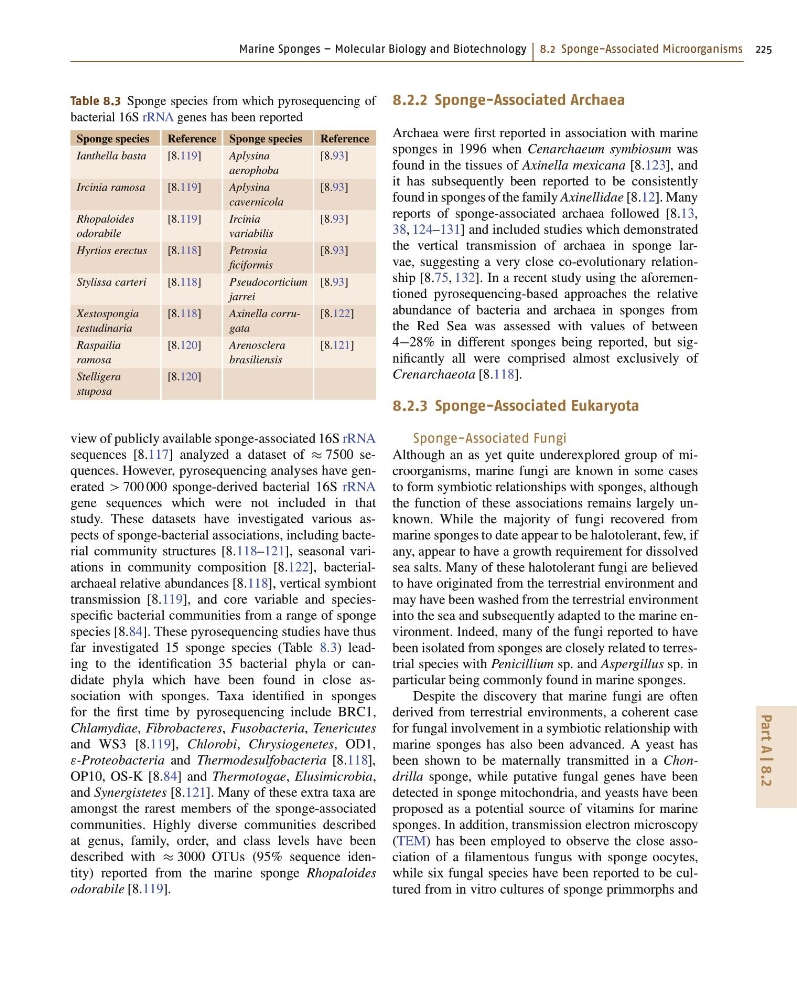
far investigated 15 sponge species (Table 8.3) leading to the identification 35 bacterial phyla or candidate phyla which have been found in close association with sponges. Taxa identified in sponges
for the first time by pyrosequencing include BRC1,
Chlamydiae, Fibrobacteres, Fusobacteria, Tenericutes
and WS3 [8.119], Chlorobi, Chrysiogenetes, OD1,
"-Proteobacteria and Thermodesulfobacteria [8.118],
OP10, OS-K [8.84] and Thermotogae, Elusimicrobia,
and Synergistetes [8.121]. Many of these extra taxa are
amongst the rarest members of the sponge-associated
communities. Highly diverse communities described
at genus, family, order, and class levels have been
described with 3000 OTUs (95% sequence identity) reported from the marine sponge Rhopaloides
odorabile [8.119].
8.2.2 Sponge-Associated Archaea
Archaea were first reported in association with marine
sponges in 1996 when Cenarchaeum symbiosum was
found in the tissues of Axinella mexicana [8.123], and
it has subsequently been reported to be consistently
found in sponges of the family Axinellidae [8.12]. Many
reports of sponge-associated archaea followed [8.13,
38, 124–131] and included studies which demonstrated
the vertical transmission of archaea in sponge larvae, suggesting a very close co-evolutionary relationship [8.75, 132]. In a recent study using the aforementioned pyrosequencing-based approaches the relative
abundance of bacteria and archaea in sponges from
the Red Sea was assessed with values of between
428% in different sponges being reported, but significantly all were comprised almost exclusively of
Crenarchaeota [8.118].
8.2.3 Sponge-Associated Eukaryota
Sponge-Associated Fungi
Although an as yet quite underexplored group of microorganisms, marine fungi are known in some cases
to form symbiotic relationships with sponges, although
the function of these associations remains largely unknown. While the majority of fungi recovered from
marine sponges to date appear to be halotolerant, few, if
any, appear to have a growth requirement for dissolved
sea salts. Many of these halotolerant fungi are believed
to have originated from the terrestrial environment and
may have been washed from the terrestrial environment
into the sea and subsequently adapted to the marine environment. Indeed, many of the fungi reported to have
been isolated from sponges are closely related to terrestrial species with Penicillium sp. and Aspergillus sp. in
particular being commonly found in marine sponges.
Despite the discovery that marine fungi are often
derived from terrestrial environments, a coherent case
for fungal involvement in a symbiotic relationship with
marine sponges has also been advanced. A yeast has
been shown to be maternally transmitted in a Chondrilla sponge, while putative fungal genes have been
detected in sponge mitochondria, and yeasts have been
proposed as a potential source of vitamins for marine
sponges. In addition, transmission electron microscopy
(TEM) has been employed to observe the close association of a filamentous fungus with sponge oocytes,
while six fungal species have been reported to be cultured from in vitro cultures of sponge primmorphs and
Part A | 8.2
Table 8.3 Sponge species from which pyrosequencing of
bacterial 16S rRNA genes has been reported
Sponge species
Reference Sponge species
Reference
Ianthella basta
[8.119]
Aplysina
aerophoba
[8.93]
Ircinia ramosa
[8.119]
Aplysina
cavernicola
[8.93]
Rhopaloides
odorabile
[8.119]
Ircinia
variabilis
[8.93]
Hyrtios erectus
[8.118]
Petrosia
ficiformis
[8.93]
Stylissa carteri
[8.118]
Pseudocorticium
jarrei
[8.93]
Xestospongia
testudinaria
[8.118]
Axinella corrugata
[8.122]
Raspailia
ramosa
[8.120]
Arenosclera
brasiliensis
[8.121]
Stelligera
stuposa
[8.120]
view of publicly available sponge-associated 16S rRNA
sequences [8.117] analyzed a dataset of 7500 sequences. However, pyrosequencing analyses have generated > 700 000 sponge-derived bacterial 16S rRNA
gene sequences which were not included in that
study. These datasets have investigated various aspects of sponge-bacterial associations, including bacterial community structures [8.118–121], seasonal variations in community composition [8.122], bacterialarchaeal relative abundances [8.118], vertical symbiont
transmission [8.119], and core variable and speciesspecific bacterial communities from a range of sponge
species [8.84]. These pyrosequencing studies have thus
far investigated 15 sponge species (Table 8.3) leading to the identification 35 bacterial phyla or candidate phyla which have been found in close association with sponges. Taxa identified in sponges
for the first time by pyrosequencing include BRC1,
Chlamydiae, Fibrobacteres, Fusobacteria, Tenericutes
and WS3 [8.119], Chlorobi, Chrysiogenetes, OD1,
"-Proteobacteria and Thermodesulfobacteria [8.118],
OP10, OS-K [8.84] and Thermotogae, Elusimicrobia,
and Synergistetes [8.121]. Many of these extra taxa are
amongst the rarest members of the sponge-associated
communities. Highly diverse communities described
at genus, family, order, and class levels have been
described with 3000 OTUs (95% sequence identity) reported from the marine sponge Rhopaloides
odorabile [8.119].
8.2.2 Sponge-Associated Archaea
Archaea were first reported in association with marine
sponges in 1996 when Cenarchaeum symbiosum was
found in the tissues of Axinella mexicana [8.123], and
it has subsequently been reported to be consistently
found in sponges of the family Axinellidae [8.12]. Many
reports of sponge-associated archaea followed [8.13,
38, 124–131] and included studies which demonstrated
the vertical transmission of archaea in sponge larvae, suggesting a very close co-evolutionary relationship [8.75, 132]. In a recent study using the aforementioned pyrosequencing-based approaches the relative
abundance of bacteria and archaea in sponges from
the Red Sea was assessed with values of between
428% in different sponges being reported, but significantly all were comprised almost exclusively of
Crenarchaeota [8.118].
8.2.3 Sponge-Associated Eukaryota
Sponge-Associated Fungi
Although an as yet quite underexplored group of microorganisms, marine fungi are known in some cases
to form symbiotic relationships with sponges, although
the function of these associations remains largely unknown. While the majority of fungi recovered from
marine sponges to date appear to be halotolerant, few, if
any, appear to have a growth requirement for dissolved
sea salts. Many of these halotolerant fungi are believed
to have originated from the terrestrial environment and
may have been washed from the terrestrial environment
into the sea and subsequently adapted to the marine environment. Indeed, many of the fungi reported to have
been isolated from sponges are closely related to terrestrial species with Penicillium sp. and Aspergillus sp. in
particular being commonly found in marine sponges.
Despite the discovery that marine fungi are often
derived from terrestrial environments, a coherent case
for fungal involvement in a symbiotic relationship with
marine sponges has also been advanced. A yeast has
been shown to be maternally transmitted in a Chondrilla sponge, while putative fungal genes have been
detected in sponge mitochondria, and yeasts have been
proposed as a potential source of vitamins for marine
sponges. In addition, transmission electron microscopy
(TEM) has been employed to observe the close association of a filamentous fungus with sponge oocytes,
while six fungal species have been reported to be cultured from in vitro cultures of sponge primmorphs and