

Marine Sponges – Molecular Biology and Biotechnology 8.1 Marine Sponges 221
Part A | 8.1
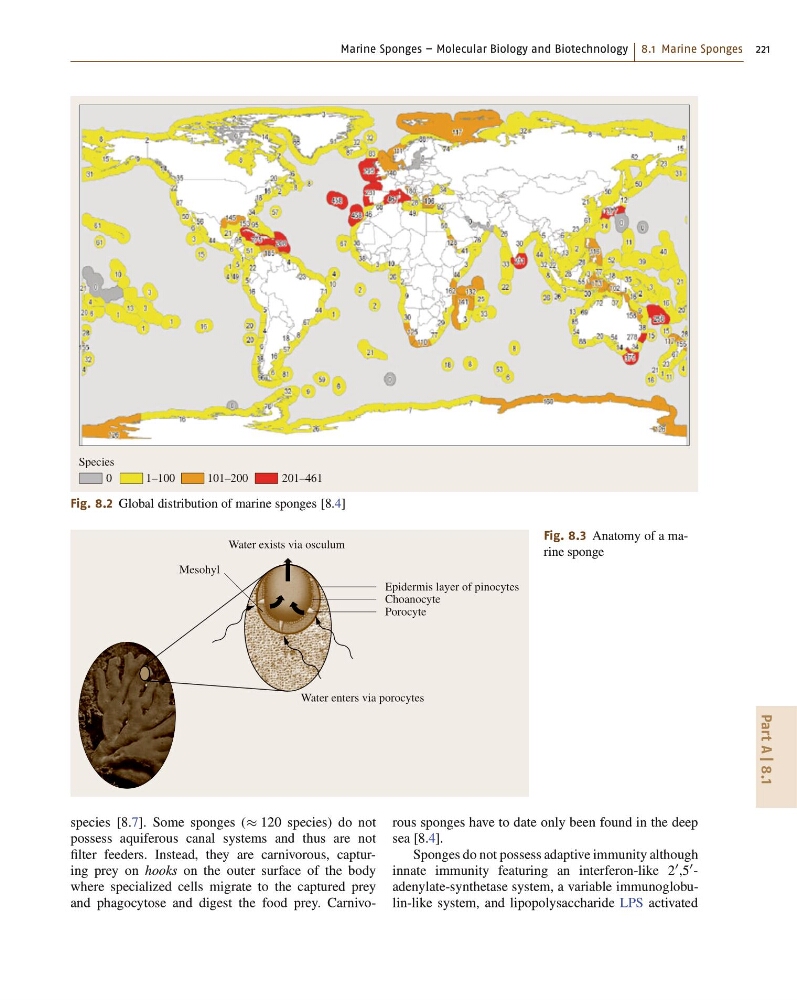
0
1–100
Species
101–200
201–461
Fig. 8.2 Global distribution of marine sponges [8.4]
Mesohyl
Water exists via osculum
Water enters via porocytes
Epidermis layer of pinocytes
Choanocyte
Porocyte
Fig. 8.3 Anatomy of a marine sponge
species [8.7]. Some sponges ( 120 species) do not
possess aquiferous canal systems and thus are not
filter feeders. Instead, they are carnivorous, capturing prey on hooks on the outer surface of the body
where specialized cells migrate to the captured prey
and phagocytose and digest the food prey. Carnivorous sponges have to date only been found in the deep
sea [8.4].
Sponges do not possess adaptive immunity although
innate immunity featuring an interferon-like 2
0 ,5
0 -
adenylate-synthetase system, a variable immunoglobulin-like system, and lipopolysaccharide LPS activated
Part A | 8.1
0
1–100
Species
101–200
201–461
Fig. 8.2 Global distribution of marine sponges [8.4]
Mesohyl
Water exists via osculum
Water enters via porocytes
Epidermis layer of pinocytes
Choanocyte
Porocyte
Fig. 8.3 Anatomy of a marine sponge
species [8.7]. Some sponges ( 120 species) do not
possess aquiferous canal systems and thus are not
filter feeders. Instead, they are carnivorous, capturing prey on hooks on the outer surface of the body
where specialized cells migrate to the captured prey
and phagocytose and digest the food prey. Carnivorous sponges have to date only been found in the deep
sea [8.4].
Sponges do not possess adaptive immunity although
innate immunity featuring an interferon-like 2
0 ,5
0 -
adenylate-synthetase system, a variable immunoglobulin-like system, and lipopolysaccharide LPS activated