

Part A | 8.1
220 Part A Marine Flora and Fauna
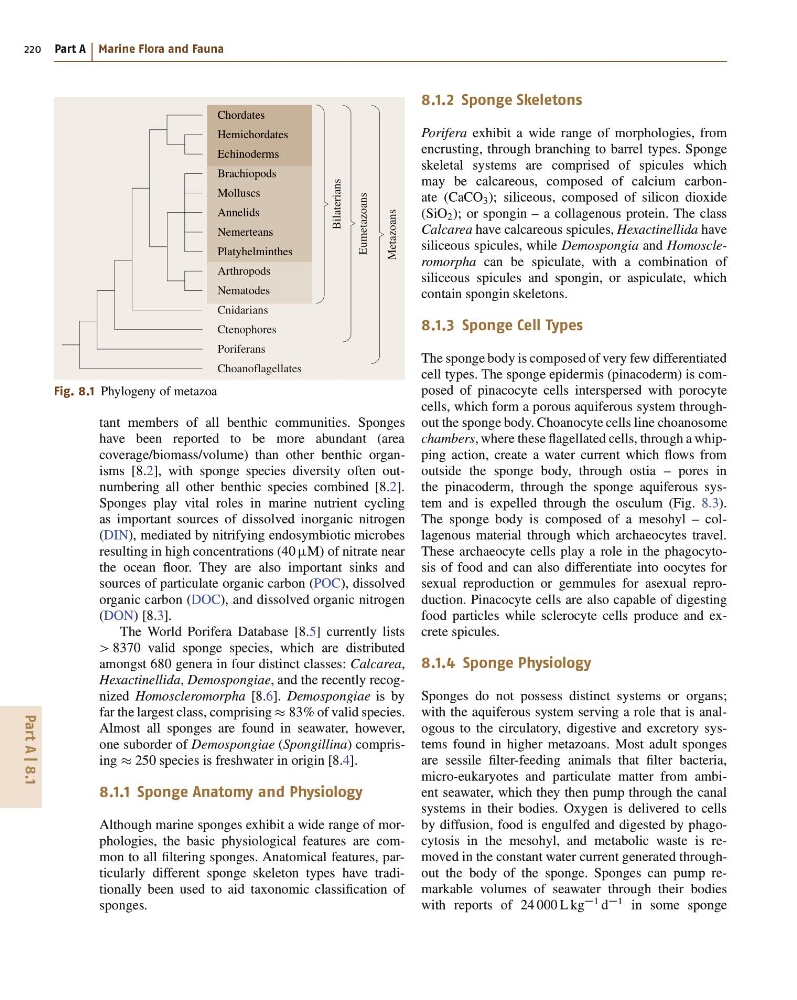
Chordates
Hemichordates
Echinoderms
Brachiopods
Molluscs
Annelids
Nemerteans
Platyhelminthes
Arthropods
Nematodes
Cnidarians
Ctenophores
Poriferans
Choanoflagellates
Bilaterians
Eumetazoans
Metazoans
Fig. 8.1 Phylogeny of metazoa
tant members of all benthic communities. Sponges
have been reported to be more abundant (area
coverage/biomass/volume) than other benthic organisms [8.2], with sponge species diversity often outnumbering all other benthic species combined [8.2].
Sponges play vital roles in marine nutrient cycling
as important sources of dissolved inorganic nitrogen
(DIN), mediated by nitrifying endosymbiotic microbes
resulting in high concentrations (40 M) of nitrate near
the ocean floor. They are also important sinks and
sources of particulate organic carbon (POC), dissolved
organic carbon (DOC), and dissolved organic nitrogen
(DON) [8.3].
The World Porifera Database [8.5] currently lists
> 8370 valid sponge species, which are distributed
amongst 680 genera in four distinct classes: Calcarea,
Hexactinellida, Demospongiae, and the recently recognized Homoscleromorpha [8.6]. Demospongiae is by
far the largest class, comprising 83% of valid species.
Almost all sponges are found in seawater, however,
one suborder of Demospongiae (Spongillina) comprising 250 species is freshwater in origin [8.4].
8.1.1 Sponge Anatomy and Physiology
Although marine sponges exhibit a wide range of morphologies, the basic physiological features are common to all filtering sponges. Anatomical features, particularly different sponge skeleton types have traditionally been used to aid taxonomic classification of
sponges.
8.1.2 Sponge Skeletons
Porifera exhibit a wide range of morphologies, from
encrusting, through branching to barrel types. Sponge
skeletal systems are comprised of spicules which
may be calcareous, composed of calcium carbonate (CaCO 3 ); siliceous, composed of silicon dioxide
(SiO 2 ); or spongin – a collagenous protein. The class
Calcarea have calcareous spicules, Hexactinellida have
siliceous spicules, while Demospongia and Homoscleromorpha can be spiculate, with a combination of
siliceous spicules and spongin, or aspiculate, which
contain spongin skeletons.
8.1.3 Sponge Cell Types
The sponge body is composed of very few differentiated
cell types. The sponge epidermis (pinacoderm) is composed of pinacocyte cells interspersed with porocyte
cells, which form a porous aquiferous system throughout the sponge body. Choanocyte cells line choanosome
chambers, where these flagellated cells, through a whipping action, create a water current which flows from
outside the sponge body, through ostia – pores in
the pinacoderm, through the sponge aquiferous system and is expelled through the osculum (Fig. 8.3).
The sponge body is composed of a mesohyl – collagenous material through which archaeocytes travel.
These archaeocyte cells play a role in the phagocytosis of food and can also differentiate into oocytes for
sexual reproduction or gemmules for asexual reproduction. Pinacocyte cells are also capable of digesting
food particles while sclerocyte cells produce and excrete spicules.
8.1.4 Sponge Physiology
Sponges do not possess distinct systems or organs;
with the aquiferous system serving a role that is analogous to the circulatory, digestive and excretory systems found in higher metazoans. Most adult sponges
are sessile filter-feeding animals that filter bacteria,
micro-eukaryotes and particulate matter from ambient seawater, which they then pump through the canal
systems in their bodies. Oxygen is delivered to cells
by diffusion, food is engulfed and digested by phagocytosis in the mesohyl, and metabolic waste is removed in the constant water current generated throughout the body of the sponge. Sponges can pump remarkable volumes of seawater through their bodies
with reports of 24 000 L kg
1 d
1 in some sponge
220 Part A Marine Flora and Fauna
Chordates
Hemichordates
Echinoderms
Brachiopods
Molluscs
Annelids
Nemerteans
Platyhelminthes
Arthropods
Nematodes
Cnidarians
Ctenophores
Poriferans
Choanoflagellates
Bilaterians
Eumetazoans
Metazoans
Fig. 8.1 Phylogeny of metazoa
tant members of all benthic communities. Sponges
have been reported to be more abundant (area
coverage/biomass/volume) than other benthic organisms [8.2], with sponge species diversity often outnumbering all other benthic species combined [8.2].
Sponges play vital roles in marine nutrient cycling
as important sources of dissolved inorganic nitrogen
(DIN), mediated by nitrifying endosymbiotic microbes
resulting in high concentrations (40 M) of nitrate near
the ocean floor. They are also important sinks and
sources of particulate organic carbon (POC), dissolved
organic carbon (DOC), and dissolved organic nitrogen
(DON) [8.3].
The World Porifera Database [8.5] currently lists
> 8370 valid sponge species, which are distributed
amongst 680 genera in four distinct classes: Calcarea,
Hexactinellida, Demospongiae, and the recently recognized Homoscleromorpha [8.6]. Demospongiae is by
far the largest class, comprising 83% of valid species.
Almost all sponges are found in seawater, however,
one suborder of Demospongiae (Spongillina) comprising 250 species is freshwater in origin [8.4].
8.1.1 Sponge Anatomy and Physiology
Although marine sponges exhibit a wide range of morphologies, the basic physiological features are common to all filtering sponges. Anatomical features, particularly different sponge skeleton types have traditionally been used to aid taxonomic classification of
sponges.
8.1.2 Sponge Skeletons
Porifera exhibit a wide range of morphologies, from
encrusting, through branching to barrel types. Sponge
skeletal systems are comprised of spicules which
may be calcareous, composed of calcium carbonate (CaCO 3 ); siliceous, composed of silicon dioxide
(SiO 2 ); or spongin – a collagenous protein. The class
Calcarea have calcareous spicules, Hexactinellida have
siliceous spicules, while Demospongia and Homoscleromorpha can be spiculate, with a combination of
siliceous spicules and spongin, or aspiculate, which
contain spongin skeletons.
8.1.3 Sponge Cell Types
The sponge body is composed of very few differentiated
cell types. The sponge epidermis (pinacoderm) is composed of pinacocyte cells interspersed with porocyte
cells, which form a porous aquiferous system throughout the sponge body. Choanocyte cells line choanosome
chambers, where these flagellated cells, through a whipping action, create a water current which flows from
outside the sponge body, through ostia – pores in
the pinacoderm, through the sponge aquiferous system and is expelled through the osculum (Fig. 8.3).
The sponge body is composed of a mesohyl – collagenous material through which archaeocytes travel.
These archaeocyte cells play a role in the phagocytosis of food and can also differentiate into oocytes for
sexual reproduction or gemmules for asexual reproduction. Pinacocyte cells are also capable of digesting
food particles while sclerocyte cells produce and excrete spicules.
8.1.4 Sponge Physiology
Sponges do not possess distinct systems or organs;
with the aquiferous system serving a role that is analogous to the circulatory, digestive and excretory systems found in higher metazoans. Most adult sponges
are sessile filter-feeding animals that filter bacteria,
micro-eukaryotes and particulate matter from ambient seawater, which they then pump through the canal
systems in their bodies. Oxygen is delivered to cells
by diffusion, food is engulfed and digested by phagocytosis in the mesohyl, and metabolic waste is removed in the constant water current generated throughout the body of the sponge. Sponges can pump remarkable volumes of seawater through their bodies
with reports of 24 000 L kg
1 d
1 in some sponge