

Part A | 7.2
184 Part A Marine Flora and Fauna
tracts obtained from L. crassum indicated ceramideas,
a moderately antibacterial component [7.100]. The Formosan L. crassum yielded three glycolipids, all of
which exhibited cytotoxicity against the growth of cancer cells of HepG2, Hep3B (human liver carcinoma),
MDA-MB-231 (human breast carcinoma), and Ca9-22
(human gingival carcinoma) with IC 50 s from 9:2 to
15 g mL
1 [7.101]. In [7.102] crassumolides A and
B and D–F, which were cytotoxic toward Ca9-22 cancer cells, and broadly cytotoxic toward all six test
cancer cell lines used were also isolated. L. crassum
also produced a cembrane-type diterpenoid, lobocrassin
F, which displayed a significant inhibitory effect on
the release of elastase by human neutrophils [7.103].
Investigations on the L. durum [7.104] led to the isolation of three hemiketal cembranolides, durumhemiketalolides AC with anti-inflammatory activities. Moreover, L. durum succumbed anti-inflammatory durumolides F–L .10 M/, which significantly reduced the
levels of the iNOS and COX-2 proteins, and also exhibited weak antibacterial activity against Salmonella
enteritidis [7.105].
Recently, six new cytotoxic cembranolides from
L. michaelae were isolated and their anti-HCMV activity as well as cytotoxicity against selected cell lines
were evaluated [7.106].
Genus Eleutherobia
Anti-inflammatory activity was observed for three related xenicane diterpenes, 9-deacetoxy-14,15-deepoxyxeniculin isolated from specimens of the South
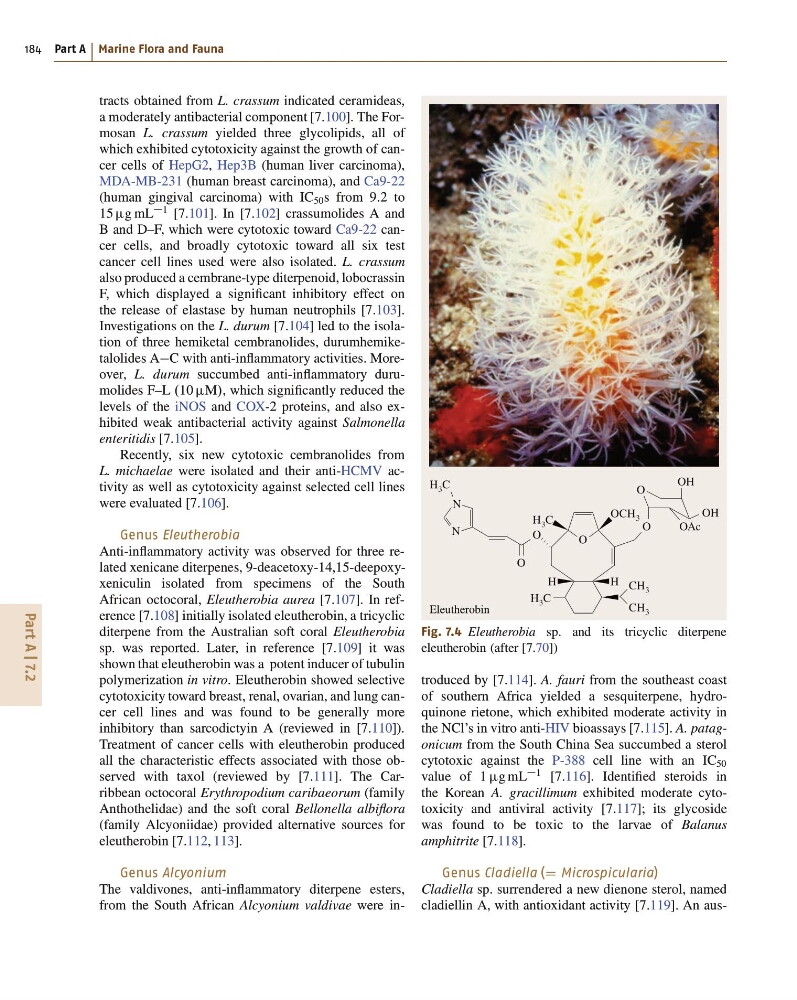
African octocoral, Eleutherobia aurea [7.107]. In reference [7.108] initially isolated eleutherobin, a tricyclic
diterpene from the Australian soft coral Eleutherobia
sp. was reported. Later, in reference [7.109] it was
shown that eleutherobin was a potent inducer of tubulin
polymerization in vitro. Eleutherobin showed selective
cytotoxicity toward breast, renal, ovarian, and lung cancer cell lines and was found to be generally more
inhibitory than sarcodictyin A (reviewed in [7.110]).
Treatment of cancer cells with eleutherobin produced
all the characteristic effects associated with those observed with taxol (reviewed by [7.111]. The Carribbean octocoral Erythropodium caribaeorum (family
Anthothelidae) and the soft coral Bellonella albiflora
(family Alcyoniidae) provided alternative sources for
eleutherobin [7.112, 113].
Genus Alcyonium
The valdivones, anti-inflammatory diterpene esters,
from the South African Alcyonium valdivae were inEleutherobin
OAc
O
O
O
N
N
O
H
H
O
OH
OH
OCH 3
H 3 C
H 3 C
H 3 C
CH 3
CH 3
Fig. 7.4 Eleutherobia sp. and its tricyclic diterpene
eleutherobin (after [7.70])
troduced by [7.114]. A. fauri from the southeast coast
of southern Africa yielded a sesquiterpene, hydroquinone rietone, which exhibited moderate activity in
the NCl’s in vitro anti-HIV bioassays [7.115]. A. patagonicum from the South China Sea succumbed a sterol
cytotoxic against the P-388 cell line with an IC 50
value of 1 g mL
1 [7.116]. Identified steroids in
the Korean A. gracillimum exhibited moderate cytotoxicity and antiviral activity [7.117]; its glycoside
was found to be toxic to the larvae of Balanus
amphitrite [7.118].
Genus Cladiella (D Microspicularia)
Cladiella sp. surrendered a new dienone sterol, named
cladiellin A, with antioxidant activity [7.119]. An aus-
184 Part A Marine Flora and Fauna
tracts obtained from L. crassum indicated ceramideas,
a moderately antibacterial component [7.100]. The Formosan L. crassum yielded three glycolipids, all of
which exhibited cytotoxicity against the growth of cancer cells of HepG2, Hep3B (human liver carcinoma),
MDA-MB-231 (human breast carcinoma), and Ca9-22
(human gingival carcinoma) with IC 50 s from 9:2 to
15 g mL
1 [7.101]. In [7.102] crassumolides A and
B and D–F, which were cytotoxic toward Ca9-22 cancer cells, and broadly cytotoxic toward all six test
cancer cell lines used were also isolated. L. crassum
also produced a cembrane-type diterpenoid, lobocrassin
F, which displayed a significant inhibitory effect on
the release of elastase by human neutrophils [7.103].
Investigations on the L. durum [7.104] led to the isolation of three hemiketal cembranolides, durumhemiketalolides AC with anti-inflammatory activities. Moreover, L. durum succumbed anti-inflammatory durumolides F–L .10 M/, which significantly reduced the
levels of the iNOS and COX-2 proteins, and also exhibited weak antibacterial activity against Salmonella
enteritidis [7.105].
Recently, six new cytotoxic cembranolides from
L. michaelae were isolated and their anti-HCMV activity as well as cytotoxicity against selected cell lines
were evaluated [7.106].
Genus Eleutherobia
Anti-inflammatory activity was observed for three related xenicane diterpenes, 9-deacetoxy-14,15-deepoxyxeniculin isolated from specimens of the South
African octocoral, Eleutherobia aurea [7.107]. In reference [7.108] initially isolated eleutherobin, a tricyclic
diterpene from the Australian soft coral Eleutherobia
sp. was reported. Later, in reference [7.109] it was
shown that eleutherobin was a potent inducer of tubulin
polymerization in vitro. Eleutherobin showed selective
cytotoxicity toward breast, renal, ovarian, and lung cancer cell lines and was found to be generally more
inhibitory than sarcodictyin A (reviewed in [7.110]).
Treatment of cancer cells with eleutherobin produced
all the characteristic effects associated with those observed with taxol (reviewed by [7.111]. The Carribbean octocoral Erythropodium caribaeorum (family
Anthothelidae) and the soft coral Bellonella albiflora
(family Alcyoniidae) provided alternative sources for
eleutherobin [7.112, 113].
Genus Alcyonium
The valdivones, anti-inflammatory diterpene esters,
from the South African Alcyonium valdivae were inEleutherobin
OAc
O
O
O
N
N
O
H
H
O
OH
OH
OCH 3
H 3 C
H 3 C
H 3 C
CH 3
CH 3
Fig. 7.4 Eleutherobia sp. and its tricyclic diterpene
eleutherobin (after [7.70])
troduced by [7.114]. A. fauri from the southeast coast
of southern Africa yielded a sesquiterpene, hydroquinone rietone, which exhibited moderate activity in
the NCl’s in vitro anti-HIV bioassays [7.115]. A. patagonicum from the South China Sea succumbed a sterol
cytotoxic against the P-388 cell line with an IC 50
value of 1 g mL
1 [7.116]. Identified steroids in
the Korean A. gracillimum exhibited moderate cytotoxicity and antiviral activity [7.117]; its glycoside
was found to be toxic to the larvae of Balanus
amphitrite [7.118].
Genus Cladiella (D Microspicularia)
Cladiella sp. surrendered a new dienone sterol, named
cladiellin A, with antioxidant activity [7.119]. An aus-