

Seaweed Flora of the European North Atlantic and Mediterranean 6.3 Seaweeds Biodiversity and Potential 137
Part A | 6.3
Uses and Compounds. Extracts of L. ochroleuca
have been found to act as a central nervous system
depressant with a slight analgesic activity. It is also
able to effectively guard DNA against UV rays and
premature aging. With these properties, it is becoming more widely used in cosmetics and in natural
therapeutic medicine. Applied topically, L. ochroleuca
helps reduce inflammation and, like many forms of
seaweed, has some amount of moisture-binding properties due to its sterol content. It is used in products
from Spain, Germany, France, and the United Kingdom; these include rescue balms, repairing and antiaging moisturizers, as well as dried and packaged
foods [6.3, 4, 908, 909].
Extracts have also antimicrobial [6.224, 269, 910–
913], antifungal [6.913], and antialgal [6.257] activity.
Saccharina latissima (Linnaeus) C.E. Lane,
C. Mayes, Druehl & G.W. Saunders
Synonym. Laminaria saccharina (Linnaeus) J.V. Lamouroux
Common Names. Sugar kelp, Sea belt, Sugar wrack.
Description. Just like most kelps, S. latissima has
blades (lamina), stipes, and holdfasts, which is attached
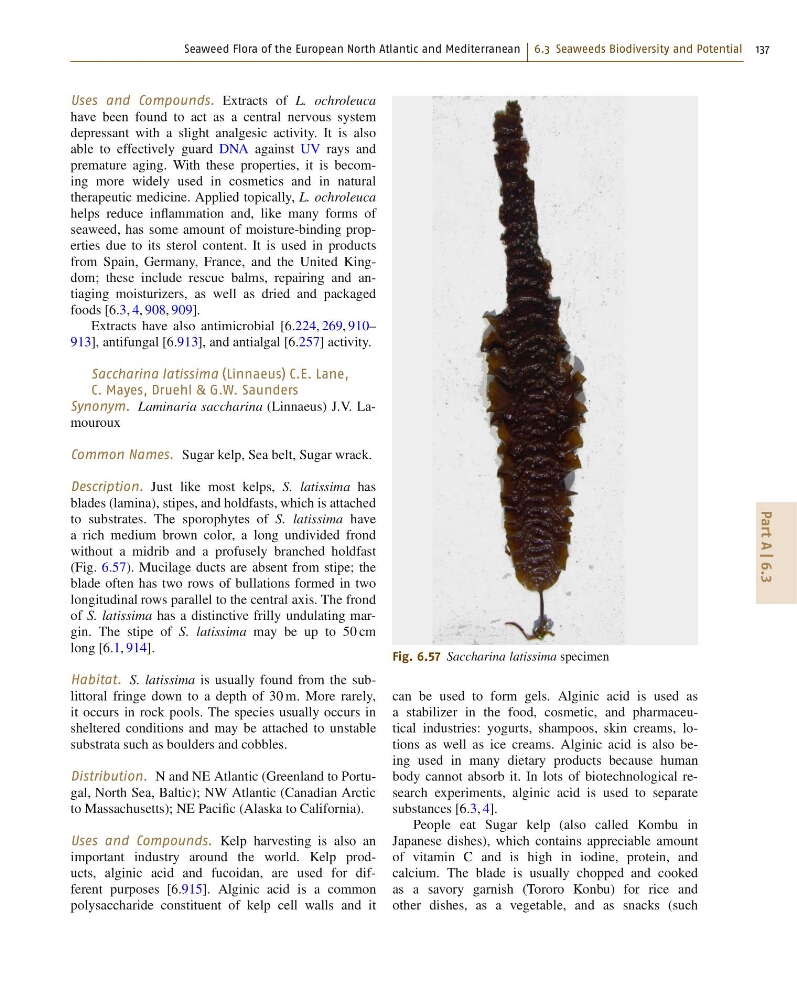
to substrates. The sporophytes of S. latissima have
a rich medium brown color, a long undivided frond
without a midrib and a profusely branched holdfast
(Fig. 6.57). Mucilage ducts are absent from stipe; the
blade often has two rows of bullations formed in two
longitudinal rows parallel to the central axis. The frond
of S. latissima has a distinctive frilly undulating margin. The stipe of S. latissima may be up to 50 cm
long [6.1, 914].
Habitat. S. latissima is usually found from the sublittoral fringe down to a depth of 30 m. More rarely,
it occurs in rock pools. The species usually occurs in
sheltered conditions and may be attached to unstable
substrata such as boulders and cobbles.
Distribution. N and NE Atlantic (Greenland to Portugal, North Sea, Baltic); NW Atlantic (Canadian Arctic
to Massachusetts); NE Pacific (Alaska to California).
Uses and Compounds. Kelp harvesting is also an
important industry around the world. Kelp products, alginic acid and fucoidan, are used for different purposes [6.915]. Alginic acid is a common
polysaccharide constituent of kelp cell walls and it
Fig. 6.57 Saccharina latissima specimen
can be used to form gels. Alginic acid is used as
a stabilizer in the food, cosmetic, and pharmaceutical industries: yogurts, shampoos, skin creams, lotions as well as ice creams. Alginic acid is also being used in many dietary products because human
body cannot absorb it. In lots of biotechnological research experiments, alginic acid is used to separate
substances [6.3, 4].
People eat Sugar kelp (also called Kombu in
Japanese dishes), which contains appreciable amount
of vitamin C and is high in iodine, protein, and
calcium. The blade is usually chopped and cooked
as a savory garnish (Tororo Konbu) for rice and
other dishes, as a vegetable, and as snacks (such
Part A | 6.3
Uses and Compounds. Extracts of L. ochroleuca
have been found to act as a central nervous system
depressant with a slight analgesic activity. It is also
able to effectively guard DNA against UV rays and
premature aging. With these properties, it is becoming more widely used in cosmetics and in natural
therapeutic medicine. Applied topically, L. ochroleuca
helps reduce inflammation and, like many forms of
seaweed, has some amount of moisture-binding properties due to its sterol content. It is used in products
from Spain, Germany, France, and the United Kingdom; these include rescue balms, repairing and antiaging moisturizers, as well as dried and packaged
foods [6.3, 4, 908, 909].
Extracts have also antimicrobial [6.224, 269, 910–
913], antifungal [6.913], and antialgal [6.257] activity.
Saccharina latissima (Linnaeus) C.E. Lane,
C. Mayes, Druehl & G.W. Saunders
Synonym. Laminaria saccharina (Linnaeus) J.V. Lamouroux
Common Names. Sugar kelp, Sea belt, Sugar wrack.
Description. Just like most kelps, S. latissima has
blades (lamina), stipes, and holdfasts, which is attached
to substrates. The sporophytes of S. latissima have
a rich medium brown color, a long undivided frond
without a midrib and a profusely branched holdfast
(Fig. 6.57). Mucilage ducts are absent from stipe; the
blade often has two rows of bullations formed in two
longitudinal rows parallel to the central axis. The frond
of S. latissima has a distinctive frilly undulating margin. The stipe of S. latissima may be up to 50 cm
long [6.1, 914].
Habitat. S. latissima is usually found from the sublittoral fringe down to a depth of 30 m. More rarely,
it occurs in rock pools. The species usually occurs in
sheltered conditions and may be attached to unstable
substrata such as boulders and cobbles.
Distribution. N and NE Atlantic (Greenland to Portugal, North Sea, Baltic); NW Atlantic (Canadian Arctic
to Massachusetts); NE Pacific (Alaska to California).
Uses and Compounds. Kelp harvesting is also an
important industry around the world. Kelp products, alginic acid and fucoidan, are used for different purposes [6.915]. Alginic acid is a common
polysaccharide constituent of kelp cell walls and it
Fig. 6.57 Saccharina latissima specimen
can be used to form gels. Alginic acid is used as
a stabilizer in the food, cosmetic, and pharmaceutical industries: yogurts, shampoos, skin creams, lotions as well as ice creams. Alginic acid is also being used in many dietary products because human
body cannot absorb it. In lots of biotechnological research experiments, alginic acid is used to separate
substances [6.3, 4].
People eat Sugar kelp (also called Kombu in
Japanese dishes), which contains appreciable amount
of vitamin C and is high in iodine, protein, and
calcium. The blade is usually chopped and cooked
as a savory garnish (Tororo Konbu) for rice and
other dishes, as a vegetable, and as snacks (such