

Part A | 6.3
134 Part A Marine Flora and Fauna
Distribution. NE Atlantic (Spain); Atlantic Islands;
NW Atlantic; Caribbean; SW Atlantic; Pacific Ocean
(Indonesia); Australia.
Uses and Compounds. Source of alginic acid [6.883]
and extracts of this species have antimicrobial [6.136,
884, 885], antifouling [6.275], and antitrypanosomal [6.822] activity.
Sargassum vulgare C. Agardh
Description. S. vulgare has a bush-like thalli reaching
1570 cm high; the fronds are oval, flattened, olivegreen to brown and possess a central rib and undulated
edge. The base of the fronds has hollow, spherical vesicles, of 58 mm, and clusters of reproductive bodies;
these are held in place by a pedicle. The alga is attached to the substrate with irregular rhizoidal branches.
S. vulgare has an olive brown to dark brown coloration [6.886].
Habitat. On firm substrata in the shallow sublittoral,
to 6 .30/m depth.
Distribution. NE Atlantic (Portugal, S Spain to Canary Islands); Mediterranean; Caribbean; SE Atlantic
(W Africa); W Pacific (Philippines); Indian Ocean.
Uses and Compounds. Source of alginic acid [6.765,
886, 887] and extracts of this species have antihelminthic [6.886], antioxidant, antimicrobial and antifungal [6.336, 888, 889], antitumor [6.765, 890, 891],
antilipemic [6.892], antifouling [6.893, 894], antimicrobial [6.228], anticoagulant, antithrombotic, and antiinflammatory [6.889] activity.
Order: Laminariales
Alaria esculenta (Linnaeus) Greville
Common Name. Dabberlocks.
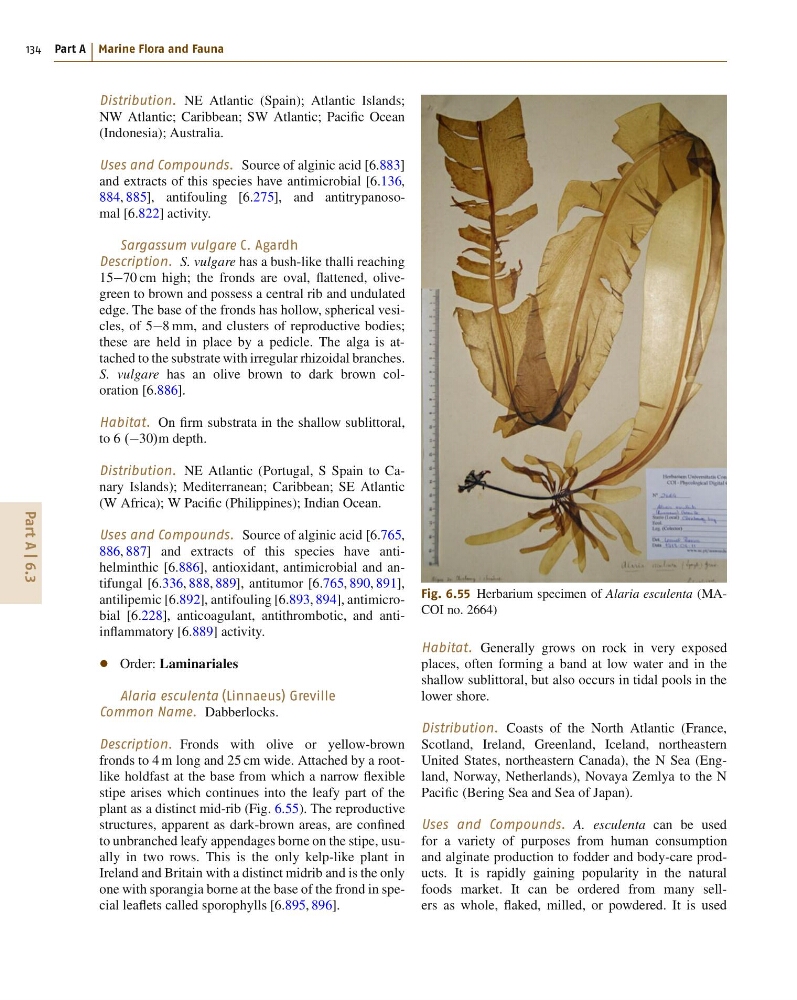
Description. Fronds with olive or yellow-brown
fronds to 4 m long and 25 cm wide. Attached by a rootlike holdfast at the base from which a narrow flexible
stipe arises which continues into the leafy part of the
plant as a distinct mid-rib (Fig. 6.55). The reproductive
structures, apparent as dark-brown areas, are confined
to unbranched leafy appendages borne on the stipe, usually in two rows. This is the only kelp-like plant in
Ireland and Britain with a distinct midrib and is the only
one with sporangia borne at the base of the frond in special leaflets called sporophylls [6.895, 896].
Fig. 6.55 Herbarium specimen of Alaria esculenta (MACOI no. 2664)
Habitat. Generally grows on rock in very exposed
places, often forming a band at low water and in the
shallow sublittoral, but also occurs in tidal pools in the
lower shore.
Distribution. Coasts of the North Atlantic (France,
Scotland, Ireland, Greenland, Iceland, northeastern
United States, northeastern Canada), the N Sea (England, Norway, Netherlands), Novaya Zemlya to the N
Pacific (Bering Sea and Sea of Japan).
Uses and Compounds. A. esculenta can be used
for a variety of purposes from human consumption
and alginate production to fodder and body-care products. It is rapidly gaining popularity in the natural
foods market. It can be ordered from many sellers as whole, flaked, milled, or powdered. It is used
134 Part A Marine Flora and Fauna
Distribution. NE Atlantic (Spain); Atlantic Islands;
NW Atlantic; Caribbean; SW Atlantic; Pacific Ocean
(Indonesia); Australia.
Uses and Compounds. Source of alginic acid [6.883]
and extracts of this species have antimicrobial [6.136,
884, 885], antifouling [6.275], and antitrypanosomal [6.822] activity.
Sargassum vulgare C. Agardh
Description. S. vulgare has a bush-like thalli reaching
1570 cm high; the fronds are oval, flattened, olivegreen to brown and possess a central rib and undulated
edge. The base of the fronds has hollow, spherical vesicles, of 58 mm, and clusters of reproductive bodies;
these are held in place by a pedicle. The alga is attached to the substrate with irregular rhizoidal branches.
S. vulgare has an olive brown to dark brown coloration [6.886].
Habitat. On firm substrata in the shallow sublittoral,
to 6 .30/m depth.
Distribution. NE Atlantic (Portugal, S Spain to Canary Islands); Mediterranean; Caribbean; SE Atlantic
(W Africa); W Pacific (Philippines); Indian Ocean.
Uses and Compounds. Source of alginic acid [6.765,
886, 887] and extracts of this species have antihelminthic [6.886], antioxidant, antimicrobial and antifungal [6.336, 888, 889], antitumor [6.765, 890, 891],
antilipemic [6.892], antifouling [6.893, 894], antimicrobial [6.228], anticoagulant, antithrombotic, and antiinflammatory [6.889] activity.
Order: Laminariales
Alaria esculenta (Linnaeus) Greville
Common Name. Dabberlocks.
Description. Fronds with olive or yellow-brown
fronds to 4 m long and 25 cm wide. Attached by a rootlike holdfast at the base from which a narrow flexible
stipe arises which continues into the leafy part of the
plant as a distinct mid-rib (Fig. 6.55). The reproductive
structures, apparent as dark-brown areas, are confined
to unbranched leafy appendages borne on the stipe, usually in two rows. This is the only kelp-like plant in
Ireland and Britain with a distinct midrib and is the only
one with sporangia borne at the base of the frond in special leaflets called sporophylls [6.895, 896].
Fig. 6.55 Herbarium specimen of Alaria esculenta (MACOI no. 2664)
Habitat. Generally grows on rock in very exposed
places, often forming a band at low water and in the
shallow sublittoral, but also occurs in tidal pools in the
lower shore.
Distribution. Coasts of the North Atlantic (France,
Scotland, Ireland, Greenland, Iceland, northeastern
United States, northeastern Canada), the N Sea (England, Norway, Netherlands), Novaya Zemlya to the N
Pacific (Bering Sea and Sea of Japan).
Uses and Compounds. A. esculenta can be used
for a variety of purposes from human consumption
and alginate production to fodder and body-care products. It is rapidly gaining popularity in the natural
foods market. It can be ordered from many sellers as whole, flaked, milled, or powdered. It is used