

Part A | 6.3
98 Part A Marine Flora and Fauna
Extracts have antifungal [6.488], contraceptive [6.489], antioxidant [6.490], antifungal, and
antibacterial [6.490–493] activity.
Gelidiella ramelosa (Kützing)
Feldmann & G. Hamel
Description. Plants occur as turfs to 12 cm in height,
with prostrate stolons attached by clusters of rhizoids to
rock. Erect axes are irregularly pinnately branched and
terete to slightly compressed. Structurally, the medulla
is pseudoparenchymatous with no discernible central
axis, and rhizines are absent. Spermatangia occur in surface sori. Tetrasporangia are borne in irregular whorls
in terete, basally constricted stichidia that are lateral on
erect axes [6.494].
Habitat. Growing as sparse turf amongst coralline algae.
Distribution. NE Atlantic (from France to Portugal);
Mediterranean; Australia.
Uses and Compounds. Extracts have cytotoxic and
antimitotic activity [6.62].
Gelidium corneum (Hudson) J.V. Lamouroux
Synonym. Gelidium sesquipedale (Clemente) Thuret.
Common Name. Kanteen.
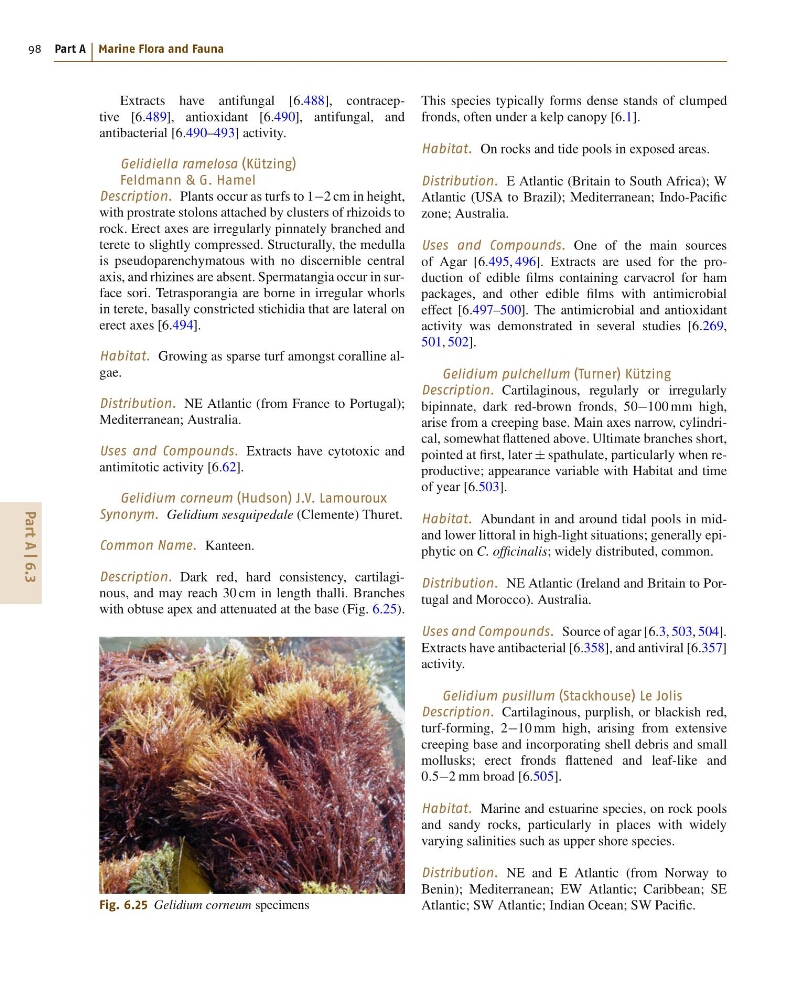
Description. Dark red, hard consistency, cartilaginous, and may reach 30 cm in length thalli. Branches
with obtuse apex and attenuated at the base (Fig. 6.25).
Fig. 6.25 Gelidium corneum specimens
This species typically forms dense stands of clumped
fronds, often under a kelp canopy [6.1].
Habitat. On rocks and tide pools in exposed areas.
Distribution. E Atlantic (Britain to South Africa); W
Atlantic (USA to Brazil); Mediterranean; Indo-Pacific
zone; Australia.
Uses and Compounds. One of the main sources
of Agar [6.495, 496]. Extracts are used for the production of edible films containing carvacrol for ham
packages, and other edible films with antimicrobial
effect [6.497–500]. The antimicrobial and antioxidant
activity was demonstrated in several studies [6.269,
501, 502].
Gelidium pulchellum (Turner) Kützing
Description. Cartilaginous, regularly or irregularly
bipinnate, dark red-brown fronds, 50100 mm high,
arise from a creeping base. Main axes narrow, cylindrical, somewhat flattened above. Ultimate branches short,
pointed at first, later ˙ spathulate, particularly when reproductive; appearance variable with Habitat and time
of year [6.503].
Habitat. Abundant in and around tidal pools in midand lower littoral in high-light situations; generally epiphytic on C. officinalis; widely distributed, common.
Distribution. NE Atlantic (Ireland and Britain to Portugal and Morocco). Australia.
Uses and Compounds. Source of agar [6.3, 503, 504].
Extracts have antibacterial [6.358], and antiviral [6.357]
activity.
Gelidium pusillum (Stackhouse) Le Jolis
Description. Cartilaginous, purplish, or blackish red,
turf-forming, 210 mm high, arising from extensive
creeping base and incorporating shell debris and small
mollusks; erect fronds flattened and leaf-like and
0:52 mm broad [6.505].
Habitat. Marine and estuarine species, on rock pools
and sandy rocks, particularly in places with widely
varying salinities such as upper shore species.
Distribution. NE and E Atlantic (from Norway to
Benin); Mediterranean; EW Atlantic; Caribbean; SE
Atlantic; SW Atlantic; Indian Ocean; SW Pacific.
98 Part A Marine Flora and Fauna
Extracts have antifungal [6.488], contraceptive [6.489], antioxidant [6.490], antifungal, and
antibacterial [6.490–493] activity.
Gelidiella ramelosa (Kützing)
Feldmann & G. Hamel
Description. Plants occur as turfs to 12 cm in height,
with prostrate stolons attached by clusters of rhizoids to
rock. Erect axes are irregularly pinnately branched and
terete to slightly compressed. Structurally, the medulla
is pseudoparenchymatous with no discernible central
axis, and rhizines are absent. Spermatangia occur in surface sori. Tetrasporangia are borne in irregular whorls
in terete, basally constricted stichidia that are lateral on
erect axes [6.494].
Habitat. Growing as sparse turf amongst coralline algae.
Distribution. NE Atlantic (from France to Portugal);
Mediterranean; Australia.
Uses and Compounds. Extracts have cytotoxic and
antimitotic activity [6.62].
Gelidium corneum (Hudson) J.V. Lamouroux
Synonym. Gelidium sesquipedale (Clemente) Thuret.
Common Name. Kanteen.
Description. Dark red, hard consistency, cartilaginous, and may reach 30 cm in length thalli. Branches
with obtuse apex and attenuated at the base (Fig. 6.25).
Fig. 6.25 Gelidium corneum specimens
This species typically forms dense stands of clumped
fronds, often under a kelp canopy [6.1].
Habitat. On rocks and tide pools in exposed areas.
Distribution. E Atlantic (Britain to South Africa); W
Atlantic (USA to Brazil); Mediterranean; Indo-Pacific
zone; Australia.
Uses and Compounds. One of the main sources
of Agar [6.495, 496]. Extracts are used for the production of edible films containing carvacrol for ham
packages, and other edible films with antimicrobial
effect [6.497–500]. The antimicrobial and antioxidant
activity was demonstrated in several studies [6.269,
501, 502].
Gelidium pulchellum (Turner) Kützing
Description. Cartilaginous, regularly or irregularly
bipinnate, dark red-brown fronds, 50100 mm high,
arise from a creeping base. Main axes narrow, cylindrical, somewhat flattened above. Ultimate branches short,
pointed at first, later ˙ spathulate, particularly when reproductive; appearance variable with Habitat and time
of year [6.503].
Habitat. Abundant in and around tidal pools in midand lower littoral in high-light situations; generally epiphytic on C. officinalis; widely distributed, common.
Distribution. NE Atlantic (Ireland and Britain to Portugal and Morocco). Australia.
Uses and Compounds. Source of agar [6.3, 503, 504].
Extracts have antibacterial [6.358], and antiviral [6.357]
activity.
Gelidium pusillum (Stackhouse) Le Jolis
Description. Cartilaginous, purplish, or blackish red,
turf-forming, 210 mm high, arising from extensive
creeping base and incorporating shell debris and small
mollusks; erect fronds flattened and leaf-like and
0:52 mm broad [6.505].
Habitat. Marine and estuarine species, on rock pools
and sandy rocks, particularly in places with widely
varying salinities such as upper shore species.
Distribution. NE and E Atlantic (from Norway to
Benin); Mediterranean; EW Atlantic; Caribbean; SE
Atlantic; SW Atlantic; Indian Ocean; SW Pacific.