

Seaweed Flora of the European North Atlantic and Mediterranean 6.3 Seaweeds Biodiversity and Potential 97
Part A | 6.3
Description. Bright pink to purplish, minutely whitespeckled calcareous crust, becoming very thick, usually
with abundant regular or irregular branches, free or attached to substratum [6.479].
Habitat. On rocks, pebbles, shells or free-living,
lower intertidal (north-east coasts) and sublittoral to
deeper waters.
Distribution. In the NE Atlantic from the British Isles
north to Arctic Russia including the Faeroe Isles, Iceland and western Baltic; in the NW Atlantic from Cape
Cod north to Arctic Canada and Greenland; also northern Japan and China in the western Pacific.
Uses and Compounds. Commercial extraction for
use as a soil conditioner on acidic ground, as an animal
food additive, for the filtration of acid drinking water
and in pharmaceutical and cosmetic products [6.386,
479]. Extracts promote the induction of metamorphosis of the sea urchin larvae (Strongylocentrotus droebachiensis) [6.480].
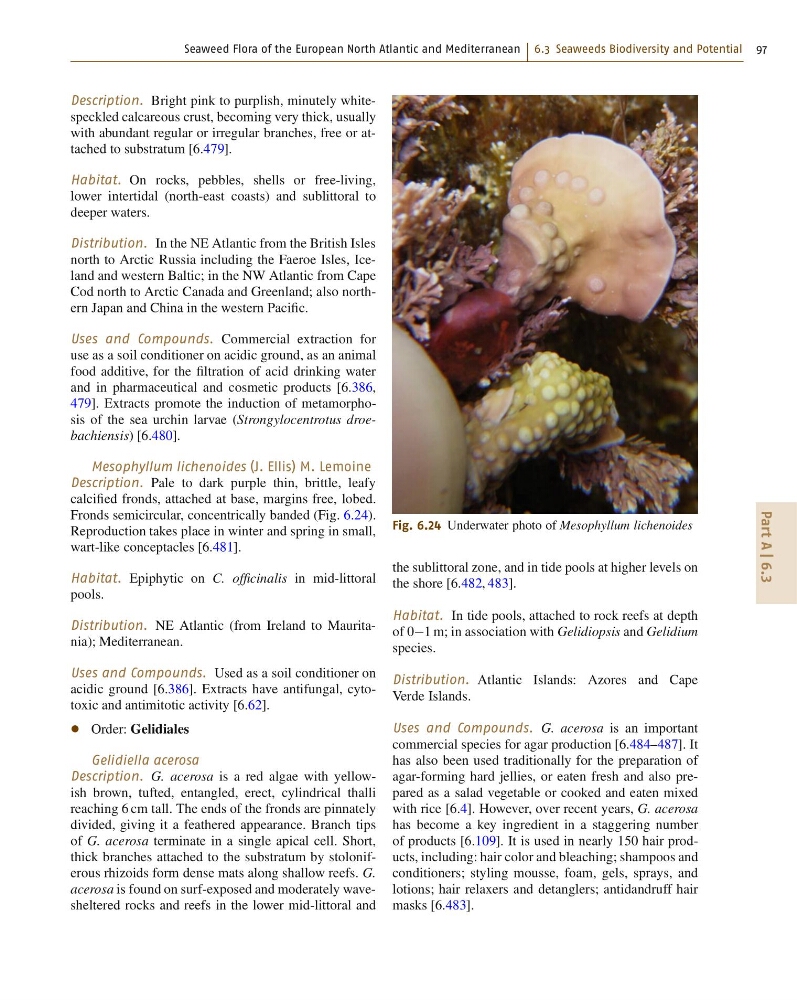
Mesophyllum lichenoides (J. Ellis) M. Lemoine
Description. Pale to dark purple thin, brittle, leafy
calcified fronds, attached at base, margins free, lobed.
Fronds semicircular, concentrically banded (Fig. 6.24).
Reproduction takes place in winter and spring in small,
wart-like conceptacles [6.481].
Habitat. Epiphytic on C. officinalis in mid-littoral
pools.
Distribution. NE Atlantic (from Ireland to Mauritania); Mediterranean.
Uses and Compounds. Used as a soil conditioner on
acidic ground [6.386]. Extracts have antifungal, cytotoxic and antimitotic activity [6.62].
Order: Gelidiales
Gelidiella acerosa
Description. G. acerosa is a red algae with yellowish brown, tufted, entangled, erect, cylindrical thalli
reaching 6 cm tall. The ends of the fronds are pinnately
divided, giving it a feathered appearance. Branch tips
of G. acerosa terminate in a single apical cell. Short,
thick branches attached to the substratum by stoloniferous rhizoids form dense mats along shallow reefs. G.
acerosa is found on surf-exposed and moderately wavesheltered rocks and reefs in the lower mid-littoral and
Fig. 6.24 Underwater photo of Mesophyllum lichenoides
the sublittoral zone, and in tide pools at higher levels on
the shore [6.482, 483].
Habitat. In tide pools, attached to rock reefs at depth
of 01 m; in association with Gelidiopsis and Gelidium
species.
Distribution. Atlantic Islands: Azores and Cape
Verde Islands.
Uses and Compounds. G. acerosa is an important
commercial species for agar production [6.484–487]. It
has also been used traditionally for the preparation of
agar-forming hard jellies, or eaten fresh and also prepared as a salad vegetable or cooked and eaten mixed
with rice [6.4]. However, over recent years, G. acerosa
has become a key ingredient in a staggering number
of products [6.109]. It is used in nearly 150 hair products, including: hair color and bleaching; shampoos and
conditioners; styling mousse, foam, gels, sprays, and
lotions; hair relaxers and detanglers; antidandruff hair
masks [6.483].
Part A | 6.3
Description. Bright pink to purplish, minutely whitespeckled calcareous crust, becoming very thick, usually
with abundant regular or irregular branches, free or attached to substratum [6.479].
Habitat. On rocks, pebbles, shells or free-living,
lower intertidal (north-east coasts) and sublittoral to
deeper waters.
Distribution. In the NE Atlantic from the British Isles
north to Arctic Russia including the Faeroe Isles, Iceland and western Baltic; in the NW Atlantic from Cape
Cod north to Arctic Canada and Greenland; also northern Japan and China in the western Pacific.
Uses and Compounds. Commercial extraction for
use as a soil conditioner on acidic ground, as an animal
food additive, for the filtration of acid drinking water
and in pharmaceutical and cosmetic products [6.386,
479]. Extracts promote the induction of metamorphosis of the sea urchin larvae (Strongylocentrotus droebachiensis) [6.480].
Mesophyllum lichenoides (J. Ellis) M. Lemoine
Description. Pale to dark purple thin, brittle, leafy
calcified fronds, attached at base, margins free, lobed.
Fronds semicircular, concentrically banded (Fig. 6.24).
Reproduction takes place in winter and spring in small,
wart-like conceptacles [6.481].
Habitat. Epiphytic on C. officinalis in mid-littoral
pools.
Distribution. NE Atlantic (from Ireland to Mauritania); Mediterranean.
Uses and Compounds. Used as a soil conditioner on
acidic ground [6.386]. Extracts have antifungal, cytotoxic and antimitotic activity [6.62].
Order: Gelidiales
Gelidiella acerosa
Description. G. acerosa is a red algae with yellowish brown, tufted, entangled, erect, cylindrical thalli
reaching 6 cm tall. The ends of the fronds are pinnately
divided, giving it a feathered appearance. Branch tips
of G. acerosa terminate in a single apical cell. Short,
thick branches attached to the substratum by stoloniferous rhizoids form dense mats along shallow reefs. G.
acerosa is found on surf-exposed and moderately wavesheltered rocks and reefs in the lower mid-littoral and
Fig. 6.24 Underwater photo of Mesophyllum lichenoides
the sublittoral zone, and in tide pools at higher levels on
the shore [6.482, 483].
Habitat. In tide pools, attached to rock reefs at depth
of 01 m; in association with Gelidiopsis and Gelidium
species.
Distribution. Atlantic Islands: Azores and Cape
Verde Islands.
Uses and Compounds. G. acerosa is an important
commercial species for agar production [6.484–487]. It
has also been used traditionally for the preparation of
agar-forming hard jellies, or eaten fresh and also prepared as a salad vegetable or cooked and eaten mixed
with rice [6.4]. However, over recent years, G. acerosa
has become a key ingredient in a staggering number
of products [6.109]. It is used in nearly 150 hair products, including: hair color and bleaching; shampoos and
conditioners; styling mousse, foam, gels, sprays, and
lotions; hair relaxers and detanglers; antidandruff hair
masks [6.483].