

56
7 Final Remarks
7.3 Mechanical Energy for Biological Production
In the entire biosphere, the primary source of energy for ecosystems is the photosynthetically active radiation of the sun; but in the oceans, such energy needs
to be complemented. Legendre et al. (1986) and Margalef (1997) conceptualized
the matter: besides this primary energy, the productivity of marine ecosystems
depends on the input of mechanical energy derived from de degradation of solar
energy (e.g. winds, freshwater runoff, air-ocean heat exchanges), or of energy of
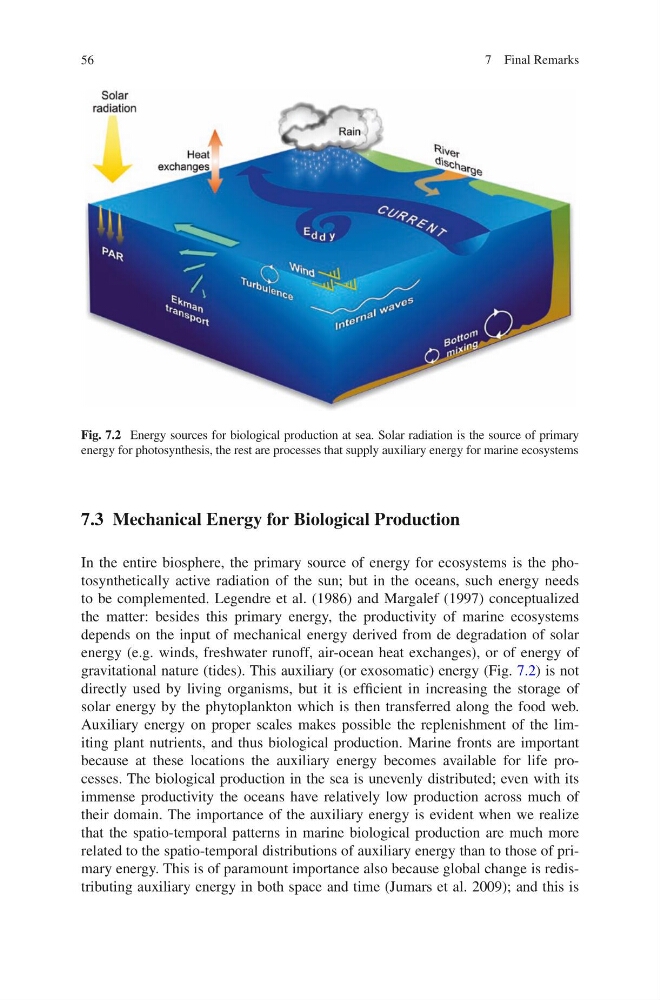
gravitational nature (tides). This auxiliary (or exosomatic) energy (Fig. 7.2) is not
directly used by living organisms, but it is efficient in increasing the storage of
solar energy by the phytoplankton which is then transferred along the food web.
Auxiliary energy on proper scales makes possible the replenishment of the limiting plant nutrients, and thus biological production. Marine fronts are important
because at these locations the auxiliary energy becomes available for life processes. The biological production in the sea is unevenly distributed; even with its
immense productivity the oceans have relatively low production across much of
their domain. The importance of the auxiliary energy is evident when we realize
that the spatio-temporal patterns in marine biological production are much more
related to the spatio-temporal distributions of auxiliary energy than to those of primary energy. This is of paramount importance also because global change is redistributing auxiliary energy in both space and time (Jumars et al. 2009); and this is
Fig. 7.2 Energy sources for biological production at sea. Solar radiation is the source of primary
energy for photosynthesis, the rest are processes that supply auxiliary energy for marine ecosystems
7 Final Remarks
7.3 Mechanical Energy for Biological Production
In the entire biosphere, the primary source of energy for ecosystems is the photosynthetically active radiation of the sun; but in the oceans, such energy needs
to be complemented. Legendre et al. (1986) and Margalef (1997) conceptualized
the matter: besides this primary energy, the productivity of marine ecosystems
depends on the input of mechanical energy derived from de degradation of solar
energy (e.g. winds, freshwater runoff, air-ocean heat exchanges), or of energy of
gravitational nature (tides). This auxiliary (or exosomatic) energy (Fig. 7.2) is not
directly used by living organisms, but it is efficient in increasing the storage of
solar energy by the phytoplankton which is then transferred along the food web.
Auxiliary energy on proper scales makes possible the replenishment of the limiting plant nutrients, and thus biological production. Marine fronts are important
because at these locations the auxiliary energy becomes available for life processes. The biological production in the sea is unevenly distributed; even with its
immense productivity the oceans have relatively low production across much of
their domain. The importance of the auxiliary energy is evident when we realize
that the spatio-temporal patterns in marine biological production are much more
related to the spatio-temporal distributions of auxiliary energy than to those of primary energy. This is of paramount importance also because global change is redistributing auxiliary energy in both space and time (Jumars et al. 2009); and this is
Fig. 7.2 Energy sources for biological production at sea. Solar radiation is the source of primary
energy for photosynthesis, the rest are processes that supply auxiliary energy for marine ecosystems