

55
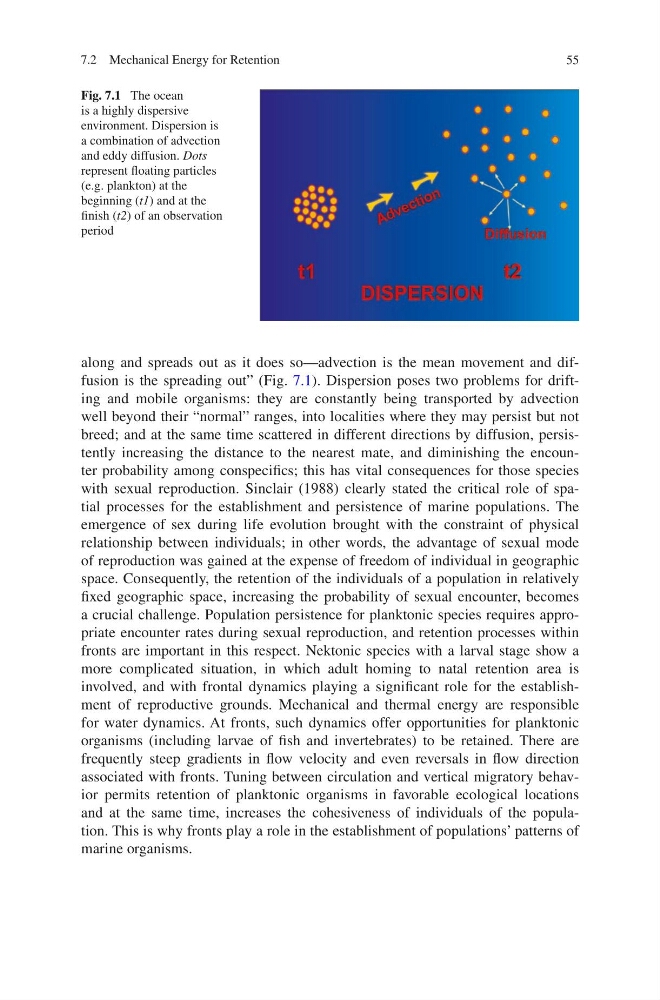
along and spreads out as it does so—advection is the mean movement and diffusion is the spreading out” (Fig. 7.1). Dispersion poses two problems for drifting and mobile organisms: they are constantly being transported by advection
well beyond their “normal” ranges, into localities where they may persist but not
breed; and at the same time scattered in different directions by diffusion, persistently increasing the distance to the nearest mate, and diminishing the encounter probability among conspecifics; this has vital consequences for those species
with sexual reproduction. Sinclair (1988) clearly stated the critical role of spatial processes for the establishment and persistence of marine populations. The
emergence of sex during life evolution brought with the constraint of physical
relationship between individuals; in other words, the advantage of sexual mode
of reproduction was gained at the expense of freedom of individual in geographic
space. Consequently, the retention of the individuals of a population in relatively
fixed geographic space, increasing the probability of sexual encounter, becomes
a crucial challenge. Population persistence for planktonic species requires appropriate encounter rates during sexual reproduction, and retention processes within
fronts are important in this respect. Nektonic species with a larval stage show a
more complicated situation, in which adult homing to natal retention area is
involved, and with frontal dynamics playing a significant role for the establishment of reproductive grounds. Mechanical and thermal energy are responsible
for water dynamics. At fronts, such dynamics offer opportunities for planktonic
organisms (including larvae of fish and invertebrates) to be retained. There are
frequently steep gradients in flow velocity and even reversals in flow direction
associated with fronts. Tuning between circulation and vertical migratory behavior permits retention of planktonic organisms in favorable ecological locations
and at the same time, increases the cohesiveness of individuals of the population. This is why fronts play a role in the establishment of populations’ patterns of
marine organisms.
Fig. 7.1 The ocean
is a highly dispersive
environment. Dispersion is
a combination of advection
and eddy diffusion. Dots
represent floating particles
(e.g. plankton) at the
beginning (t1) and at the
finish (t2) of an observation
period
7.2 Mechanical Energy for Retention
along and spreads out as it does so—advection is the mean movement and diffusion is the spreading out” (Fig. 7.1). Dispersion poses two problems for drifting and mobile organisms: they are constantly being transported by advection
well beyond their “normal” ranges, into localities where they may persist but not
breed; and at the same time scattered in different directions by diffusion, persistently increasing the distance to the nearest mate, and diminishing the encounter probability among conspecifics; this has vital consequences for those species
with sexual reproduction. Sinclair (1988) clearly stated the critical role of spatial processes for the establishment and persistence of marine populations. The
emergence of sex during life evolution brought with the constraint of physical
relationship between individuals; in other words, the advantage of sexual mode
of reproduction was gained at the expense of freedom of individual in geographic
space. Consequently, the retention of the individuals of a population in relatively
fixed geographic space, increasing the probability of sexual encounter, becomes
a crucial challenge. Population persistence for planktonic species requires appropriate encounter rates during sexual reproduction, and retention processes within
fronts are important in this respect. Nektonic species with a larval stage show a
more complicated situation, in which adult homing to natal retention area is
involved, and with frontal dynamics playing a significant role for the establishment of reproductive grounds. Mechanical and thermal energy are responsible
for water dynamics. At fronts, such dynamics offer opportunities for planktonic
organisms (including larvae of fish and invertebrates) to be retained. There are
frequently steep gradients in flow velocity and even reversals in flow direction
associated with fronts. Tuning between circulation and vertical migratory behavior permits retention of planktonic organisms in favorable ecological locations
and at the same time, increases the cohesiveness of individuals of the population. This is why fronts play a role in the establishment of populations’ patterns of
marine organisms.
Fig. 7.1 The ocean
is a highly dispersive
environment. Dispersion is
a combination of advection
and eddy diffusion. Dots
represent floating particles
(e.g. plankton) at the
beginning (t1) and at the
finish (t2) of an observation
period
7.2 Mechanical Energy for Retention