

91
II. Results and discussion
Two different !'lechanisms for nutrient enrichrrent of the euphotic zone
occurred in the Gulf of Naples and Salerno. Offshore waters having the
same characteristics described for the Tyrrhenian Sea (Hopkins, 1978)
depended on the vertical transport of deep water nutrients during winter
isothermy. In contrast, inshore waters were mainly influenced by land rUnoff from small rivers, as well as domestic and industrial discharges.
A. Open waters
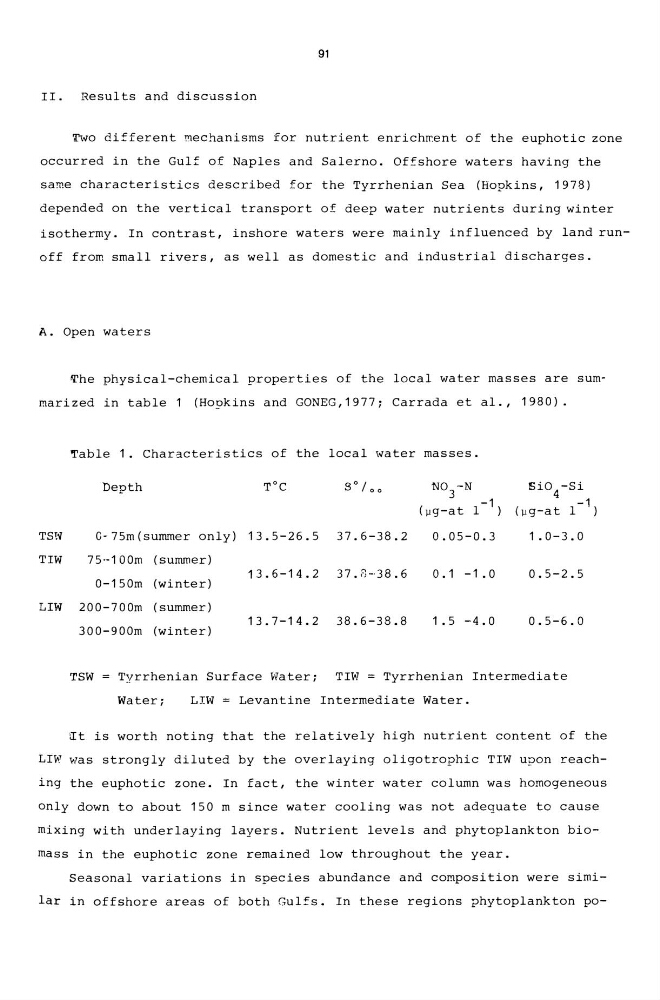
~he physical-chemical properties of the local water masses are summarized in table 1 (Ho!Jkins and GONEG,1977; Carrada et al., 1980).
Table 1. Characteristics of the local water masses.
Depth
TOC
3%
0
N0 3 -N
6i0 4 -Si
()lg-at 1- 1 ) ()lg-at 1- 1 )
TSI'l
G-75m(summer only) 13.5-26.5 37.6-38.2
0.05-0.3
1.0-3.0
TIW
75··1 GOm (summer)
13.6-14.2 37.
0.5-2.5
0-150m (winter)
LIW 200-700m (summer)
13.7-14.2 38.6-38.8
1.5 -4.0
0.5-6.0
300-900m (winter)
TSW
Tyrrhenian Surface Water; TIW = Tyrrhenian Intermediate
Water;
LHv = Levantine Intermediate Water.
ITt is worth noting that the relatively high nutrient content of the
LIW was strongly diluted by the overlaying oligotrophic TIW upon reaching the euphotic zone. In fact, the winter water column was homogeneous
only down to about 150 m since water cooling was not adequate to cause
mixing with underlaying layers. Nutrient levels and phytoplankton biomass in the euphotic zone remained low throughout the year.
Seasonal variations in species abundance and composition were similar in offshore areas of both Gulfs. In these regions phytoplankton po-
II. Results and discussion
Two different !'lechanisms for nutrient enrichrrent of the euphotic zone
occurred in the Gulf of Naples and Salerno. Offshore waters having the
same characteristics described for the Tyrrhenian Sea (Hopkins, 1978)
depended on the vertical transport of deep water nutrients during winter
isothermy. In contrast, inshore waters were mainly influenced by land rUnoff from small rivers, as well as domestic and industrial discharges.
A. Open waters
~he physical-chemical properties of the local water masses are summarized in table 1 (Ho!Jkins and GONEG,1977; Carrada et al., 1980).
Table 1. Characteristics of the local water masses.
Depth
TOC
3%
0
N0 3 -N
6i0 4 -Si
()lg-at 1- 1 ) ()lg-at 1- 1 )
TSI'l
G-75m(summer only) 13.5-26.5 37.6-38.2
0.05-0.3
1.0-3.0
TIW
75··1 GOm (summer)
13.6-14.2 37.
0.5-2.5
0-150m (winter)
LIW 200-700m (summer)
13.7-14.2 38.6-38.8
1.5 -4.0
0.5-6.0
300-900m (winter)
TSW
Tyrrhenian Surface Water; TIW = Tyrrhenian Intermediate
Water;
LHv = Levantine Intermediate Water.
ITt is worth noting that the relatively high nutrient content of the
LIW was strongly diluted by the overlaying oligotrophic TIW upon reaching the euphotic zone. In fact, the winter water column was homogeneous
only down to about 150 m since water cooling was not adequate to cause
mixing with underlaying layers. Nutrient levels and phytoplankton biomass in the euphotic zone remained low throughout the year.
Seasonal variations in species abundance and composition were similar in offshore areas of both Gulfs. In these regions phytoplankton po-