

57
Isolation of a Novel Arsenical Precursor of Arsenobetaine
In one diatom, Chaetoceros gracilis (Thomas, 1966), of the many
species studied to date, there is formed a novel water-soluble arsenical
in addition to those previously recognized in all aquatic plants.
Whether it is actually the product of symbiotic bacteria is not firmly
established. The diatom extracts however, were prepared from radiolabeled cells centrifuged from their media and washed with distilled
water. No differences were observed in extracts of unwashed cells.
The novel compound, no,n was neutral at pH 6 and pH 2. It hydrolyzed in dilute acid (O.lN BC1) at 80 0 in one hour to yield a cationic
product having chromatographic properties similar to those of "B,n
5-dimethylarsenosoribosylglycerol. Its electrophoretic mobility suggested molecular size and structure of a riboside. nO," was converted
in good yield to "An the 5-dimethylarsenosoribosylglycerol sulfate by
bromine oxidation. Similarly, the cationic hydrolysis product of "On was
oxidized by bromine to yield a product with properties of "B." It is
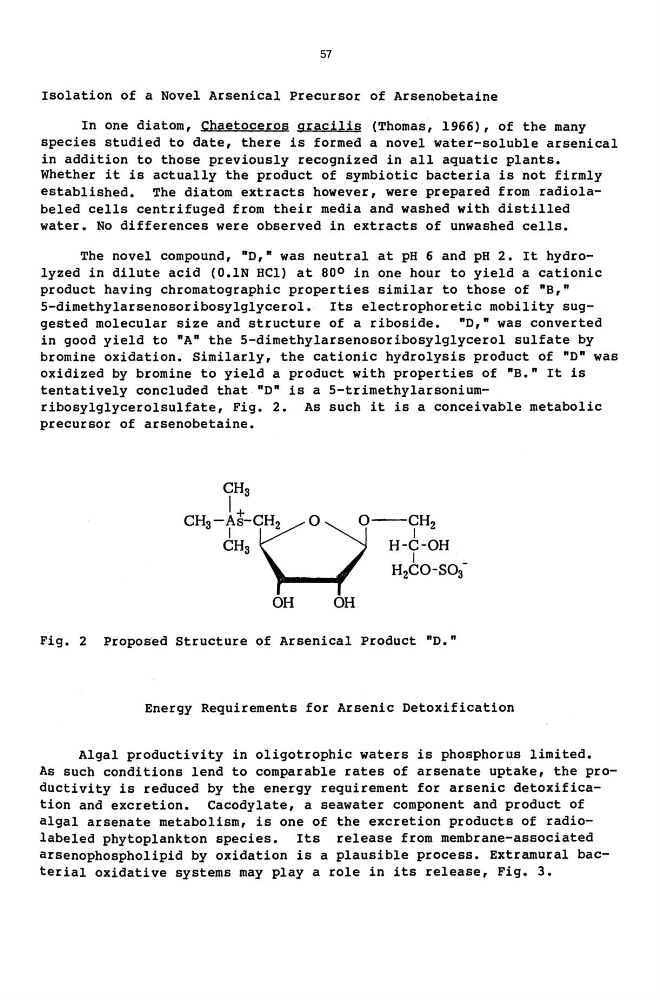
tentatively concluded that "On is a 5-trimethylarsoniumribosylglycerolsulfate, Fig. 2. As such it is a conceivable metabolic
precursor of arsenobetaine.
CH 3
1+
CH3-As-cpH2 0
O--CH2
I
I
CH 3
H-C-OH
I
_
H 2 CO-S0 3
OH
OH
Fig. 2 Propos~d Structure of Arsenical Product nO."
Energy Requirements for Arsenic Detoxification
Algal productivity in oligotrophic waters is phosphorus limited.
As such conditions lend to comparable rates of arsenate uptake, the productivity is reduced by the energy requirement for arsenic detoxification and excretion. Cacodylate, a seawater component and product of
algal arsenate metabolism, is one of the excretion products of radiolabeled phytoplankton species. Its release from membrane-associated
arsenophospholipid by oxidation is a plausible process. Extramural bacterial oxidative systems may playa role in its release, Fig. 3.
Isolation of a Novel Arsenical Precursor of Arsenobetaine
In one diatom, Chaetoceros gracilis (Thomas, 1966), of the many
species studied to date, there is formed a novel water-soluble arsenical
in addition to those previously recognized in all aquatic plants.
Whether it is actually the product of symbiotic bacteria is not firmly
established. The diatom extracts however, were prepared from radiolabeled cells centrifuged from their media and washed with distilled
water. No differences were observed in extracts of unwashed cells.
The novel compound, no,n was neutral at pH 6 and pH 2. It hydrolyzed in dilute acid (O.lN BC1) at 80 0 in one hour to yield a cationic
product having chromatographic properties similar to those of "B,n
5-dimethylarsenosoribosylglycerol. Its electrophoretic mobility suggested molecular size and structure of a riboside. nO," was converted
in good yield to "An the 5-dimethylarsenosoribosylglycerol sulfate by
bromine oxidation. Similarly, the cationic hydrolysis product of "On was
oxidized by bromine to yield a product with properties of "B." It is
tentatively concluded that "On is a 5-trimethylarsoniumribosylglycerolsulfate, Fig. 2. As such it is a conceivable metabolic
precursor of arsenobetaine.
CH 3
1+
CH3-As-cpH2 0
O--CH2
I
I
CH 3
H-C-OH
I
_
H 2 CO-S0 3
OH
OH
Fig. 2 Propos~d Structure of Arsenical Product nO."
Energy Requirements for Arsenic Detoxification
Algal productivity in oligotrophic waters is phosphorus limited.
As such conditions lend to comparable rates of arsenate uptake, the productivity is reduced by the energy requirement for arsenic detoxification and excretion. Cacodylate, a seawater component and product of
algal arsenate metabolism, is one of the excretion products of radiolabeled phytoplankton species. Its release from membrane-associated
arsenophospholipid by oxidation is a plausible process. Extramural bacterial oxidative systems may playa role in its release, Fig. 3.