

161
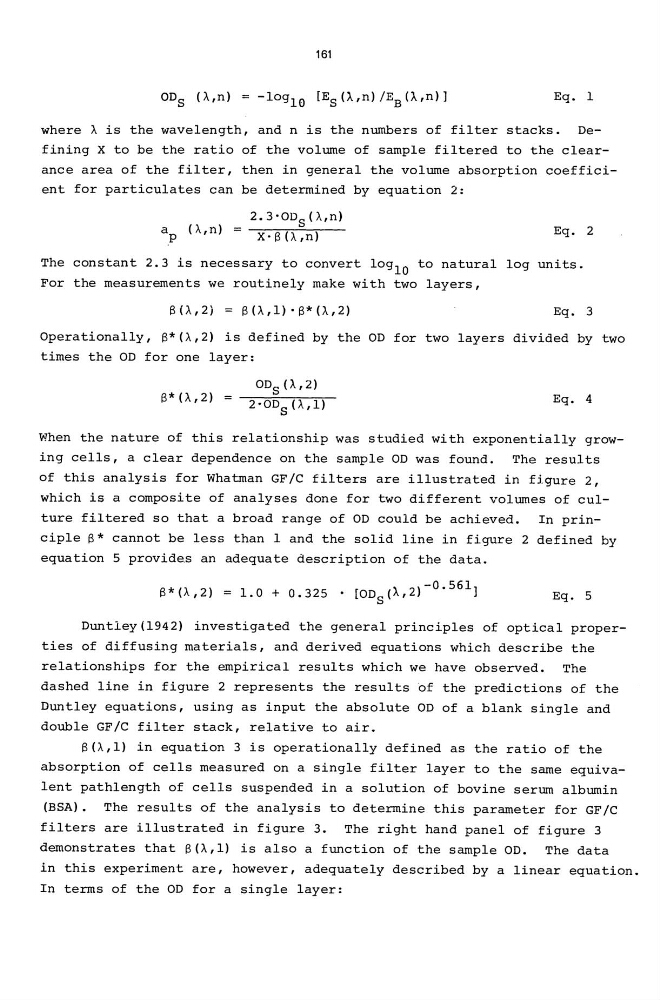
ODS (A,n) = -loglO [ES (A,n) /EB (A,n) 1
Eq. 1
where A is the wavelength, and n is the numbers of filter stacks. Defining X to be the ratio of the volume of sample filtered to the clearance area of the filter, then in general the volume absorption coefficient for particulates can be determined by equation 2:
2.3·0D S (A,n)
a p (A , n ) = X. S (A , n )
Eg. 2
The constant 2.3 is necessary to convert loglO to natural log units.
For the measurements we routinely make with two layers,
S(A,2) = S(A,1)·S*(A,2)
Eq. 3
Operationally, S*(A,2) is defined by the OD for two layers divided by two
times the OD for one layer:
S*(A,2) =
Eq. 4
When the nature of this relationship was studied with exponentially growing cells, a clear dependence on the sample OD was found.
The results
of this analysis for Whatrnan GF/C filters are illustrated in figure 2,
which is a composite of analyses done for two different volumes of culture filtered so that a broad range of OD could be achieved.
In principle S* cannot be less than 1 and the solid line in figure 2 defined by
equation 5 provides an adequate description of the data.
-0.561
S*(A,2) = 1.0 + 0.325 • [OD S (A,2)
1
Eq. 5
Duntley(1942) investigated the general principles of optical properties of diffusing materials, and derived equations which describe the
relationships for the empirical results which we have observed.
The
dashed line in figure 2 represents the results of the predictions of the
Duntley equations, using as input the absolute OD of a blank single and
double GF/C filter stack, relative to air.
S(A,l) in equation 3 is operationally defined as the ratio of the
absorption of cells measured on a single filter layer to the same equivalent pathlength of cells suspended in a solution of bovine serum albumin
(BSA). The results of the analysis to determine this parameter for GF/C
filters are illustrated in figure 3.
The right hand panel of figure 3
demonstrates that S(A,l) is also a function of the sample OD.
The data
in this experiment are, however, adequately described by a linear equation.
In terms of the OD for a single layer:
ODS (A,n) = -loglO [ES (A,n) /EB (A,n) 1
Eq. 1
where A is the wavelength, and n is the numbers of filter stacks. Defining X to be the ratio of the volume of sample filtered to the clearance area of the filter, then in general the volume absorption coefficient for particulates can be determined by equation 2:
2.3·0D S (A,n)
a p (A , n ) = X. S (A , n )
Eg. 2
The constant 2.3 is necessary to convert loglO to natural log units.
For the measurements we routinely make with two layers,
S(A,2) = S(A,1)·S*(A,2)
Eq. 3
Operationally, S*(A,2) is defined by the OD for two layers divided by two
times the OD for one layer:
S*(A,2) =
Eq. 4
When the nature of this relationship was studied with exponentially growing cells, a clear dependence on the sample OD was found.
The results
of this analysis for Whatrnan GF/C filters are illustrated in figure 2,
which is a composite of analyses done for two different volumes of culture filtered so that a broad range of OD could be achieved.
In principle S* cannot be less than 1 and the solid line in figure 2 defined by
equation 5 provides an adequate description of the data.
-0.561
S*(A,2) = 1.0 + 0.325 • [OD S (A,2)
1
Eq. 5
Duntley(1942) investigated the general principles of optical properties of diffusing materials, and derived equations which describe the
relationships for the empirical results which we have observed.
The
dashed line in figure 2 represents the results of the predictions of the
Duntley equations, using as input the absolute OD of a blank single and
double GF/C filter stack, relative to air.
S(A,l) in equation 3 is operationally defined as the ratio of the
absorption of cells measured on a single filter layer to the same equivalent pathlength of cells suspended in a solution of bovine serum albumin
(BSA). The results of the analysis to determine this parameter for GF/C
filters are illustrated in figure 3.
The right hand panel of figure 3
demonstrates that S(A,l) is also a function of the sample OD.
The data
in this experiment are, however, adequately described by a linear equation.
In terms of the OD for a single layer: