

116
measured but were assumed to be equal to phosphate.
Furnas (1982a)
estimated that higher flux rates in cages would support approximately
3 times more chlorophyll than in dialysis tubes.
This should also
yield a longer exponential phase and possibly higher growth rates.
I have measured ammonia flux rates through dialysis membranes
using the same size tubing as Furnas (1982a). He measured flux rates
in beakers using deionized water and a 1 millimolar initial phosphate
concentration gradient. My rates are, however, based on measurements
made under the same experimental conditions used to incubate samples.
Decreases in ammonium and phosphate followed an exponential decay.
Flux rates were calculated from the average difference between the
tubes and the tank over a 1 hour period using the mean concentration
gradient.
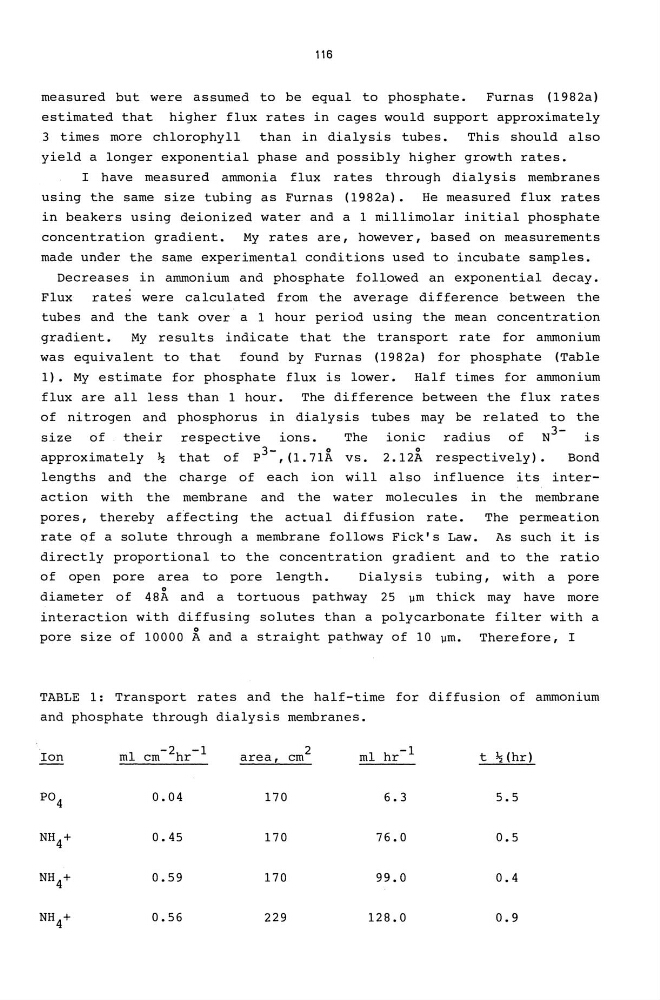
My results indicate that the transport rate for ammonium
was equivalent to that found by Furnas (1982a) for phosphate (Table
1). My estimate for phosphate flux is lower. Half times for ammonium
flux are all less than 1 hour. The difference between the flux rates
of nitrogen and phosphorus in dialysis tubes may be related to the
size of their respective ions.
The ionic radius of N 3 -
is
approximately ~ that of p3-, (1. 71A vs. 2.12A respectively).
Bond
lengths and the charge of each ion will also influence its interaction with the membrane and the water molecules in the membrane
pores, thereby ai"fecting the actual diffusion rate.
The permeation
rate qf a solute through a membrane follows Fick's Law. As such it is
directly proportional to the concentration gradient and to the ratio
of open pore area to pore length.
Dialysis tubing, with a pore
o
diameter of 48A and a tortuous pathway 25 11m thick may have more
interaction with diffusing solutes than a polycarbonate filter with a
pore size of 10000 A and a straight pathway of 10 11m. Therefore, I
TABLE 1: Transport rates and the half-time for diffusion of ammonium
and phosphate through dialysis membranes.
Ion
-2 -1
ml cm hr
area, cm 2
ml hr -1
t ~(hr)
P04
0.04
170
6.3
5.5
NH4+
0.45
170
76.0
0.5
NH4+
0.59
170
99.0
0.4
NH4+
0.56
229
128.0
0.9
measured but were assumed to be equal to phosphate.
Furnas (1982a)
estimated that higher flux rates in cages would support approximately
3 times more chlorophyll than in dialysis tubes.
This should also
yield a longer exponential phase and possibly higher growth rates.
I have measured ammonia flux rates through dialysis membranes
using the same size tubing as Furnas (1982a). He measured flux rates
in beakers using deionized water and a 1 millimolar initial phosphate
concentration gradient. My rates are, however, based on measurements
made under the same experimental conditions used to incubate samples.
Decreases in ammonium and phosphate followed an exponential decay.
Flux rates were calculated from the average difference between the
tubes and the tank over a 1 hour period using the mean concentration
gradient.
My results indicate that the transport rate for ammonium
was equivalent to that found by Furnas (1982a) for phosphate (Table
1). My estimate for phosphate flux is lower. Half times for ammonium
flux are all less than 1 hour. The difference between the flux rates
of nitrogen and phosphorus in dialysis tubes may be related to the
size of their respective ions.
The ionic radius of N 3 -
is
approximately ~ that of p3-, (1. 71A vs. 2.12A respectively).
Bond
lengths and the charge of each ion will also influence its interaction with the membrane and the water molecules in the membrane
pores, thereby ai"fecting the actual diffusion rate.
The permeation
rate qf a solute through a membrane follows Fick's Law. As such it is
directly proportional to the concentration gradient and to the ratio
of open pore area to pore length.
Dialysis tubing, with a pore
o
diameter of 48A and a tortuous pathway 25 11m thick may have more
interaction with diffusing solutes than a polycarbonate filter with a
pore size of 10000 A and a straight pathway of 10 11m. Therefore, I
TABLE 1: Transport rates and the half-time for diffusion of ammonium
and phosphate through dialysis membranes.
Ion
-2 -1
ml cm hr
area, cm 2
ml hr -1
t ~(hr)
P04
0.04
170
6.3
5.5
NH4+
0.45
170
76.0
0.5
NH4+
0.59
170
99.0
0.4
NH4+
0.56
229
128.0
0.9