

733
sepium, yarrow Achillea millefolium, wild strawberry Fragaria virginiana), and so
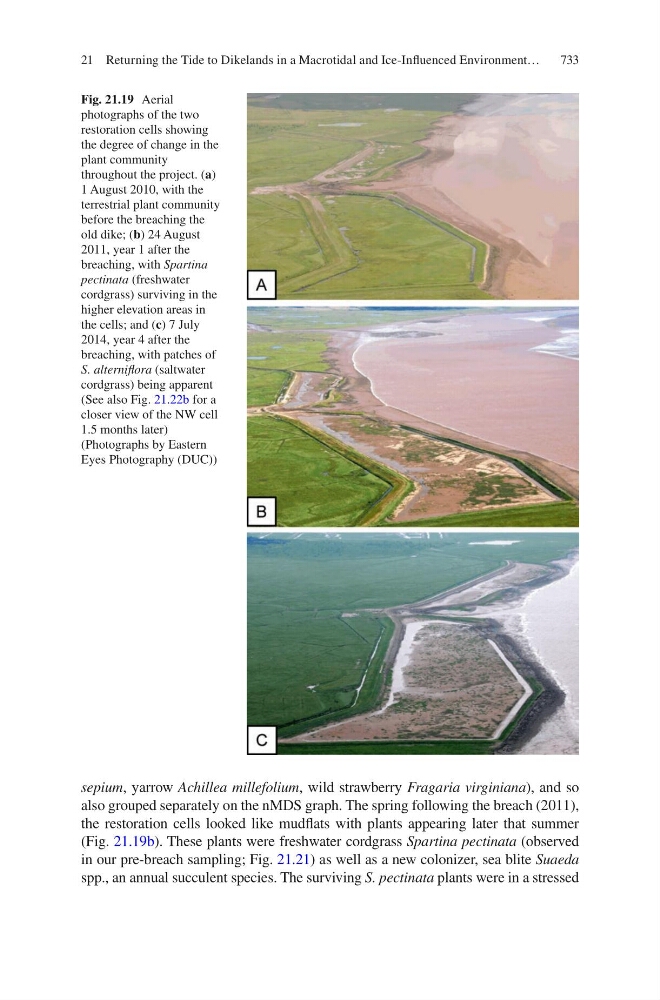
also grouped separately on the nMDS graph. The spring following the breach (2011),
the restoration cells looked like mudflats with plants appearing later that summer
(Fig. 21.19b). These plants were freshwater cordgrass Spartina pectinata (observed
in our pre-breach sampling; Fig. 21.21) as well as a new colonizer, sea blite Suaeda
spp., an annual succulent species. The surviving S. pectinata plants were in a stressed
Fig. 21.19 Aerial
photographs of the two
restoration cells showing
the degree of change in the
plant community
throughout the project. (a)
1 August 2010, with the
terrestrial plant community
before the breaching the
old dike; (b) 24 August
2011, year 1 after the
breaching, with Spartina
pectinata (freshwater
cordgrass) surviving in the
higher elevation areas in
the cells; and (c) 7 July
2014, year 4 after the
breaching, with patches of
S. alterniflora (saltwater
cordgrass) being apparent
(See also Fig. 21.22b for a
closer view of the NW cell
1.5 months later)
(Photographs by Eastern
Eyes Photography (DUC))
21 Returning the Tide to Dikelands in a Macrotidal and Ice-Influenced Environment…