

646
20.3.2 Goiana River Estuary
Possibly 450–1000 fishers’ traditional families exploit natural living resources from
the Goiana Estuary for subsistence and income generation (Barletta and Costa
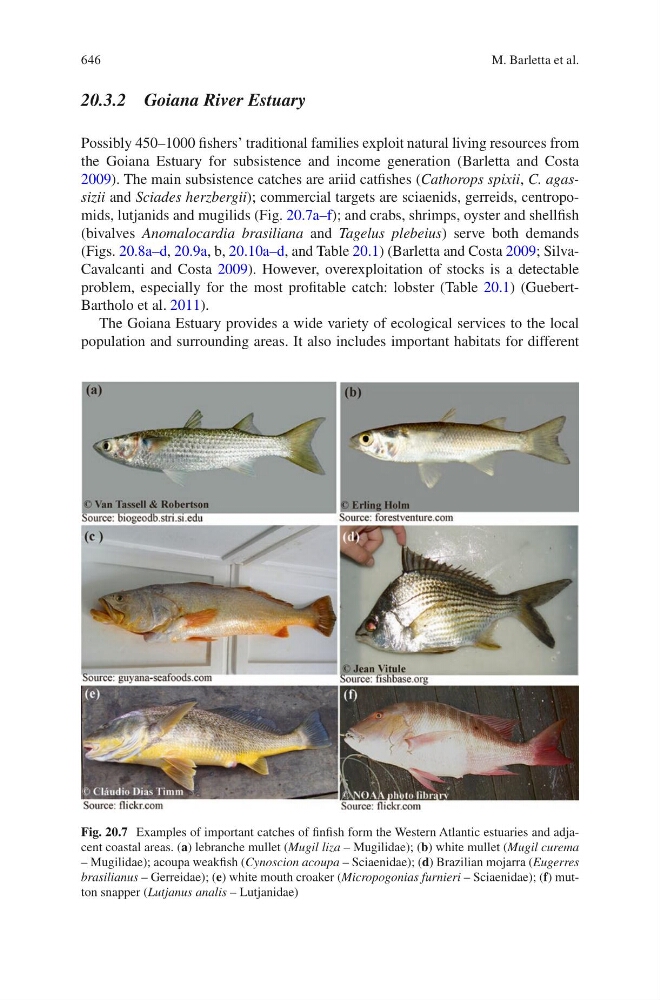
2009). The main subsistence catches are ariid catfishes (Cathorops spixii, C. agassizii and Sciades herzbergii); commercial targets are sciaenids, gerreids, centropomids, lutjanids and mugilids (Fig. 20.7a–f); and crabs, shrimps, oyster and shellfish
(bivalves Anomalocardia brasiliana and Tagelus plebeius) serve both demands
(Figs. 20.8a–d, 20.9a, b, 20.10a–d, and Table 20.1) (Barletta and Costa 2009; SilvaCavalcanti and Costa 2009). However, overexploitation of stocks is a detectable
problem, especially for the most profitable catch: lobster (Table 20.1) (GuebertBartholo et al. 2011).
The Goiana Estuary provides a wide variety of ecological services to the local
population and surrounding areas. It also includes important habitats for different
Fig. 20.7 Examples of important catches of finfish form the Western Atlantic estuaries and adjacent coastal areas. (a) lebranche mullet (Mugil liza – Mugilidae); (b) white mullet (Mugil curema
– Mugilidae); acoupa weakfish (Cynoscion acoupa – Sciaenidae); (d) Brazilian mojarra (Eugerres
brasilianus – Gerreidae); (e) white mouth croaker (Micropogonias furnieri – Sciaenidae); (f) mutton snapper (Lutjanus analis – Lutjanidae)
M. Barletta et al.