

525
most important topic in discussions of the sustainable development of the land
where they live. The scientists working for the National Danube Delta Research
Institute support the idea of flooding the polder and restoring it to its initial state,
i.e., its state prior to the 1960s. The researchers working in this institute claim that
a considerable portion (50–60%) of this polder is not cultivated and that crop rotation is not performed properly, with the result that the crops harvested here are quite
small in comparison to the investments that have been made. However, the most
clear-cut position on this issue is that of the Tulcea General Council. According to
this council, polder flooding is merely utopian. They claim that the flooding would
ruin Pardina’s economic environment and lead to further degradation of the standard of living of the local population. Each year, the General Council collects several hundreds of thousands of Euros in concession fees. One of the problems that
make the application of this project difficult is the fact that compensations would
have to be paid to the polder farmers if they are expropriated. The Romanian
Government has tried to find solutions to this problem, but given the current crisis,
this project is no longer considered a priority (Niculescu et al. 2015b).
Seven thousand five hundred fifty hectares of the Sireasa polder have undergone
similar radical agricultural development (Fig. 17.7). Such development has also
occurred in Murighiol-Dunavat (on the Sfantu-Gheorghe Branch) (Fig. 17.8) as
well as in Babina and Cernovca (located on the Chilia Branch) (Fig. 17.9), where
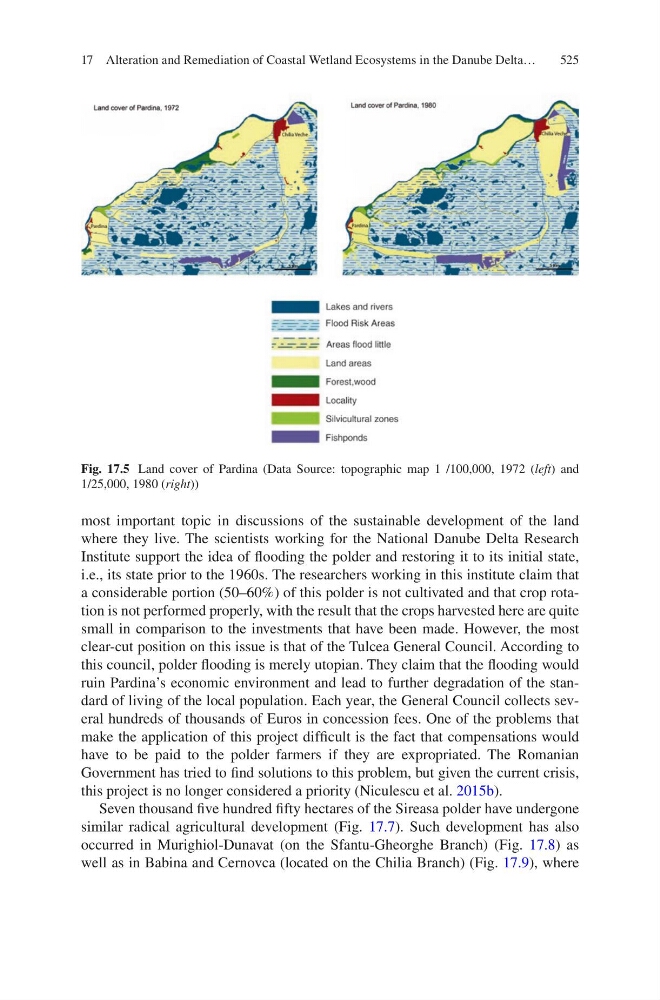
Fig. 17.5 Land cover of Pardina (Data Source: topographic map 1 /100,000, 1972 (left) and
1/25,000, 1980 (right))
17 Alteration and Remediation of Coastal Wetland Ecosystems in the Danube Delta…
most important topic in discussions of the sustainable development of the land
where they live. The scientists working for the National Danube Delta Research
Institute support the idea of flooding the polder and restoring it to its initial state,
i.e., its state prior to the 1960s. The researchers working in this institute claim that
a considerable portion (50–60%) of this polder is not cultivated and that crop rotation is not performed properly, with the result that the crops harvested here are quite
small in comparison to the investments that have been made. However, the most
clear-cut position on this issue is that of the Tulcea General Council. According to
this council, polder flooding is merely utopian. They claim that the flooding would
ruin Pardina’s economic environment and lead to further degradation of the standard of living of the local population. Each year, the General Council collects several hundreds of thousands of Euros in concession fees. One of the problems that
make the application of this project difficult is the fact that compensations would
have to be paid to the polder farmers if they are expropriated. The Romanian
Government has tried to find solutions to this problem, but given the current crisis,
this project is no longer considered a priority (Niculescu et al. 2015b).
Seven thousand five hundred fifty hectares of the Sireasa polder have undergone
similar radical agricultural development (Fig. 17.7). Such development has also
occurred in Murighiol-Dunavat (on the Sfantu-Gheorghe Branch) (Fig. 17.8) as
well as in Babina and Cernovca (located on the Chilia Branch) (Fig. 17.9), where
Fig. 17.5 Land cover of Pardina (Data Source: topographic map 1 /100,000, 1972 (left) and
1/25,000, 1980 (right))
17 Alteration and Remediation of Coastal Wetland Ecosystems in the Danube Delta…