

496
more than 19 tonnes of two commercially important fishes in earlier life stages,
C. acoupa (Fig. 16.11a) and the Gerreidae Eugerres brasilianus (Brazilian
mojarra) (Fig. 16.13f) (Ferreira et al. 2016; Ramos et al. 2016) (Fig. 16.1). All
these species were also found in mangrove tidal creeks near the mouth of the
estuary (April/May 2008), together with another seven commercially important
marine species (Centropomidae, Lutjanidae and Mugilidae) (Ramos et al. 2011).
Larval stages of Sciaenidae, Gerreidae and Centropomidae were also found in
the main channel and mangrove tidal creeks of the Goiana Estuary (Lima et al.
2015, 2016).
Possibly 450–1000 families explore living natural resources from the Goiana
Estuary as a mean of traditional livelihoods (Barletta and Costa 2009). The main
income sources are subsistence fishing of ariid catfishes (C. spixii, C. agassizii and
S. herzbergii – Fig. 16.13a–c); commercial fishing of sciaenids, gerreids, centropomids, lutjanids and mugilids; and exploitation of crabs, prawns, oyster and shellfish
(bivalves Anomalocardia brasiliana and Tagelus plebeius – Fig. 16.13g–h) (Barletta
and Costa 2009). Overexploitation of fish stocks is a problem, especially for the
most profitable catch as lobster (Guebert-Bartholo et al. 2011). Fishing with gillnets
and interaction with plastic debris were considered the most important threat to the
sea turtle populations that feed, mate and nest in the area (Guebert et al. 2013).
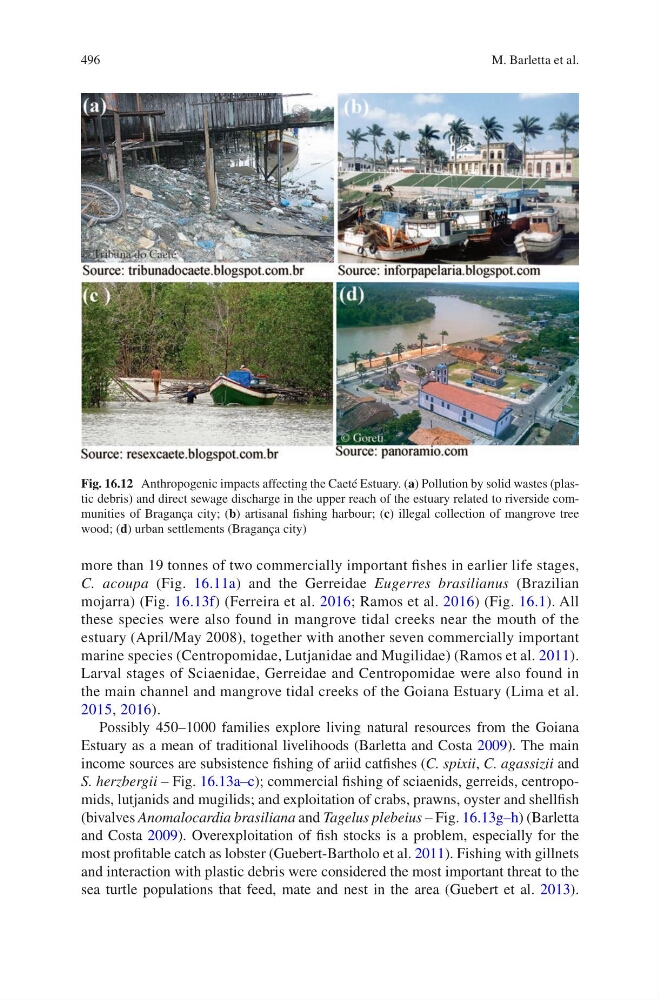
Fig. 16.12 Anthropogenic impacts affecting the Caeté Estuary. (a) Pollution by solid wastes (plastic debris) and direct sewage discharge in the upper reach of the estuary related to riverside communities of Bragança city; (b) artisanal fishing harbour; (c) illegal collection of mangrove tree
wood; (d) urban settlements (Bragança city)
M. Barletta et al.
more than 19 tonnes of two commercially important fishes in earlier life stages,
C. acoupa (Fig. 16.11a) and the Gerreidae Eugerres brasilianus (Brazilian
mojarra) (Fig. 16.13f) (Ferreira et al. 2016; Ramos et al. 2016) (Fig. 16.1). All
these species were also found in mangrove tidal creeks near the mouth of the
estuary (April/May 2008), together with another seven commercially important
marine species (Centropomidae, Lutjanidae and Mugilidae) (Ramos et al. 2011).
Larval stages of Sciaenidae, Gerreidae and Centropomidae were also found in
the main channel and mangrove tidal creeks of the Goiana Estuary (Lima et al.
2015, 2016).
Possibly 450–1000 families explore living natural resources from the Goiana
Estuary as a mean of traditional livelihoods (Barletta and Costa 2009). The main
income sources are subsistence fishing of ariid catfishes (C. spixii, C. agassizii and
S. herzbergii – Fig. 16.13a–c); commercial fishing of sciaenids, gerreids, centropomids, lutjanids and mugilids; and exploitation of crabs, prawns, oyster and shellfish
(bivalves Anomalocardia brasiliana and Tagelus plebeius – Fig. 16.13g–h) (Barletta
and Costa 2009). Overexploitation of fish stocks is a problem, especially for the
most profitable catch as lobster (Guebert-Bartholo et al. 2011). Fishing with gillnets
and interaction with plastic debris were considered the most important threat to the
sea turtle populations that feed, mate and nest in the area (Guebert et al. 2013).
Fig. 16.12 Anthropogenic impacts affecting the Caeté Estuary. (a) Pollution by solid wastes (plastic debris) and direct sewage discharge in the upper reach of the estuary related to riverside communities of Bragança city; (b) artisanal fishing harbour; (c) illegal collection of mangrove tree
wood; (d) urban settlements (Bragança city)
M. Barletta et al.