

349
deltas growing at an average rate of around 12,000 m
3
/a, the remainder being deposited on the ocean bar and, subsequently, as nourishment, onto the ocean beach
(Watterson 2010). The piling foundations of the main road bridge spanning the
entrance channel at Swansea village have been compromised by the channel scour,
necessitating the placement of large volumes of rock scour protection, which
requires frequent maintenance. In accordance with Sect. 10.2.3, it appears that a
revetment constructed to protect the nearby airstrip has attracted the thalweg of the
channel, increasing velocities there. This, along with the three-dimensional flow
induced by the “cross-over” downstream, has induced additional scour and, hence,
a deepening of the channel at that location.
The changes have been progressive over many decades, if not centuries. At Lake
Macquarie, the data indicated that the rate of change may be accelerating. The
acceleration of an unstable scouring mode may be caused by a sea level rise.
However, that the rate may be increasing is predicted by the Escoffier Curve. The
implication is for continued scouring of Swansea Channel. Progressively, this is
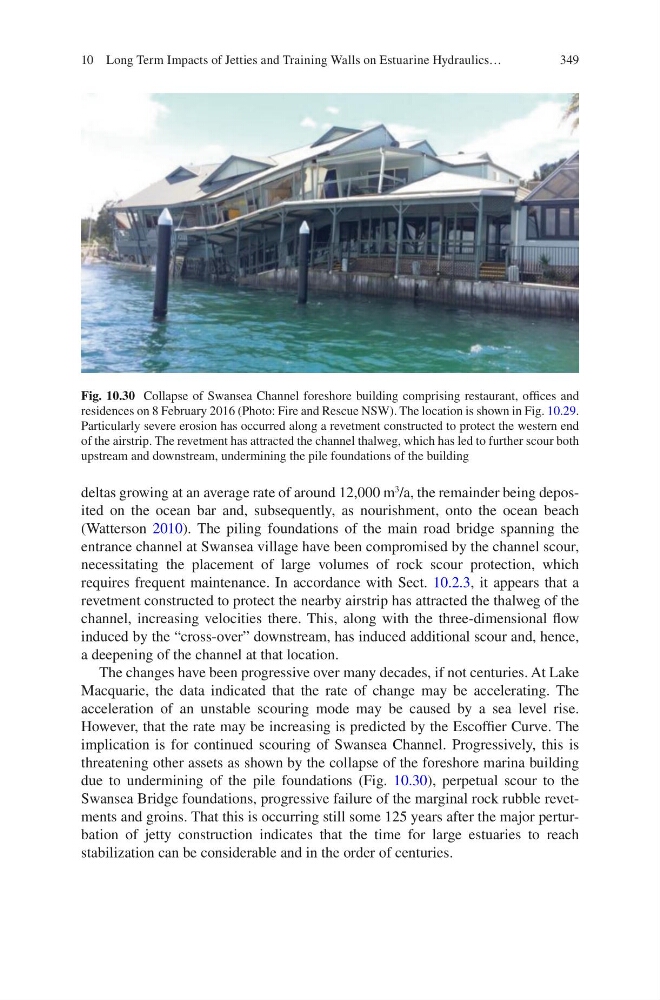
threatening other assets as shown by the collapse of the foreshore marina building
due to undermining of the pile foundations (Fig. 10.30), perpetual scour to the
Swansea Bridge foundations, progressive failure of the marginal rock rubble revetments and groins. That this is occurring still some 125 years after the major perturbation of jetty construction indicates that the time for large estuaries to reach
stabilization can be considerable and in the order of centuries.
Fig. 10.30 Collapse of Swansea Channel foreshore building comprising restaurant, offices and
residences on 8 February 2016 (Photo: Fire and Rescue NSW). The location is shown in Fig. 10.29.
Particularly severe erosion has occurred along a revetment constructed to protect the western end
of the airstrip. The revetment has attracted the channel thalweg, which has led to further scour both
upstream and downstream, undermining the pile foundations of the building
10 Long Term Impacts of Jetties and Training Walls on Estuarine Hydraulics…
deltas growing at an average rate of around 12,000 m
3
/a, the remainder being deposited on the ocean bar and, subsequently, as nourishment, onto the ocean beach
(Watterson 2010). The piling foundations of the main road bridge spanning the
entrance channel at Swansea village have been compromised by the channel scour,
necessitating the placement of large volumes of rock scour protection, which
requires frequent maintenance. In accordance with Sect. 10.2.3, it appears that a
revetment constructed to protect the nearby airstrip has attracted the thalweg of the
channel, increasing velocities there. This, along with the three-dimensional flow
induced by the “cross-over” downstream, has induced additional scour and, hence,
a deepening of the channel at that location.
The changes have been progressive over many decades, if not centuries. At Lake
Macquarie, the data indicated that the rate of change may be accelerating. The
acceleration of an unstable scouring mode may be caused by a sea level rise.
However, that the rate may be increasing is predicted by the Escoffier Curve. The
implication is for continued scouring of Swansea Channel. Progressively, this is
threatening other assets as shown by the collapse of the foreshore marina building
due to undermining of the pile foundations (Fig. 10.30), perpetual scour to the
Swansea Bridge foundations, progressive failure of the marginal rock rubble revetments and groins. That this is occurring still some 125 years after the major perturbation of jetty construction indicates that the time for large estuaries to reach
stabilization can be considerable and in the order of centuries.
Fig. 10.30 Collapse of Swansea Channel foreshore building comprising restaurant, offices and
residences on 8 February 2016 (Photo: Fire and Rescue NSW). The location is shown in Fig. 10.29.
Particularly severe erosion has occurred along a revetment constructed to protect the western end
of the airstrip. The revetment has attracted the channel thalweg, which has led to further scour both
upstream and downstream, undermining the pile foundations of the building
10 Long Term Impacts of Jetties and Training Walls on Estuarine Hydraulics…