

328
that value (van de Kreeke 1992). Escoffier (1940) dismissed any relevance of this
lower root.
Seabergh (2003) discussed approaches other than those using an equilibrium
P E /A E relationship for determining the stable equilibrium condition on the Escoffier
Diagram. Mota Oliviera (1970) proposed that the stable point may be reached when
the Repletion Coefficient reached a value between 0.6 and 0.8. This was based on
calculations that included the consideration of tidal stage with maximum ebb tide
scour velocities, which occurred on low waters rather than on the Keulegan (1967)
assumption of average depth. Another approach of Skou (1990) proposed that the
most optimum situation for an inlet to remain stable was where the cross-sectional
area coincided with the maximum gradient of the Escoffier curve.
When constructing the Escoffier Diagram for a particular estuary the following
approach can be used (after Czerniak 1978):
• a B /a O is calculated from existing data and K is determined from Fig. 10.5
• Equation 10.7 is solved for L c using K and known values of A c , R, T, a O , A B , f,
k en and k ex
• The hydraulic stability curve is computed using Eqs. 10.6 and 10.7 and Fig. 10.5
(for v′ max ) with only A c (and, consequently, R and, hence, f) varying over the
entire range, maintaining the ratio of channel width to depth used in the
calibration.
In Eq. 10.7, four head loss parameters (k en , k ex , f, L c ) are used to describe the total
impedance of the entrance channel to the flow. A typical value for k en + k ex is 1.3
(O’Brien and Dean 1972) with f = 0.02 being adopted for the calibration conditions
adopted herein, thereafter f varying with R as indicated in Eq. 10.9.
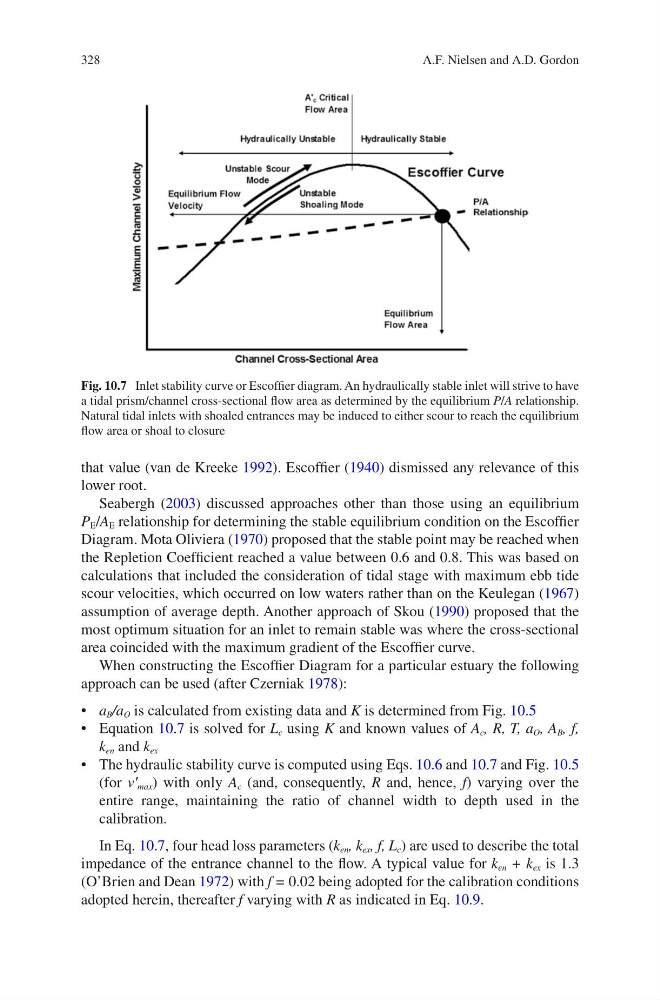
Fig. 10.7 Inlet stability curve or Escoffier diagram. An hydraulically stable inlet will strive to have
a tidal prism/channel cross-sectional flow area as determined by the equilibrium P/A relationship.
Natural tidal inlets with shoaled entrances may be induced to either scour to reach the equilibrium
flow area or shoal to closure
A.F. Nielsen and A.D. Gordon
that value (van de Kreeke 1992). Escoffier (1940) dismissed any relevance of this
lower root.
Seabergh (2003) discussed approaches other than those using an equilibrium
P E /A E relationship for determining the stable equilibrium condition on the Escoffier
Diagram. Mota Oliviera (1970) proposed that the stable point may be reached when
the Repletion Coefficient reached a value between 0.6 and 0.8. This was based on
calculations that included the consideration of tidal stage with maximum ebb tide
scour velocities, which occurred on low waters rather than on the Keulegan (1967)
assumption of average depth. Another approach of Skou (1990) proposed that the
most optimum situation for an inlet to remain stable was where the cross-sectional
area coincided with the maximum gradient of the Escoffier curve.
When constructing the Escoffier Diagram for a particular estuary the following
approach can be used (after Czerniak 1978):
• a B /a O is calculated from existing data and K is determined from Fig. 10.5
• Equation 10.7 is solved for L c using K and known values of A c , R, T, a O , A B , f,
k en and k ex
• The hydraulic stability curve is computed using Eqs. 10.6 and 10.7 and Fig. 10.5
(for v′ max ) with only A c (and, consequently, R and, hence, f) varying over the
entire range, maintaining the ratio of channel width to depth used in the
calibration.
In Eq. 10.7, four head loss parameters (k en , k ex , f, L c ) are used to describe the total
impedance of the entrance channel to the flow. A typical value for k en + k ex is 1.3
(O’Brien and Dean 1972) with f = 0.02 being adopted for the calibration conditions
adopted herein, thereafter f varying with R as indicated in Eq. 10.9.
Fig. 10.7 Inlet stability curve or Escoffier diagram. An hydraulically stable inlet will strive to have
a tidal prism/channel cross-sectional flow area as determined by the equilibrium P/A relationship.
Natural tidal inlets with shoaled entrances may be induced to either scour to reach the equilibrium
flow area or shoal to closure
A.F. Nielsen and A.D. Gordon