

326
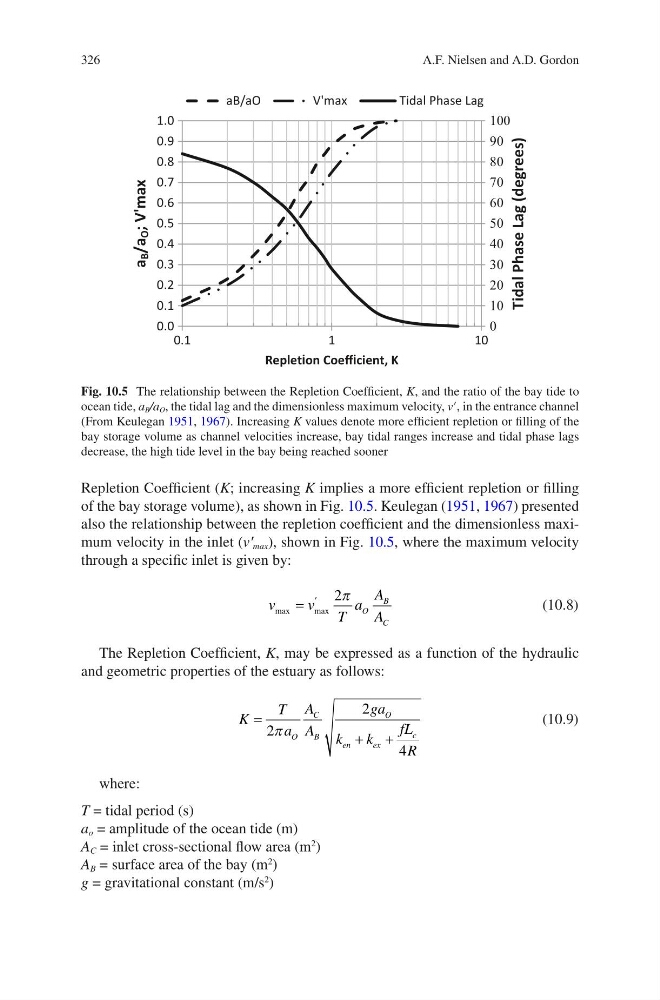
Repletion Coefficient (K; increasing K implies a more efficient repletion or filling
of the bay storage volume), as shown in Fig. 10.5. Keulegan (1951, 1967) presented
also the relationship between the repletion coefficient and the dimensionless maximum velocity in the inlet (v′ max ), shown in Fig. 10.5, where the maximum velocity
through a specific inlet is given by:
v
v
T
a
A
A
O
B
C
max
m ax
=
′
2π
(10.8)
The Repletion Coefficient, K, may be expressed as a function of the hydraulic
and geometric properties of the estuary as follows:
K
T
a
A
A
ga
k
k
fL
R
O
C
B
O
en
ex
c
=
+ +
2
2
4
π
(10.9)
where:
T = tidal period (s)
a o = amplitude of the ocean tide (m)
A C = inlet cross-sectional flow area (m
2
)
A B = surface area of the bay (m
2
)
g = gravitational constant (m/s
2
)
0
10
20
30
40
50
60
70
80
90
100
0.0
0.1
0.2
0.3
0.4
0.5
0.6
0.7
0.8
0.9
1.0
0.1
1
1 0
Tidal Phase Lag (degrees)
a
B /a
O ; V'max
Replet¶on Coeff¶cient, K
aB/aO
V'max
Tidal Phase Lag
Fig. 10.5 The relationship between the Repletion Coefficient, K, and the ratio of the bay tide to
ocean tide, a B /a O , the tidal lag and the dimensionless maximum velocity, v′, in the entrance channel
(From Keulegan 1951, 1967). Increasing K values denote more efficient repletion or filling of the
bay storage volume as channel velocities increase, bay tidal ranges increase and tidal phase lags
decrease, the high tide level in the bay being reached sooner
A.F. Nielsen and A.D. Gordon
Repletion Coefficient (K; increasing K implies a more efficient repletion or filling
of the bay storage volume), as shown in Fig. 10.5. Keulegan (1951, 1967) presented
also the relationship between the repletion coefficient and the dimensionless maximum velocity in the inlet (v′ max ), shown in Fig. 10.5, where the maximum velocity
through a specific inlet is given by:
v
v
T
a
A
A
O
B
C
max
m ax
=
′
2π
(10.8)
The Repletion Coefficient, K, may be expressed as a function of the hydraulic
and geometric properties of the estuary as follows:
K
T
a
A
A
ga
k
k
fL
R
O
C
B
O
en
ex
c
=
+ +
2
2
4
π
(10.9)
where:
T = tidal period (s)
a o = amplitude of the ocean tide (m)
A C = inlet cross-sectional flow area (m
2
)
A B = surface area of the bay (m
2
)
g = gravitational constant (m/s
2
)
0
10
20
30
40
50
60
70
80
90
100
0.0
0.1
0.2
0.3
0.4
0.5
0.6
0.7
0.8
0.9
1.0
0.1
1
1 0
Tidal Phase Lag (degrees)
a
B /a
O ; V'max
Replet¶on Coeff¶cient, K
aB/aO
V'max
Tidal Phase Lag
Fig. 10.5 The relationship between the Repletion Coefficient, K, and the ratio of the bay tide to
ocean tide, a B /a O , the tidal lag and the dimensionless maximum velocity, v′, in the entrance channel
(From Keulegan 1951, 1967). Increasing K values denote more efficient repletion or filling of the
bay storage volume as channel velocities increase, bay tidal ranges increase and tidal phase lags
decrease, the high tide level in the bay being reached sooner
A.F. Nielsen and A.D. Gordon