

313
9.6 Conclusions
Based on the results obtained, it can be concluded that the associated littoral bar to
the coastal wetland “Mallorquín Lagoon” is in dynamic equilibrium. It should be
noted that any change in the marine dynamics will produce drastic changes in the
behaviour of the wetland, reducing the width of the bar and perhaps its total loss.
From the hydrodynamics perspective, it is clear that the lack of sediment in the
system, whose contribution rate varies depending on season weather conditions.
There is a gain during the dry season and a reduction of the sedimentary contribution during the humid season by the change in wave direction.
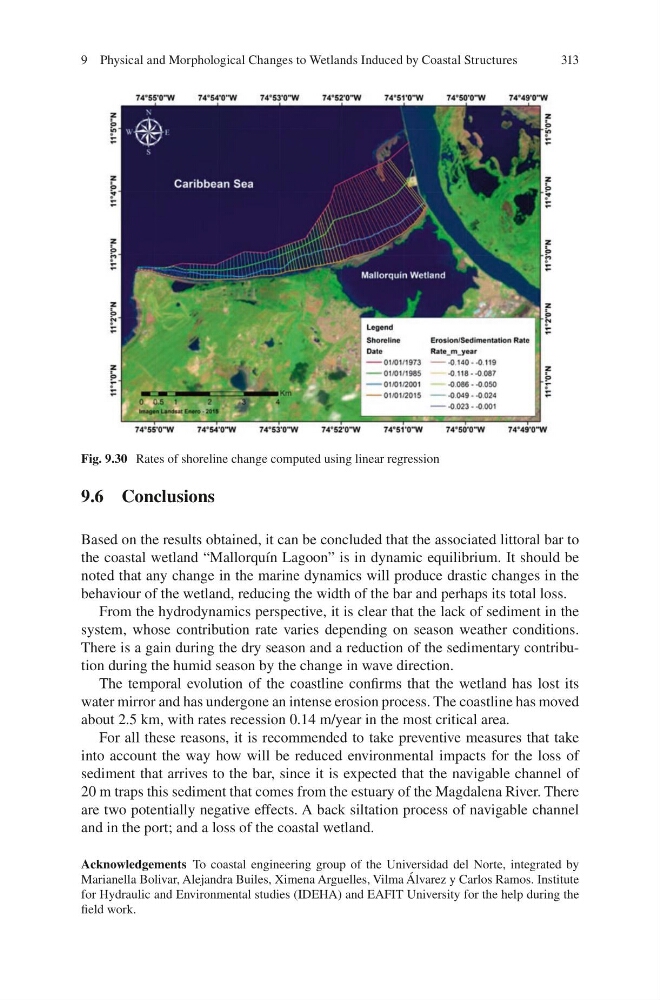
The temporal evolution of the coastline confirms that the wetland has lost its
water mirror and has undergone an intense erosion process. The coastline has moved
about 2.5 km, with rates recession 0.14 m/year in the most critical area.
For all these reasons, it is recommended to take preventive measures that take
into account the way how will be reduced environmental impacts for the loss of
sediment that arrives to the bar, since it is expected that the navigable channel of
20 m traps this sediment that comes from the estuary of the Magdalena River. There
are two potentially negative effects. A back siltation process of navigable channel
and in the port; and a loss of the coastal wetland.
Acknowledgements To coastal engineering group of the Universidad del Norte, integrated by
Marianella Bolivar, Alejandra Builes, Ximena Arguelles, Vilma Álvarez y Carlos Ramos. Institute
for Hydraulic and Environmental studies (IDEHA) and EAFIT University for the help during the
field work.
Fig. 9.30 Rates of shoreline change computed using linear regression
9 Physical and Morphological Changes to Wetlands Induced by Coastal Structures
9.6 Conclusions
Based on the results obtained, it can be concluded that the associated littoral bar to
the coastal wetland “Mallorquín Lagoon” is in dynamic equilibrium. It should be
noted that any change in the marine dynamics will produce drastic changes in the
behaviour of the wetland, reducing the width of the bar and perhaps its total loss.
From the hydrodynamics perspective, it is clear that the lack of sediment in the
system, whose contribution rate varies depending on season weather conditions.
There is a gain during the dry season and a reduction of the sedimentary contribution during the humid season by the change in wave direction.
The temporal evolution of the coastline confirms that the wetland has lost its
water mirror and has undergone an intense erosion process. The coastline has moved
about 2.5 km, with rates recession 0.14 m/year in the most critical area.
For all these reasons, it is recommended to take preventive measures that take
into account the way how will be reduced environmental impacts for the loss of
sediment that arrives to the bar, since it is expected that the navigable channel of
20 m traps this sediment that comes from the estuary of the Magdalena River. There
are two potentially negative effects. A back siltation process of navigable channel
and in the port; and a loss of the coastal wetland.
Acknowledgements To coastal engineering group of the Universidad del Norte, integrated by
Marianella Bolivar, Alejandra Builes, Ximena Arguelles, Vilma Álvarez y Carlos Ramos. Institute
for Hydraulic and Environmental studies (IDEHA) and EAFIT University for the help during the
field work.
Fig. 9.30 Rates of shoreline change computed using linear regression
9 Physical and Morphological Changes to Wetlands Induced by Coastal Structures