

282
nal agents (natural element), phenomena (forcings), and processes (effect) correlate qualitatively within the natural environment.
Black-box Testing. It is the most generalist approach since it only allows making a
description of more relevant elements of the system from a physical
perspective.
Grey-box Testing. This analysis is the most detailed of all because within the qualitative description, it allows to identify the elements contained not only in general
but in every littoral cell or subsystem and so establishing physical relations
between the natural variables.
In virtue of the aforementioned, we have selected the gray-box testing for the
analysis of the Mallorquín lagoon, where it allows to identify not only of in a general manner but also the elements contained within subsystems (subcells) or littoral
cells that compose it, with the purpose to understand the relations between natural
variables and physical processes that are part of the wetland dynamic. The process
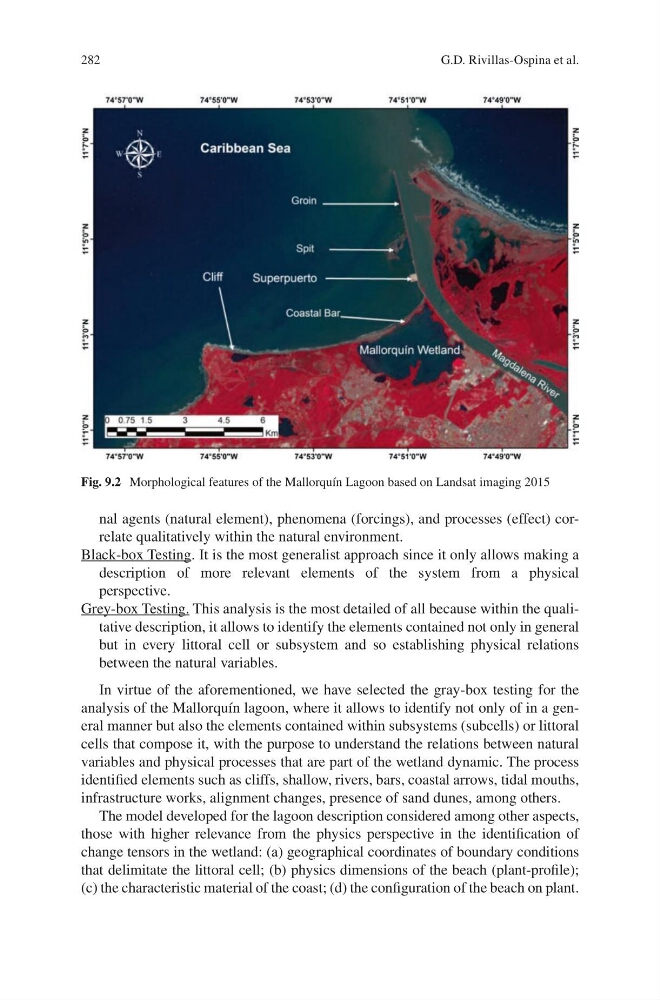
identified elements such as cliffs, shallow, rivers, bars, coastal arrows, tidal mouths,
infrastructure works, alignment changes, presence of sand dunes, among others.
The model developed for the lagoon description considered among other aspects,
those with higher relevance from the physics perspective in the identification of
change tensors in the wetland: (a) geographical coordinates of boundary conditions
that delimitate the littoral cell; (b) physics dimensions of the beach (plant-profile);
(c) the characteristic material of the coast; (d) the configuration of the beach on plant.
Fig. 9.2 Morphological features of the Mallorquín Lagoon based on Landsat imaging 2015
G.D. Rivillas-Ospina et al.
nal agents (natural element), phenomena (forcings), and processes (effect) correlate qualitatively within the natural environment.
Black-box Testing. It is the most generalist approach since it only allows making a
description of more relevant elements of the system from a physical
perspective.
Grey-box Testing. This analysis is the most detailed of all because within the qualitative description, it allows to identify the elements contained not only in general
but in every littoral cell or subsystem and so establishing physical relations
between the natural variables.
In virtue of the aforementioned, we have selected the gray-box testing for the
analysis of the Mallorquín lagoon, where it allows to identify not only of in a general manner but also the elements contained within subsystems (subcells) or littoral
cells that compose it, with the purpose to understand the relations between natural
variables and physical processes that are part of the wetland dynamic. The process
identified elements such as cliffs, shallow, rivers, bars, coastal arrows, tidal mouths,
infrastructure works, alignment changes, presence of sand dunes, among others.
The model developed for the lagoon description considered among other aspects,
those with higher relevance from the physics perspective in the identification of
change tensors in the wetland: (a) geographical coordinates of boundary conditions
that delimitate the littoral cell; (b) physics dimensions of the beach (plant-profile);
(c) the characteristic material of the coast; (d) the configuration of the beach on plant.
Fig. 9.2 Morphological features of the Mallorquín Lagoon based on Landsat imaging 2015
G.D. Rivillas-Ospina et al.