

281
coastal protection work (Fig. 9.2). The coastal spit behaviour is very dynamic,
increasing its size during the dry season and inversely, it loses materials during the
winter season when the waves has a high energetic content.
Analyzing the shoreline lagoon, it can be observed that it is part of a strip of sediments that flows parallel to the coast from river mouth (“Bocas de Ceniza”). The
waves overcomes the coastal protection and sediment is transported by the diffraction to the coastal spit and subsequently, to the beach. Therefore, the morphological
configuration of the bar is function of diffracted and refracted waves that travel in a
submarine platform relatively low.
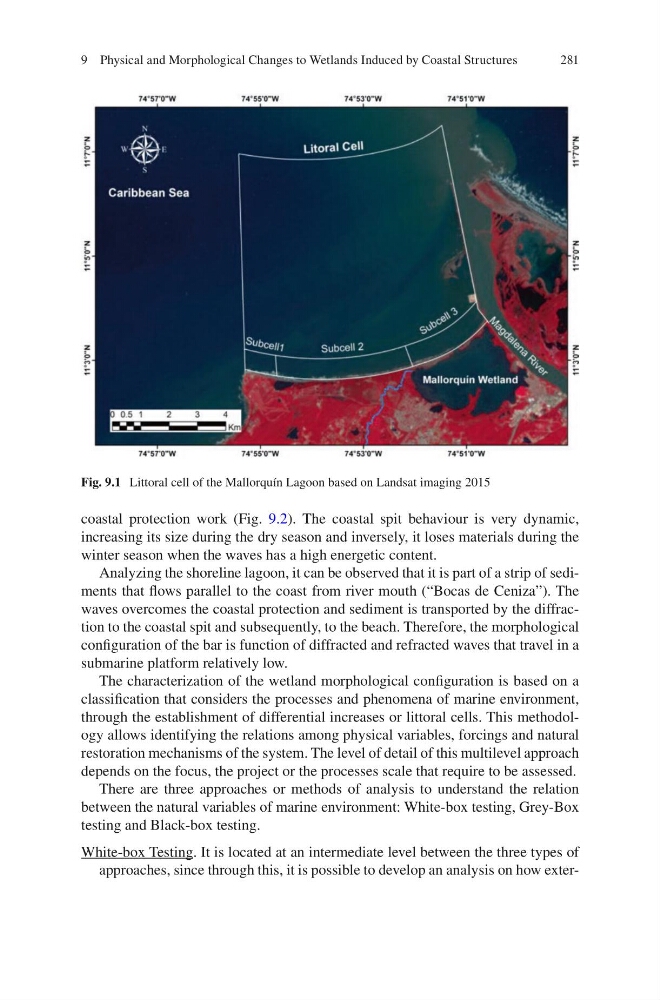
The characterization of the wetland morphological configuration is based on a
classification that considers the processes and phenomena of marine environment,
through the establishment of differential increases or littoral cells. This methodology allows identifying the relations among physical variables, forcings and natural
restoration mechanisms of the system. The level of detail of this multilevel approach
depends on the focus, the project or the processes scale that require to be assessed.
There are three approaches or methods of analysis to understand the relation
between the natural variables of marine environment: White-box testing, Grey-Box
testing and Black-box testing.
White-box Testing. It is located at an intermediate level between the three types of
approaches, since through this, it is possible to develop an analysis on how exterFig. 9.1 Littoral cell of the Mallorquín Lagoon based on Landsat imaging 2015
9 Physical and Morphological Changes to Wetlands Induced by Coastal Structures
coastal protection work (Fig. 9.2). The coastal spit behaviour is very dynamic,
increasing its size during the dry season and inversely, it loses materials during the
winter season when the waves has a high energetic content.
Analyzing the shoreline lagoon, it can be observed that it is part of a strip of sediments that flows parallel to the coast from river mouth (“Bocas de Ceniza”). The
waves overcomes the coastal protection and sediment is transported by the diffraction to the coastal spit and subsequently, to the beach. Therefore, the morphological
configuration of the bar is function of diffracted and refracted waves that travel in a
submarine platform relatively low.
The characterization of the wetland morphological configuration is based on a
classification that considers the processes and phenomena of marine environment,
through the establishment of differential increases or littoral cells. This methodology allows identifying the relations among physical variables, forcings and natural
restoration mechanisms of the system. The level of detail of this multilevel approach
depends on the focus, the project or the processes scale that require to be assessed.
There are three approaches or methods of analysis to understand the relation
between the natural variables of marine environment: White-box testing, Grey-Box
testing and Black-box testing.
White-box Testing. It is located at an intermediate level between the three types of
approaches, since through this, it is possible to develop an analysis on how exterFig. 9.1 Littoral cell of the Mallorquín Lagoon based on Landsat imaging 2015
9 Physical and Morphological Changes to Wetlands Induced by Coastal Structures