

263
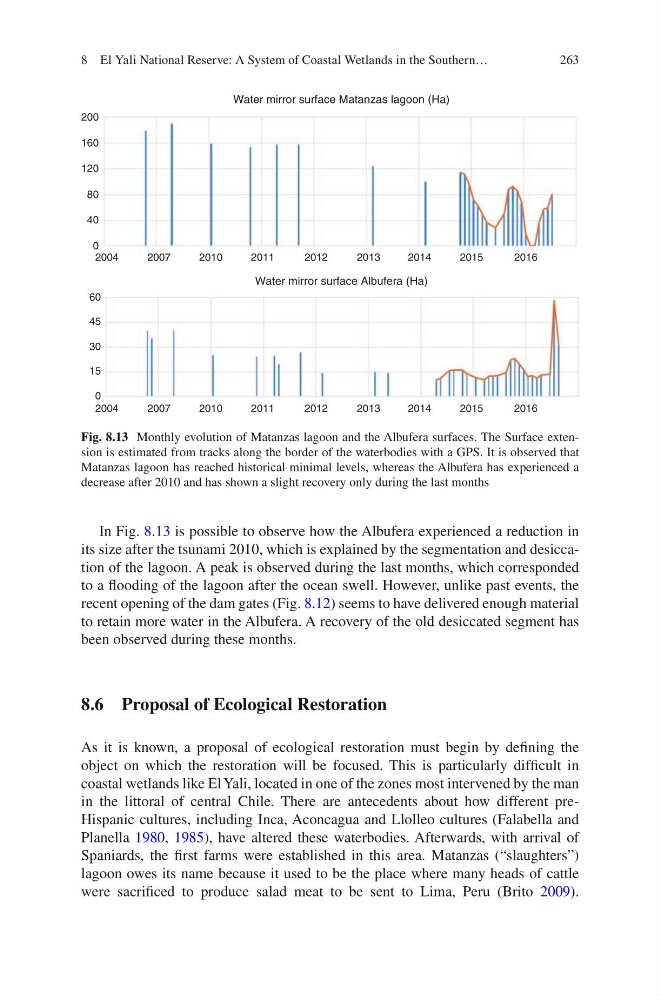
In Fig. 8.13 is possible to observe how the Albufera experienced a reduction in
its size after the tsunami 2010, which is explained by the segmentation and desiccation of the lagoon. A peak is observed during the last months, which corresponded
to a flooding of the lagoon after the ocean swell. However, unlike past events, the
recent opening of the dam gates (Fig. 8.12) seems to have delivered enough material
to retain more water in the Albufera. A recovery of the old desiccated segment has
been observed during these months.
8.6 Proposal of Ecological Restoration
As it is known, a proposal of ecological restoration must begin by defining the
object on which the restoration will be focused. This is particularly difficult in
coastal wetlands like El Yali, located in one of the zones most intervened by the man
in the littoral of central Chile. There are antecedents about how different preHispanic cultures, including Inca, Aconcagua and Llolleo cultures (Falabella and
Planella 1980, 1985), have altered these waterbodies. Afterwards, with arrival of
Spaniards, the first farms were established in this area. Matanzas (“slaughters”)
lagoon owes its name because it used to be the place where many heads of cattle
were sacrificed to produce salad meat to be sent to Lima, Peru (Brito 2009).
Water mirror surface Matanzas lagoon (Ha)
Water mirror surface Albufera (Ha)
200
160
120
80
40
0
0
15
30
45
60
2004
2007
2010
2011
2012
2013
2014
2015
2016
2004
2007
2010
2011
2012
2013
2014
2015
2016
Fig. 8.13 Monthly evolution of Matanzas lagoon and the Albufera surfaces. The Surface extension is estimated from tracks along the border of the waterbodies with a GPS. It is observed that
Matanzas lagoon has reached historical minimal levels, whereas the Albufera has experienced a
decrease after 2010 and has shown a slight recovery only during the last months
8 El Yali National Reserve: A System of Coastal Wetlands in the Southern…
In Fig. 8.13 is possible to observe how the Albufera experienced a reduction in
its size after the tsunami 2010, which is explained by the segmentation and desiccation of the lagoon. A peak is observed during the last months, which corresponded
to a flooding of the lagoon after the ocean swell. However, unlike past events, the
recent opening of the dam gates (Fig. 8.12) seems to have delivered enough material
to retain more water in the Albufera. A recovery of the old desiccated segment has
been observed during these months.
8.6 Proposal of Ecological Restoration
As it is known, a proposal of ecological restoration must begin by defining the
object on which the restoration will be focused. This is particularly difficult in
coastal wetlands like El Yali, located in one of the zones most intervened by the man
in the littoral of central Chile. There are antecedents about how different preHispanic cultures, including Inca, Aconcagua and Llolleo cultures (Falabella and
Planella 1980, 1985), have altered these waterbodies. Afterwards, with arrival of
Spaniards, the first farms were established in this area. Matanzas (“slaughters”)
lagoon owes its name because it used to be the place where many heads of cattle
were sacrificed to produce salad meat to be sent to Lima, Peru (Brito 2009).
Water mirror surface Matanzas lagoon (Ha)
Water mirror surface Albufera (Ha)
200
160
120
80
40
0
0
15
30
45
60
2004
2007
2010
2011
2012
2013
2014
2015
2016
2004
2007
2010
2011
2012
2013
2014
2015
2016
Fig. 8.13 Monthly evolution of Matanzas lagoon and the Albufera surfaces. The Surface extension is estimated from tracks along the border of the waterbodies with a GPS. It is observed that
Matanzas lagoon has reached historical minimal levels, whereas the Albufera has experienced a
decrease after 2010 and has shown a slight recovery only during the last months
8 El Yali National Reserve: A System of Coastal Wetlands in the Southern…