

227
tolerate high Cu concentrations due to its capacity to accumulate the metal in its
roots and effectively prevent its translocation to photosynthetic tissues (Cambrollé
et al. 2013).
Finally, it has been suggested that Atriplex halimus L. may be useful in the restoration of Cu-polluted areas (Mateos-Naranjo et al. 2013), and it has been found
that its stem cuttings are able to survive, root and grow at concentrations up to
9 mmol l
−1
under greenhouse conditions (Mancilla-Leytón et al. 2016). In this
sense, A. halimus could be also considered to be implemented in restoration projects
in metal-polluted soils.
7.4 Dealing with the Case of Spartina densiflora in the Odiel
Marshes: Between Invader and Phytoremediator
The dense-flowered alien cordgrass S. densiflora was unintentionally introduced to
the Gulf of Cádiz (SW Spain) probably in the sixteenth century from South America,
where it is a salt-marsh dominant of wide latitudinal range (Nieva and Luque 1996).
In Europe, this species has extended its range into the Mediterranean and into
Portuguese marshes (Castillo et al. 2000). Odiel Marshes are extensively invaded by
this species, where it has colonized a wide range of habitats including dunes, high
marsh and levees, salt pans, and intertidal flats, where it has competitively displaced
most of the native halophytes, getting into contact with the indigenous low-marsh
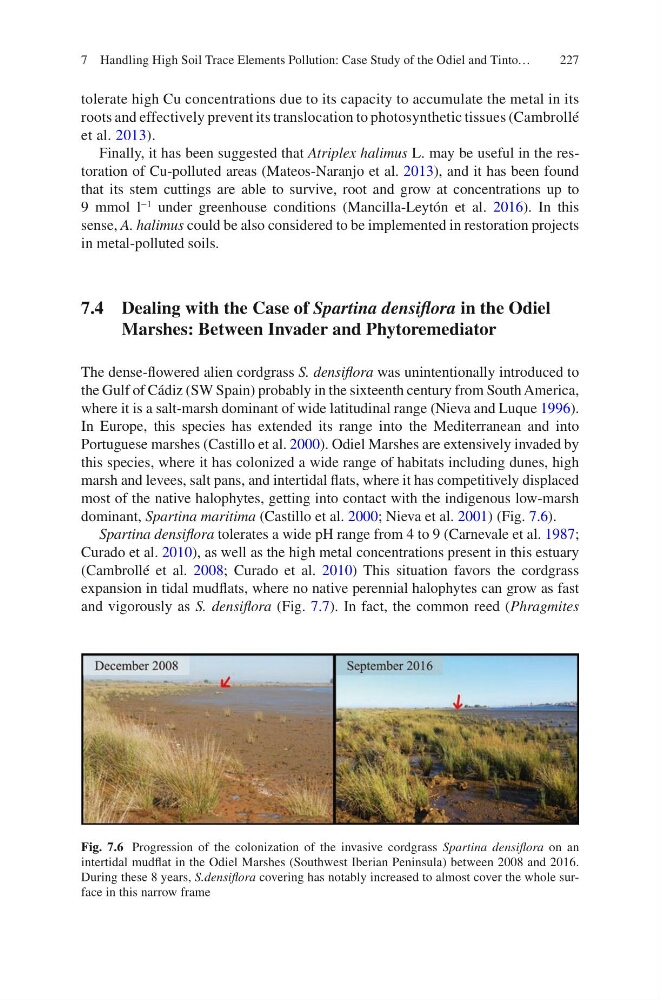
dominant, Spartina maritima (Castillo et al. 2000; Nieva et al. 2001) (Fig. 7.6).
Spartina densiflora tolerates a wide pH range from 4 to 9 (Carnevale et al. 1987;
Curado et al. 2010), as well as the high metal concentrations present in this estuary
(Cambrollé et al. 2008; Curado et al. 2010) This situation favors the cordgrass
expansion in tidal mudflats, where no native perennial halophytes can grow as fast
and vigorously as S. densiflora (Fig. 7.7). In fact, the common reed (Phragmites
Fig. 7.6 Progression of the colonization of the invasive cordgrass Spartina densiflora on an
intertidal mudflat in the Odiel Marshes (Southwest Iberian Peninsula) between 2008 and 2016.
During these 8 years, S.densiflora covering has notably increased to almost cover the whole surface in this narrow frame
7 Handling High Soil Trace Elements Pollution: Case Study of the Odiel and Tinto…
tolerate high Cu concentrations due to its capacity to accumulate the metal in its
roots and effectively prevent its translocation to photosynthetic tissues (Cambrollé
et al. 2013).
Finally, it has been suggested that Atriplex halimus L. may be useful in the restoration of Cu-polluted areas (Mateos-Naranjo et al. 2013), and it has been found
that its stem cuttings are able to survive, root and grow at concentrations up to
9 mmol l
−1
under greenhouse conditions (Mancilla-Leytón et al. 2016). In this
sense, A. halimus could be also considered to be implemented in restoration projects
in metal-polluted soils.
7.4 Dealing with the Case of Spartina densiflora in the Odiel
Marshes: Between Invader and Phytoremediator
The dense-flowered alien cordgrass S. densiflora was unintentionally introduced to
the Gulf of Cádiz (SW Spain) probably in the sixteenth century from South America,
where it is a salt-marsh dominant of wide latitudinal range (Nieva and Luque 1996).
In Europe, this species has extended its range into the Mediterranean and into
Portuguese marshes (Castillo et al. 2000). Odiel Marshes are extensively invaded by
this species, where it has colonized a wide range of habitats including dunes, high
marsh and levees, salt pans, and intertidal flats, where it has competitively displaced
most of the native halophytes, getting into contact with the indigenous low-marsh
dominant, Spartina maritima (Castillo et al. 2000; Nieva et al. 2001) (Fig. 7.6).
Spartina densiflora tolerates a wide pH range from 4 to 9 (Carnevale et al. 1987;
Curado et al. 2010), as well as the high metal concentrations present in this estuary
(Cambrollé et al. 2008; Curado et al. 2010) This situation favors the cordgrass
expansion in tidal mudflats, where no native perennial halophytes can grow as fast
and vigorously as S. densiflora (Fig. 7.7). In fact, the common reed (Phragmites
Fig. 7.6 Progression of the colonization of the invasive cordgrass Spartina densiflora on an
intertidal mudflat in the Odiel Marshes (Southwest Iberian Peninsula) between 2008 and 2016.
During these 8 years, S.densiflora covering has notably increased to almost cover the whole surface in this narrow frame
7 Handling High Soil Trace Elements Pollution: Case Study of the Odiel and Tinto…