

220
Despite this situation, these marshes have merit their protection under different
figures and levels, particularly due to their interest for birds conservation. They are
protected as Natural Park (Paraje Natural; 1984), with two areas where spoonbills
(Platalea leucorodia) nest (Isla de Enmedio and Marisma del Burro) declared
Singular Natural Reserves (Reservas Naturales). The Odiel Marshes have been
declared Natural Reserve of the Biosphere by UNESCO (1983), and they are
included in the European Natura 2000 Network as SCI (Site of Community Interest;
2016) and SPA (Special Protection Area for Birds; 1987), and proposed for EU
Special Area of Conservation (SAC). Odiel Marshes are considered a site of international importance for migratory waders through the East Atlantic flyway (Sánchez
et al. 2006), and they are catalogued as Wetland of International Importance (Ramsar
Convention 1989). In this area, a totality of 11 EU habitats of interest (Habitat
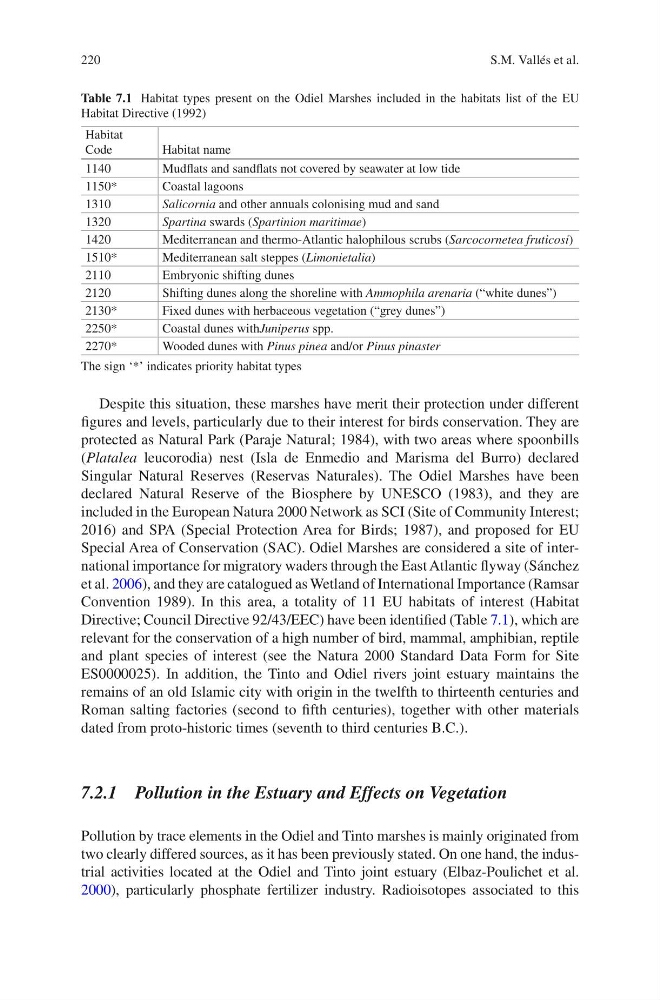
Directive; Council Directive 92/43/EEC) have been identified (Table 7.1), which are
relevant for the conservation of a high number of bird, mammal, amphibian, reptile
and plant species of interest (see the Natura 2000 Standard Data Form for Site
ES0000025). In addition, the Tinto and Odiel rivers joint estuary maintains the
remains of an old Islamic city with origin in the twelfth to thirteenth centuries and
Roman salting factories (second to fifth centuries), together with other materials
dated from proto-historic times (seventh to third centuries B.C.).
7.2.1 Pollution in the Estuary and Effects on Vegetation
Pollution by trace elements in the Odiel and Tinto marshes is mainly originated from
two clearly differed sources, as it has been previously stated. On one hand, the industrial activities located at the Odiel and Tinto joint estuary (Elbaz-Poulichet et al.
2000), particularly phosphate fertilizer industry. Radioisotopes associated to this
Table 7.1 Habitat types present on the Odiel Marshes included in the habitats list of the EU
Habitat Directive (1992)
Habitat
Code
Habitat name
1140
Mudflats and sandflats not covered by seawater at low tide
1150*
Coastal lagoons
1310
Salicornia and other annuals colonising mud and sand
1320
Spartina swards (Spartinion maritimae)
1420
Mediterranean and thermo-Atlantic halophilous scrubs (Sarcocornetea fruticosi)
1510*
Mediterranean salt steppes (Limonietalia)
2110
Embryonic shifting dunes
2120
Shifting dunes along the shoreline with Ammophila arenaria (“white dunes”)
2130*
Fixed dunes with herbaceous vegetation (“grey dunes”)
2250*
Coastal dunes withJuniperus spp.
2270*
Wooded dunes with Pinus pinea and/or Pinus pinaster
The sign ‘*’ indicates priority habitat types
S.M. Vallés et al.
Despite this situation, these marshes have merit their protection under different
figures and levels, particularly due to their interest for birds conservation. They are
protected as Natural Park (Paraje Natural; 1984), with two areas where spoonbills
(Platalea leucorodia) nest (Isla de Enmedio and Marisma del Burro) declared
Singular Natural Reserves (Reservas Naturales). The Odiel Marshes have been
declared Natural Reserve of the Biosphere by UNESCO (1983), and they are
included in the European Natura 2000 Network as SCI (Site of Community Interest;
2016) and SPA (Special Protection Area for Birds; 1987), and proposed for EU
Special Area of Conservation (SAC). Odiel Marshes are considered a site of international importance for migratory waders through the East Atlantic flyway (Sánchez
et al. 2006), and they are catalogued as Wetland of International Importance (Ramsar
Convention 1989). In this area, a totality of 11 EU habitats of interest (Habitat
Directive; Council Directive 92/43/EEC) have been identified (Table 7.1), which are
relevant for the conservation of a high number of bird, mammal, amphibian, reptile
and plant species of interest (see the Natura 2000 Standard Data Form for Site
ES0000025). In addition, the Tinto and Odiel rivers joint estuary maintains the
remains of an old Islamic city with origin in the twelfth to thirteenth centuries and
Roman salting factories (second to fifth centuries), together with other materials
dated from proto-historic times (seventh to third centuries B.C.).
7.2.1 Pollution in the Estuary and Effects on Vegetation
Pollution by trace elements in the Odiel and Tinto marshes is mainly originated from
two clearly differed sources, as it has been previously stated. On one hand, the industrial activities located at the Odiel and Tinto joint estuary (Elbaz-Poulichet et al.
2000), particularly phosphate fertilizer industry. Radioisotopes associated to this
Table 7.1 Habitat types present on the Odiel Marshes included in the habitats list of the EU
Habitat Directive (1992)
Habitat
Code
Habitat name
1140
Mudflats and sandflats not covered by seawater at low tide
1150*
Coastal lagoons
1310
Salicornia and other annuals colonising mud and sand
1320
Spartina swards (Spartinion maritimae)
1420
Mediterranean and thermo-Atlantic halophilous scrubs (Sarcocornetea fruticosi)
1510*
Mediterranean salt steppes (Limonietalia)
2110
Embryonic shifting dunes
2120
Shifting dunes along the shoreline with Ammophila arenaria (“white dunes”)
2130*
Fixed dunes with herbaceous vegetation (“grey dunes”)
2250*
Coastal dunes withJuniperus spp.
2270*
Wooded dunes with Pinus pinea and/or Pinus pinaster
The sign ‘*’ indicates priority habitat types
S.M. Vallés et al.