

194
6.5.1 Changes of Coastal Ecosystem and Biodiversity
The salinity investigation results shows that the south west Bengal coastal regions
are carrying the highest rate of water salinity which is unbalancing the coastal ecosystem and ecologies. According to salinity approximation this high rate is harmful
to for urban biodiversity as well as for urban drinking water (Fig. 6.3). The Fig. 6.4
demonstrates the water salinity intrusion trends in the south west region of the
Ganges deltaic region, where four major cities and 136 small towns are located in
the coastal region in Bangladesh. All most all the towns are effected through salinity
intrusion and sea level rise impacts in the region. Therefore, the investigation result
of salinity modelling in the South west coastal deltaic regions are under threat for
ecosystems and coastal urban ecosystem goods and services. The coastal mangrove
and agro biodiversity loss is a common scenario in the Ganges-BrahmaputraMeghna Rivers deltaic region between Bangladesh and India (Chowdhury and
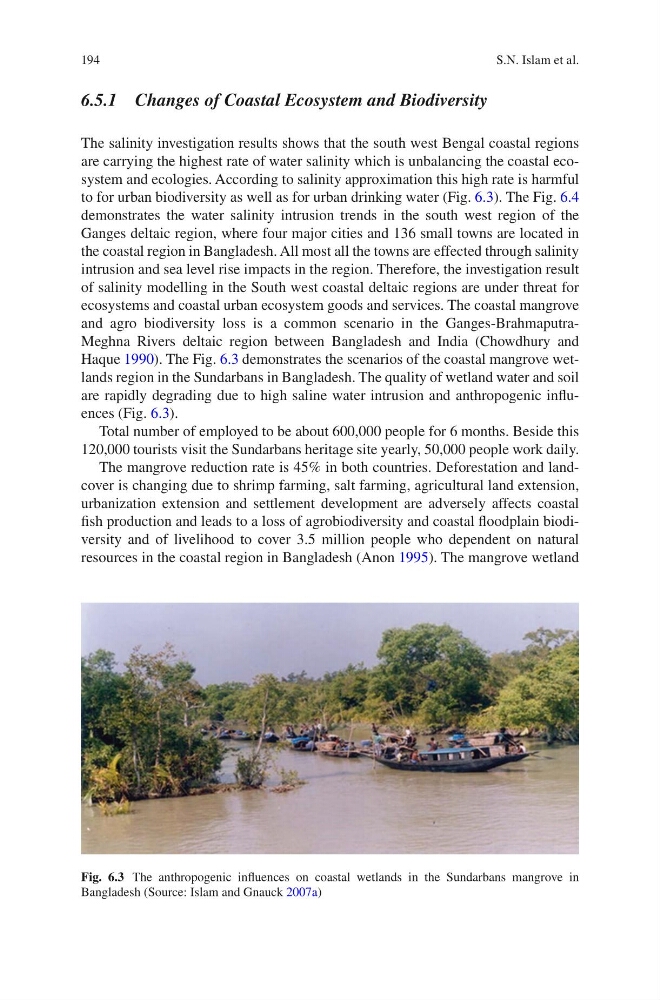
Haque 1990). The Fig. 6.3 demonstrates the scenarios of the coastal mangrove wetlands region in the Sundarbans in Bangladesh. The quality of wetland water and soil
are rapidly degrading due to high saline water intrusion and anthropogenic influences (Fig. 6.3).
Total number of employed to be about 600,000 people for 6 months. Beside this
120,000 tourists visit the Sundarbans heritage site yearly, 50,000 people work daily.
The mangrove reduction rate is 45% in both countries. Deforestation and landcover is changing due to shrimp farming, salt farming, agricultural land extension,
urbanization extension and settlement development are adversely affects coastal
fish production and leads to a loss of agrobiodiversity and coastal floodplain biodiversity and of livelihood to cover 3.5 million people who dependent on natural
resources in the coastal region in Bangladesh (Anon 1995). The mangrove wetland
Fig. 6.3 The anthropogenic influences on coastal wetlands in the Sundarbans mangrove in
Bangladesh (Source: Islam and Gnauck 2007a)
S.N. Islam et al.
6.5.1 Changes of Coastal Ecosystem and Biodiversity
The salinity investigation results shows that the south west Bengal coastal regions
are carrying the highest rate of water salinity which is unbalancing the coastal ecosystem and ecologies. According to salinity approximation this high rate is harmful
to for urban biodiversity as well as for urban drinking water (Fig. 6.3). The Fig. 6.4
demonstrates the water salinity intrusion trends in the south west region of the
Ganges deltaic region, where four major cities and 136 small towns are located in
the coastal region in Bangladesh. All most all the towns are effected through salinity
intrusion and sea level rise impacts in the region. Therefore, the investigation result
of salinity modelling in the South west coastal deltaic regions are under threat for
ecosystems and coastal urban ecosystem goods and services. The coastal mangrove
and agro biodiversity loss is a common scenario in the Ganges-BrahmaputraMeghna Rivers deltaic region between Bangladesh and India (Chowdhury and
Haque 1990). The Fig. 6.3 demonstrates the scenarios of the coastal mangrove wetlands region in the Sundarbans in Bangladesh. The quality of wetland water and soil
are rapidly degrading due to high saline water intrusion and anthropogenic influences (Fig. 6.3).
Total number of employed to be about 600,000 people for 6 months. Beside this
120,000 tourists visit the Sundarbans heritage site yearly, 50,000 people work daily.
The mangrove reduction rate is 45% in both countries. Deforestation and landcover is changing due to shrimp farming, salt farming, agricultural land extension,
urbanization extension and settlement development are adversely affects coastal
fish production and leads to a loss of agrobiodiversity and coastal floodplain biodiversity and of livelihood to cover 3.5 million people who dependent on natural
resources in the coastal region in Bangladesh (Anon 1995). The mangrove wetland
Fig. 6.3 The anthropogenic influences on coastal wetlands in the Sundarbans mangrove in
Bangladesh (Source: Islam and Gnauck 2007a)
S.N. Islam et al.