

180
temporary crops over permanent crops. Except for the city of Alcobaça that had
more permanent crops, such as coco-da-baía (coconut), passion fruit, papaya,
annatto and coffee.
Caravelas and Nova Viçosa are mainly involved with production of sugarcane,
watermelon, cassava, corn and black pepper. Mucuri, in 2013, had approximately
13,600 ha of permanent and temporary agricultural areas. Its production focus on
sugarcane, cocoa, papaya, cassava and coco-da-baía. Mucuri showed, in 2013, a
harvested area larger than the total area harvested in Alcobaça and Nova Viçosa
combined. This fact proves the existence of investments, agricultural policies and,
especially, forestry partnership programs between farmers and forestry units.
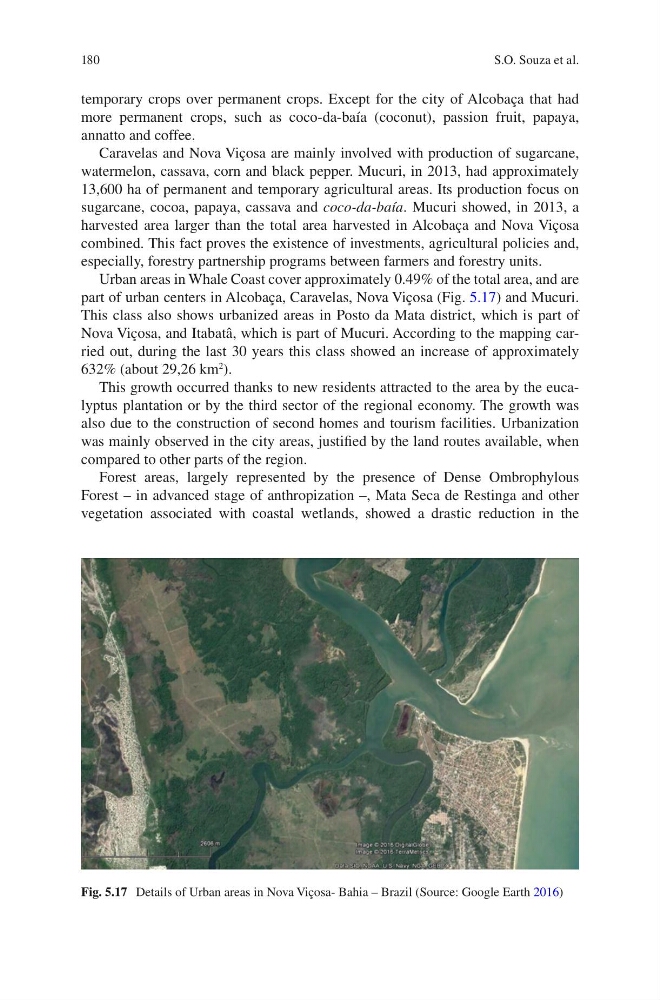
Urban areas in Whale Coast cover approximately 0.49% of the total area, and are
part of urban centers in Alcobaça, Caravelas, Nova Viçosa (Fig. 5.17) and Mucuri.
This class also shows urbanized areas in Posto da Mata district, which is part of
Nova Viçosa, and Itabatâ, which is part of Mucuri. According to the mapping carried out, during the last 30 years this class showed an increase of approximately
632% (about 29,26 km
2
).
This growth occurred thanks to new residents attracted to the area by the eucalyptus plantation or by the third sector of the regional economy. The growth was
also due to the construction of second homes and tourism facilities. Urbanization
was mainly observed in the city areas, justified by the land routes available, when
compared to other parts of the region.
Forest areas, largely represented by the presence of Dense Ombrophylous
Forest – in advanced stage of anthropization –, Mata Seca de Restinga and other
vegetation associated with coastal wetlands, showed a drastic reduction in the
Fig. 5.17 Details of Urban areas in Nova Viçosa- Bahia – Brazil (Source: Google Earth 2016)
S.O. Souza et al.
temporary crops over permanent crops. Except for the city of Alcobaça that had
more permanent crops, such as coco-da-baía (coconut), passion fruit, papaya,
annatto and coffee.
Caravelas and Nova Viçosa are mainly involved with production of sugarcane,
watermelon, cassava, corn and black pepper. Mucuri, in 2013, had approximately
13,600 ha of permanent and temporary agricultural areas. Its production focus on
sugarcane, cocoa, papaya, cassava and coco-da-baía. Mucuri showed, in 2013, a
harvested area larger than the total area harvested in Alcobaça and Nova Viçosa
combined. This fact proves the existence of investments, agricultural policies and,
especially, forestry partnership programs between farmers and forestry units.
Urban areas in Whale Coast cover approximately 0.49% of the total area, and are
part of urban centers in Alcobaça, Caravelas, Nova Viçosa (Fig. 5.17) and Mucuri.
This class also shows urbanized areas in Posto da Mata district, which is part of
Nova Viçosa, and Itabatâ, which is part of Mucuri. According to the mapping carried out, during the last 30 years this class showed an increase of approximately
632% (about 29,26 km
2
).
This growth occurred thanks to new residents attracted to the area by the eucalyptus plantation or by the third sector of the regional economy. The growth was
also due to the construction of second homes and tourism facilities. Urbanization
was mainly observed in the city areas, justified by the land routes available, when
compared to other parts of the region.
Forest areas, largely represented by the presence of Dense Ombrophylous
Forest – in advanced stage of anthropization –, Mata Seca de Restinga and other
vegetation associated with coastal wetlands, showed a drastic reduction in the
Fig. 5.17 Details of Urban areas in Nova Viçosa- Bahia – Brazil (Source: Google Earth 2016)
S.O. Souza et al.