

179
As described in Figs. 5.14 and 5.15, eucalyptus cultivation occupied mostly previously uncovered areas, or areas already deforested – mainly degraded pastures –,
meaning environmental improvements over the previous use, visible in a short
period of time. An approximate reduction of 42% was observed, equivalent to
2,271 km
2
. Floriano (2004) defends that forest plantations are less impactful than
pastures, with more benefits during periods when the tree layer is closed.
However, there are many negative aspects – whether ecological or social. It is
noteworthy that the planting of eucalyptus (Eucalyptus sp.) occurs through the
insertion of exotic and transgenic species. This fact alone is a great demerit for the
local environmental development. It is known that invasive alien species have a
significant impact on environmental biodiversity and are considered the second biggest threat to biodiversity (Espínola and Júlio Júnior 2007), after the destruction of
habitats, thus directly affecting coastal wetlands, local economy and human health,
also leading to environmental homogenization, destruction of unique characteristics
and alterations in essential ecological properties.
During the study period, we noticed a continuous increase of areas occupied by
pastures, represented by the existence of introduced herbaceous/granitoids fields or
by deforestations with the purpose of becoming pastures. This class had an absolute
increase of 394 km
2
(about 154%), which is explained by the local economic reality,
supported mainly by activities related to agriculture and breeding. This use occupied, in 2014, approximately 648.49 km
2
, or 9.41% of the area of study.
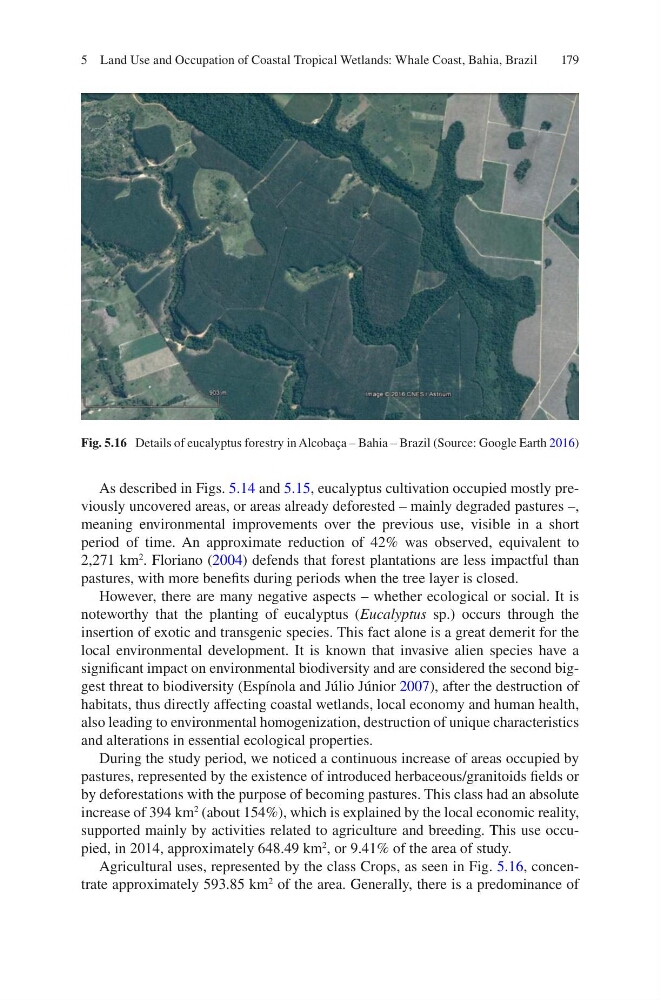
Agricultural uses, represented by the class Crops, as seen in Fig. 5.16, concentrate approximately 593.85 km
2
of the area. Generally, there is a predominance of
Fig. 5.16 Details of eucalyptus forestry in Alcobaça – Bahia – Brazil (Source: Google Earth 2016)
5 Land Use and Occupation of Coastal Tropical Wetlands: Whale Coast, Bahia, Brazil
As described in Figs. 5.14 and 5.15, eucalyptus cultivation occupied mostly previously uncovered areas, or areas already deforested – mainly degraded pastures –,
meaning environmental improvements over the previous use, visible in a short
period of time. An approximate reduction of 42% was observed, equivalent to
2,271 km
2
. Floriano (2004) defends that forest plantations are less impactful than
pastures, with more benefits during periods when the tree layer is closed.
However, there are many negative aspects – whether ecological or social. It is
noteworthy that the planting of eucalyptus (Eucalyptus sp.) occurs through the
insertion of exotic and transgenic species. This fact alone is a great demerit for the
local environmental development. It is known that invasive alien species have a
significant impact on environmental biodiversity and are considered the second biggest threat to biodiversity (Espínola and Júlio Júnior 2007), after the destruction of
habitats, thus directly affecting coastal wetlands, local economy and human health,
also leading to environmental homogenization, destruction of unique characteristics
and alterations in essential ecological properties.
During the study period, we noticed a continuous increase of areas occupied by
pastures, represented by the existence of introduced herbaceous/granitoids fields or
by deforestations with the purpose of becoming pastures. This class had an absolute
increase of 394 km
2
(about 154%), which is explained by the local economic reality,
supported mainly by activities related to agriculture and breeding. This use occupied, in 2014, approximately 648.49 km
2
, or 9.41% of the area of study.
Agricultural uses, represented by the class Crops, as seen in Fig. 5.16, concentrate approximately 593.85 km
2
of the area. Generally, there is a predominance of
Fig. 5.16 Details of eucalyptus forestry in Alcobaça – Bahia – Brazil (Source: Google Earth 2016)
5 Land Use and Occupation of Coastal Tropical Wetlands: Whale Coast, Bahia, Brazil