

164
11. Fluvial lakes (including backwaters of the river), floodplains;
12. Freshwater lakes and associated wetlands (lake area);
13. Freshwater ponds (less than 8 ha), wetlands, mudflats;
14. Saltwater ponds, saline (continental interior systems);
15. Dams, barrages;
16. Fields seasonally flooded, savannas, palm groves;
17. Flooded crop fields, irrigated terrain;
18. Swamp forest (swamp forest) temporary flood forest;
19. Mires, wet Andean meadows, flooded areas by melting snow.
In an inventory specific for Brazil, Diegues (1990) classified 22 types of wetlands that meet the categories proposed by Scott and Carbonell (1986), and some
others: river islands, coral reefs, sandy plains and dunes (interior) and – a separate
category for lagoons – salt marshes. It is evident that coastal wetlands in Brazil
conglomerate various ecosystems such as freshwater ponds, brackish water ponds
without marine influence; mangroves, Atlantic forests, coastal vegetation, savannah,
fields, temporarily or permanently flood forests, among others.
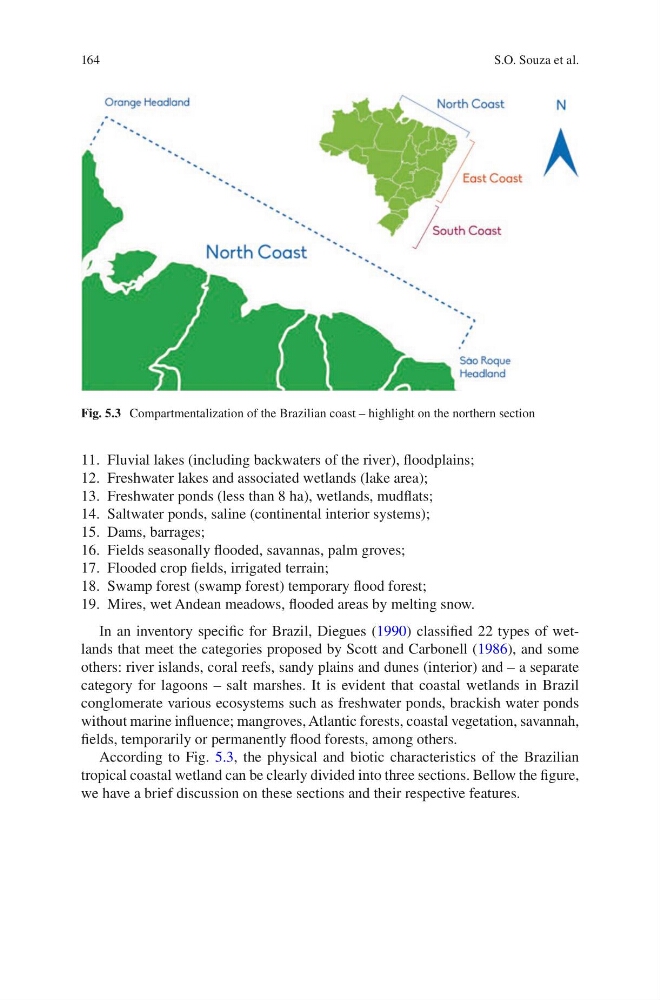
According to Fig. 5.3, the physical and biotic characteristics of the Brazilian
tropical coastal wetland can be clearly divided into three sections. Bellow the figure,
we have a brief discussion on these sections and their respective features.
Fig. 5.3 Compartmentalization of the Brazilian coast – highlight on the northern section
S.O. Souza et al.
11. Fluvial lakes (including backwaters of the river), floodplains;
12. Freshwater lakes and associated wetlands (lake area);
13. Freshwater ponds (less than 8 ha), wetlands, mudflats;
14. Saltwater ponds, saline (continental interior systems);
15. Dams, barrages;
16. Fields seasonally flooded, savannas, palm groves;
17. Flooded crop fields, irrigated terrain;
18. Swamp forest (swamp forest) temporary flood forest;
19. Mires, wet Andean meadows, flooded areas by melting snow.
In an inventory specific for Brazil, Diegues (1990) classified 22 types of wetlands that meet the categories proposed by Scott and Carbonell (1986), and some
others: river islands, coral reefs, sandy plains and dunes (interior) and – a separate
category for lagoons – salt marshes. It is evident that coastal wetlands in Brazil
conglomerate various ecosystems such as freshwater ponds, brackish water ponds
without marine influence; mangroves, Atlantic forests, coastal vegetation, savannah,
fields, temporarily or permanently flood forests, among others.
According to Fig. 5.3, the physical and biotic characteristics of the Brazilian
tropical coastal wetland can be clearly divided into three sections. Bellow the figure,
we have a brief discussion on these sections and their respective features.
Fig. 5.3 Compartmentalization of the Brazilian coast – highlight on the northern section
S.O. Souza et al.