

134
4.1 Introduction
Brunei Darussalam is one of the country that have high proportion of primary forest
and wetland among all countries around the world. Brunei Darussalam is well
known to protect their forest and rivers and continue to maintain it high biodiversity
and landscapes (Engbers 2010; Rhett 2013). A fluctuating sea level, and the geomorphologic evolution that it induces, generates changes of the ecological state of
coastal wetlands (Sandal 1996). These changes modulate the transgression upslope
from upland forest to sub tidal ecosystems in different part of the critical geomorphic regions as well as in the Sungai Mangsalut basin area in Brunei (Wolanski et al.
2009). Tropical and sub-tropical coastal wetlands represent particularly productive
ecosystems that contribute to both terrestrial and marine biodiversity and landscape.
In this chapter, the Sungai Mangsalut basin area laduse and the coastal wetlands that
will be considered are associated with mangrove and salt marshes shorelines
(Wooddroffe and Davies 2009). Mangrove characterize the upper intertidal zone on
many low-energy tropical coasts, often with salt marsh and associated wetlands that
can form landward of such halophytic vegetation which is displaying the similar
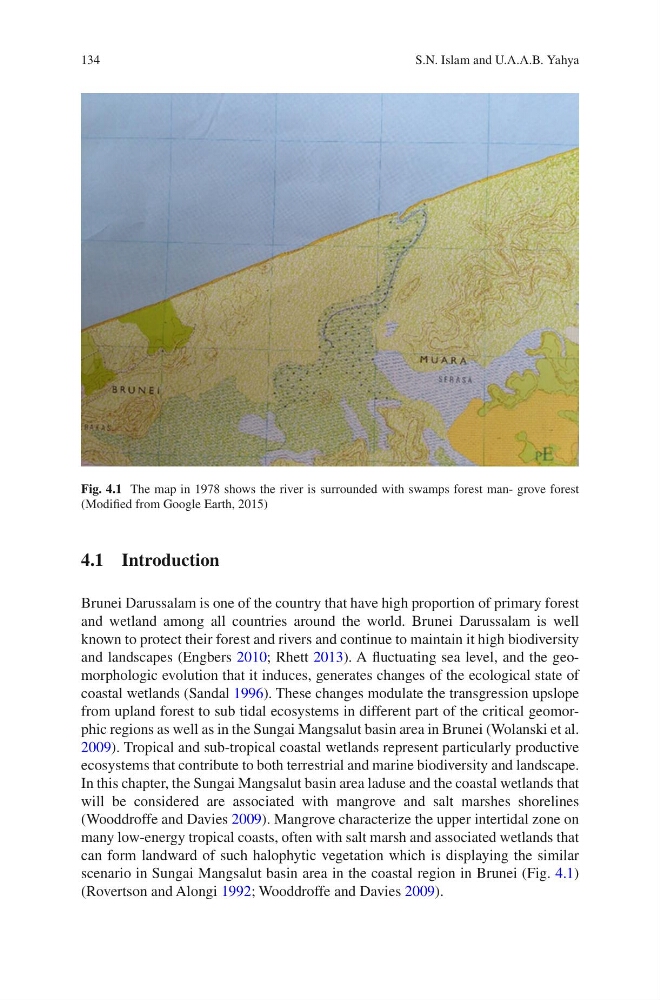
scenario in Sungai Mangsalut basin area in the coastal region in Brunei (Fig. 4.1)
(Rovertson and Alongi 1992; Wooddroffe and Davies 2009).
Fig. 4.1 The map in 1978 shows the river is surrounded with swamps forest man- grove forest
(Modified from Google Earth, 2015)
S.N. Islam and U.A.A.B. Yahya
4.1 Introduction
Brunei Darussalam is one of the country that have high proportion of primary forest
and wetland among all countries around the world. Brunei Darussalam is well
known to protect their forest and rivers and continue to maintain it high biodiversity
and landscapes (Engbers 2010; Rhett 2013). A fluctuating sea level, and the geomorphologic evolution that it induces, generates changes of the ecological state of
coastal wetlands (Sandal 1996). These changes modulate the transgression upslope
from upland forest to sub tidal ecosystems in different part of the critical geomorphic regions as well as in the Sungai Mangsalut basin area in Brunei (Wolanski et al.
2009). Tropical and sub-tropical coastal wetlands represent particularly productive
ecosystems that contribute to both terrestrial and marine biodiversity and landscape.
In this chapter, the Sungai Mangsalut basin area laduse and the coastal wetlands that
will be considered are associated with mangrove and salt marshes shorelines
(Wooddroffe and Davies 2009). Mangrove characterize the upper intertidal zone on
many low-energy tropical coasts, often with salt marsh and associated wetlands that
can form landward of such halophytic vegetation which is displaying the similar
scenario in Sungai Mangsalut basin area in the coastal region in Brunei (Fig. 4.1)
(Rovertson and Alongi 1992; Wooddroffe and Davies 2009).
Fig. 4.1 The map in 1978 shows the river is surrounded with swamps forest man- grove forest
(Modified from Google Earth, 2015)
S.N. Islam and U.A.A.B. Yahya