

92
shrubs and short trees of Rhizophora spp. characterized by dwarfed and tortuous
stems. The inner part of this zone is generally opened and often invaded by
shrubs and young trees of Conocarpus erectus, Dalbergia ecastaphyllum,
Drepanocarpus lunatus, Hibiscus tiliaceus, Laguncularia racemosa,
Ormocarpum verrucosum;
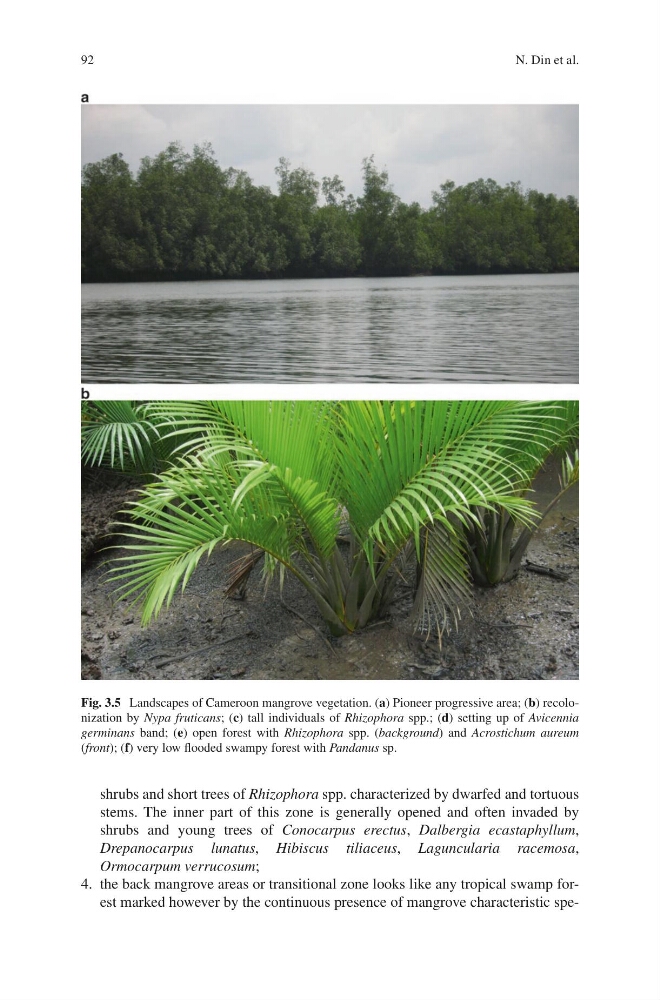
4. the back mangrove areas or transitional zone looks like any tropical swamp forest marked however by the continuous presence of mangrove characteristic speFig. 3.5 Landscapes of Cameroon mangrove vegetation. (a) Pioneer progressive area; (b) recolonization by Nypa fruticans; (c) tall individuals of Rhizophora spp.; (d) setting up of Avicennia
germinans band; (e) open forest with Rhizophora spp. (background) and Acrostichum aureum
(front); (f) very low flooded swampy forest with Pandanus sp.
N. Din et al.
shrubs and short trees of Rhizophora spp. characterized by dwarfed and tortuous
stems. The inner part of this zone is generally opened and often invaded by
shrubs and young trees of Conocarpus erectus, Dalbergia ecastaphyllum,
Drepanocarpus lunatus, Hibiscus tiliaceus, Laguncularia racemosa,
Ormocarpum verrucosum;
4. the back mangrove areas or transitional zone looks like any tropical swamp forest marked however by the continuous presence of mangrove characteristic speFig. 3.5 Landscapes of Cameroon mangrove vegetation. (a) Pioneer progressive area; (b) recolonization by Nypa fruticans; (c) tall individuals of Rhizophora spp.; (d) setting up of Avicennia
germinans band; (e) open forest with Rhizophora spp. (background) and Acrostichum aureum
(front); (f) very low flooded swampy forest with Pandanus sp.
N. Din et al.