

78
Daniel Siscart, Victoria Diego and Francisco Lloret
Table 6.1. Interannual variation of acorn production (g m- 2 year-I, including cups) in different
holm oak forests of the NW Mediterranean Basin"
Year
Le Rouquet
Mallorca
Prades
Prades
Montseny
Montseny
- Menut
-Avic
- Torners
1
2
1965-1972
1988-1990
1982-1988
1989-1994
1978-1981
1985-1987
1
15.0
76
32.1
0.1
14.5
29.9
2
48.6
19
26.6
21.8
88.2
17.2
3
10.7
8.6
64.5
72.5
4
37.8
3.6
108.5
5
116.1
2.0
13.7
6
36.9
24.6
7
93.6
12.4
Mean
51.2
47.5
15.7
41.7
58.4
23.6
SE
14.9
28.5
4.5
19.9
22.4
6.4
CV(%)
77.0
84.9
76.3
106.4
66.5
38.1
CV, Coefficient of variation.
" Acorns collected in litter traps. Data from: Le Rouquet (southern France; Loissant and Rapp
1978), Mallorca-Menut (Xamena 1994), Prades-Avic (Bellot et al. 1992), Prades-Torners (three
control plots; V. Diego, pers. observ.), Montseny 1 (permanent plot at La Castanya; Verdu
1984), and Montseny 2 (Torrent de la Mina, 18 plots; X. Mayor, pers. comm.).
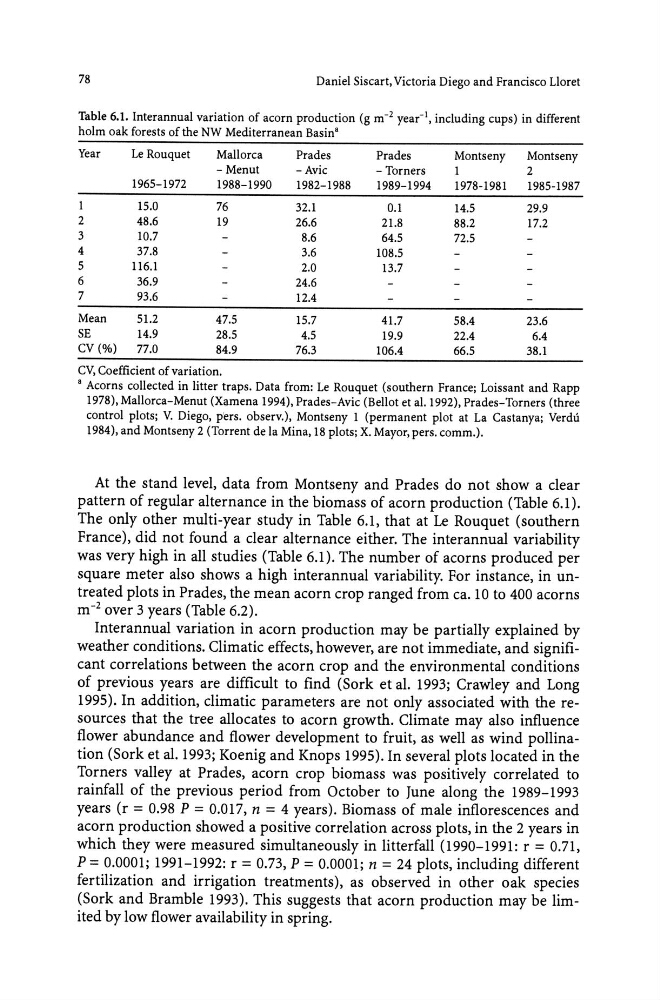
At the stand level, data from Montseny and Prades do not show a clear
pattern of regular alternance in the biomass of acorn production (Table 6.1).
The only other multi-year study in Table 6.1, that at Le Rouquet (southern
France), did not found a clear alternance either. The interannual variability
was very high in all studies (Table 6.1). The number of acorns produced per
square meter also shows a high interannual variability. For instance, in untreated plots in Prades, the mean acorn crop ranged from ca. 10 to 400 acorns
m- 2 over 3 years (Table 6.2).
Interannual variation in acorn production may be partially explained by
weather conditions. Climatic effects, however, are not immediate, and significant correlations between the acorn crop and the environmental conditions
of previous years are difficult to find (Sork et al. 1993; Crawley and Long
1995). In addition, climatic parameters are not only associated with the resources that the tree allocates to acorn growth. Climate may also influence
flower abundance and flower development to fruit, as well as wind pollination (Sork et al. 1993; Koenig and Knops 1995). In several plots located in the
Torners valley at Prades, acorn crop biomass was positively correlated to
rainfall of the previous period from October to June along the 1989-1993
years (r = 0.98 P = 0.017, n = 4 years). Biomass of male inflorescences and
acorn production showed a positive correlation across plots, in the 2 years in
which they were measured simultaneously in litterfall (1990-1991: r = 0.71,
P = 0.0001; 1991-1992: r = 0.73, P = 0.0001; n = 24 plots, including different
fertilization and irrigation treatments), as observed in other oak species
(Sork and Bramble 1993). This suggests that acorn production may be limited by low flower availability in spring.
Daniel Siscart, Victoria Diego and Francisco Lloret
Table 6.1. Interannual variation of acorn production (g m- 2 year-I, including cups) in different
holm oak forests of the NW Mediterranean Basin"
Year
Le Rouquet
Mallorca
Prades
Prades
Montseny
Montseny
- Menut
-Avic
- Torners
1
2
1965-1972
1988-1990
1982-1988
1989-1994
1978-1981
1985-1987
1
15.0
76
32.1
0.1
14.5
29.9
2
48.6
19
26.6
21.8
88.2
17.2
3
10.7
8.6
64.5
72.5
4
37.8
3.6
108.5
5
116.1
2.0
13.7
6
36.9
24.6
7
93.6
12.4
Mean
51.2
47.5
15.7
41.7
58.4
23.6
SE
14.9
28.5
4.5
19.9
22.4
6.4
CV(%)
77.0
84.9
76.3
106.4
66.5
38.1
CV, Coefficient of variation.
" Acorns collected in litter traps. Data from: Le Rouquet (southern France; Loissant and Rapp
1978), Mallorca-Menut (Xamena 1994), Prades-Avic (Bellot et al. 1992), Prades-Torners (three
control plots; V. Diego, pers. observ.), Montseny 1 (permanent plot at La Castanya; Verdu
1984), and Montseny 2 (Torrent de la Mina, 18 plots; X. Mayor, pers. comm.).
At the stand level, data from Montseny and Prades do not show a clear
pattern of regular alternance in the biomass of acorn production (Table 6.1).
The only other multi-year study in Table 6.1, that at Le Rouquet (southern
France), did not found a clear alternance either. The interannual variability
was very high in all studies (Table 6.1). The number of acorns produced per
square meter also shows a high interannual variability. For instance, in untreated plots in Prades, the mean acorn crop ranged from ca. 10 to 400 acorns
m- 2 over 3 years (Table 6.2).
Interannual variation in acorn production may be partially explained by
weather conditions. Climatic effects, however, are not immediate, and significant correlations between the acorn crop and the environmental conditions
of previous years are difficult to find (Sork et al. 1993; Crawley and Long
1995). In addition, climatic parameters are not only associated with the resources that the tree allocates to acorn growth. Climate may also influence
flower abundance and flower development to fruit, as well as wind pollination (Sork et al. 1993; Koenig and Knops 1995). In several plots located in the
Torners valley at Prades, acorn crop biomass was positively correlated to
rainfall of the previous period from October to June along the 1989-1993
years (r = 0.98 P = 0.017, n = 4 years). Biomass of male inflorescences and
acorn production showed a positive correlation across plots, in the 2 years in
which they were measured simultaneously in litterfall (1990-1991: r = 0.71,
P = 0.0001; 1991-1992: r = 0.73, P = 0.0001; n = 24 plots, including different
fertilization and irrigation treatments), as observed in other oak species
(Sork and Bramble 1993). This suggests that acorn production may be limited by low flower availability in spring.