

Acorn Ecology
77
6.2.2 Pattern of Acorn Production
High interannual variability of fruit production is a well-known pattern in
many forest species and particularly in oaks (Sork and Bramble 1993). A
pattern of synchronous high production in periodic years, named mast
years, has been described in temperate forests (Kelly 1994). Masting is not a
simple response to weather events but arises as an evolved reproductive
strategy (Silvertown 1980; Sork et al. 1993). Resource availability, attraction
of seed dispersers, increased efficiency of wind pollination, and predator satiation are some of the main hypotheses proposed to explain masting, but at
present there is no general consensus about its evolutionary significance
(Kelly 1994). Mast years have been observed in several Quercus species (Sork
et al. 1993; Koenig et al. 1994), and some observations are consistent with the
wind pollination and predator satiation hypotheses (Koenig et al. 1994).
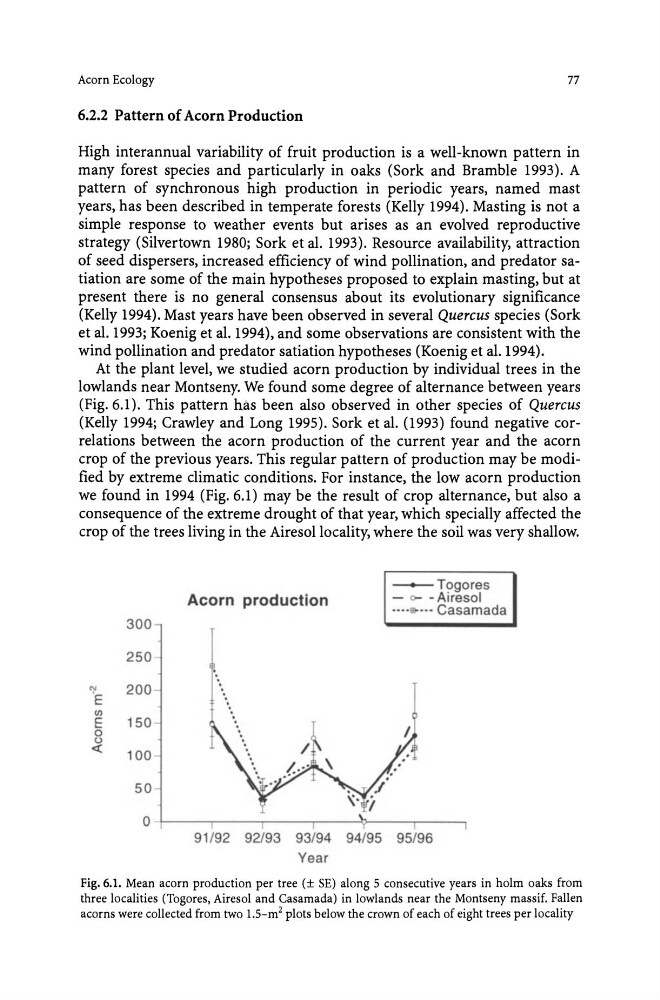
At the plant level, we studied acorn production by individual trees in the
lowlands near Montseny. We found some degree of alternance between years
(Fig. 6.1). This pattern has been also observed in other species of Quercus
(Kelly 1994; Crawley and Long 1995). Sork et al. (1993) found negative correlations between the acorn production of the current year and the acorn
crop of the previous years. This regular pattern of production may be modified by extreme climatic conditions. For instance, the low acorn production
we found in 1994 (Fig. 6.1) may be the result of crop alternance, but also a
consequence of the extreme drought of that year, which specially affected the
crop of the trees living in the Airesollocality, where the soil was very shallow.
- - - Togores
Acorn production
-
- Airesol
...•... Casamada
300
250
., 200
E
II)
c:
150
... 0
u
« 100
50
0
91 /92 92/93 93/94 94/95 95/96
Year
Fig. 6.1. Mean acorn production per tree (± SE) along 5 consecutive years in holm oaks from
three localities (Togores. Airesol and Casamada) in lowlands near the Montseny massif. Fallen
acorns were collected from two 1.5-m 2 plots below the crown of each of eight trees per locality
77
6.2.2 Pattern of Acorn Production
High interannual variability of fruit production is a well-known pattern in
many forest species and particularly in oaks (Sork and Bramble 1993). A
pattern of synchronous high production in periodic years, named mast
years, has been described in temperate forests (Kelly 1994). Masting is not a
simple response to weather events but arises as an evolved reproductive
strategy (Silvertown 1980; Sork et al. 1993). Resource availability, attraction
of seed dispersers, increased efficiency of wind pollination, and predator satiation are some of the main hypotheses proposed to explain masting, but at
present there is no general consensus about its evolutionary significance
(Kelly 1994). Mast years have been observed in several Quercus species (Sork
et al. 1993; Koenig et al. 1994), and some observations are consistent with the
wind pollination and predator satiation hypotheses (Koenig et al. 1994).
At the plant level, we studied acorn production by individual trees in the
lowlands near Montseny. We found some degree of alternance between years
(Fig. 6.1). This pattern has been also observed in other species of Quercus
(Kelly 1994; Crawley and Long 1995). Sork et al. (1993) found negative correlations between the acorn production of the current year and the acorn
crop of the previous years. This regular pattern of production may be modified by extreme climatic conditions. For instance, the low acorn production
we found in 1994 (Fig. 6.1) may be the result of crop alternance, but also a
consequence of the extreme drought of that year, which specially affected the
crop of the trees living in the Airesollocality, where the soil was very shallow.
- - - Togores
Acorn production
-
- Airesol
...•... Casamada
300
250
., 200
E
II)
c:
150
... 0
u
« 100
50
0
91 /92 92/93 93/94 94/95 95/96
Year
Fig. 6.1. Mean acorn production per tree (± SE) along 5 consecutive years in holm oaks from
three localities (Togores. Airesol and Casamada) in lowlands near the Montseny massif. Fallen
acorns were collected from two 1.5-m 2 plots below the crown of each of eight trees per locality