

Stand Structure, Aboveground Biomass and Production
35
1750
til 1500
f.ii 1250
E
Q)
1000
~
Z:- 750
'iii
~
500
o 250
L'Avic (Prades)
1981
_
1986
O -t-'----r"-'~ ........ .,...--.,-~
5
10 15 20 25 30
050 (em)
Torrent de la Mina (Montseny)
1750
til 1500
.t::
U! 1250
E
Q)
1000
~
Z:- 750
'iii
~
500
o 250
1985
_
1995
O +"'--r'-'~""""'-.,--i
5
10 15 20 25 30
OBH (em)
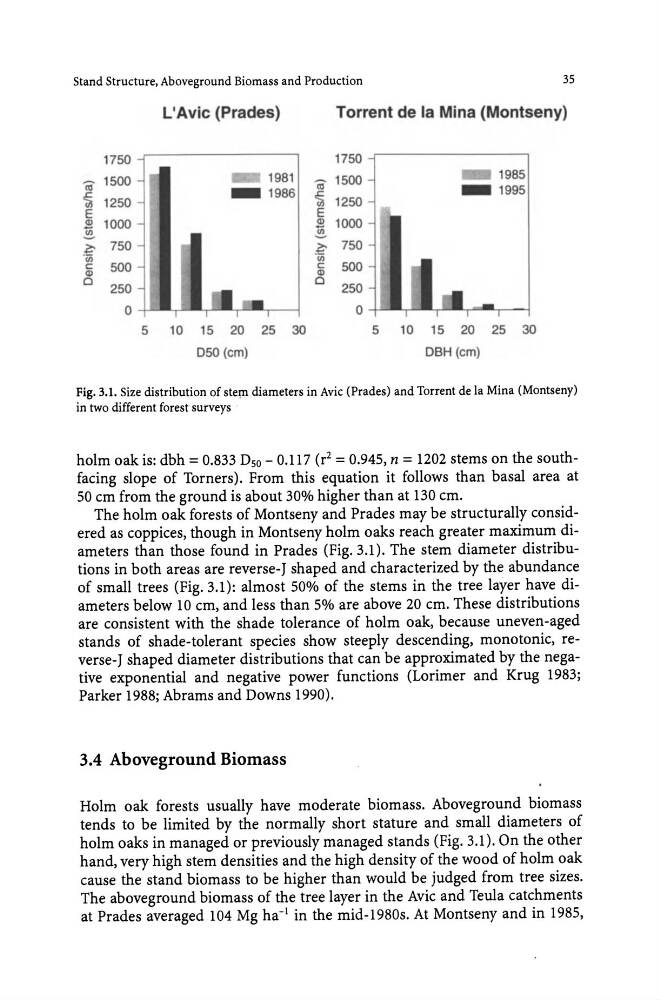
Fig. 3.1. Size distribution of ste!ll diameters in Avic (Prades) and Torrent de la Mina (Montseny)
in two different forest surveys
holm oak is: dbh = 0.833 Dso - 0.117 (r2 = 0.945, n = 1202 stems on the southfacing slope of Tomers). From this equation it follows than basal area at
50 cm from the ground is about 30% higher than at 130 cm.
The holm oak forests of Montseny and Prades may be structurally considered as coppices, though in Montseny holm oaks reach greater maximum diameters than those found in Prades (Fig. 3.1). The stem diameter distributions in both areas are reverse-J shaped and characterized by the abundance
of small trees (Fig. 3.1): almost 50% of the stems in the tree layer have diameters below lO cm, and less than 5% are above 20 cm. These distributions
are consistent with the shade tolerance of holm oak, because uneven-aged
stands of shade-tolerant species show steeply descending, monotonic, reverse-J shaped diameter distributions that can be approximated by the negative exponential and negative power functions (Lorimer and Krug 1983;
Parker 1988; Abrams and Downs 1990).
3.4 Aboveground Biomass
Holm oak forests usually have moderate biomass. Aboveground biomass
tends to be limited by the normally short stature and small diameters of
holm oaks in managed or previously managed stands (Fig. 3.1). On the other
hand, very high stem densities and the high density of the wood of holm oak
cause the stand biomass to be higher than would be judged from tree sizes.
The aboveground biomass of the tree layer in the Avic and Teula catchments
at Prades averaged lO4 Mg ha- 1 in the mid-1980s. At Montseny and in 1985,
35
1750
til 1500
f.ii 1250
E
Q)
1000
~
Z:- 750
'iii
~
500
o 250
L'Avic (Prades)
1981
_
1986
O -t-'----r"-'~ ........ .,...--.,-~
5
10 15 20 25 30
050 (em)
Torrent de la Mina (Montseny)
1750
til 1500
.t::
U! 1250
E
Q)
1000
~
Z:- 750
'iii
~
500
o 250
1985
_
1995
O +"'--r'-'~""""'-.,--i
5
10 15 20 25 30
OBH (em)
Fig. 3.1. Size distribution of ste!ll diameters in Avic (Prades) and Torrent de la Mina (Montseny)
in two different forest surveys
holm oak is: dbh = 0.833 Dso - 0.117 (r2 = 0.945, n = 1202 stems on the southfacing slope of Tomers). From this equation it follows than basal area at
50 cm from the ground is about 30% higher than at 130 cm.
The holm oak forests of Montseny and Prades may be structurally considered as coppices, though in Montseny holm oaks reach greater maximum diameters than those found in Prades (Fig. 3.1). The stem diameter distributions in both areas are reverse-J shaped and characterized by the abundance
of small trees (Fig. 3.1): almost 50% of the stems in the tree layer have diameters below lO cm, and less than 5% are above 20 cm. These distributions
are consistent with the shade tolerance of holm oak, because uneven-aged
stands of shade-tolerant species show steeply descending, monotonic, reverse-J shaped diameter distributions that can be approximated by the negative exponential and negative power functions (Lorimer and Krug 1983;
Parker 1988; Abrams and Downs 1990).
3.4 Aboveground Biomass
Holm oak forests usually have moderate biomass. Aboveground biomass
tends to be limited by the normally short stature and small diameters of
holm oaks in managed or previously managed stands (Fig. 3.1). On the other
hand, very high stem densities and the high density of the wood of holm oak
cause the stand biomass to be higher than would be judged from tree sizes.
The aboveground biomass of the tree layer in the Avic and Teula catchments
at Prades averaged lO4 Mg ha- 1 in the mid-1980s. At Montseny and in 1985,