

Composition and Dynamics of the Bird Community
361
20% of their individuals belonging to these species, while in localities north
of the Pyrenees higher percentages were frequent. This gradient could be explained by regression of percentage of long-distance migrants on latitude or
on mean temperature of the coldest month with almost the same determination coefficient. Herrera (1978) then suggested that the percentage of migrants depended both on resource abundance during the breeding season
and on the severity of the winter. The lower the level of resources in winter
the lower would be the population of resident birds that survive and then
greater the relative availability of resources to summer migrants.
If this hypothesis is true we could expect that, within the Iberian forests,
the percentage of summer migrants would be smaller in evergreen than in
deciduous forests. The reason is that in evergreen forests just a small fraction
of leaves is renewed each year, and only the young leaves may be eaten by
caterpillars which are the main food for breeding birds (Iglesias 1996). In deciduous forests, on the contrary, all leaves are newly produced each spring,
thus supplying a burst of food for insects and therefore for birds. Evergreen
forests have a reduced level of summer resources compared to deciduous
forests, but they offer more cover and food (insects, fruits) in winter. This results in a lower difference between summer and winter resource availability
for birds and a lower percentage of summer migrants in evergreen forests.
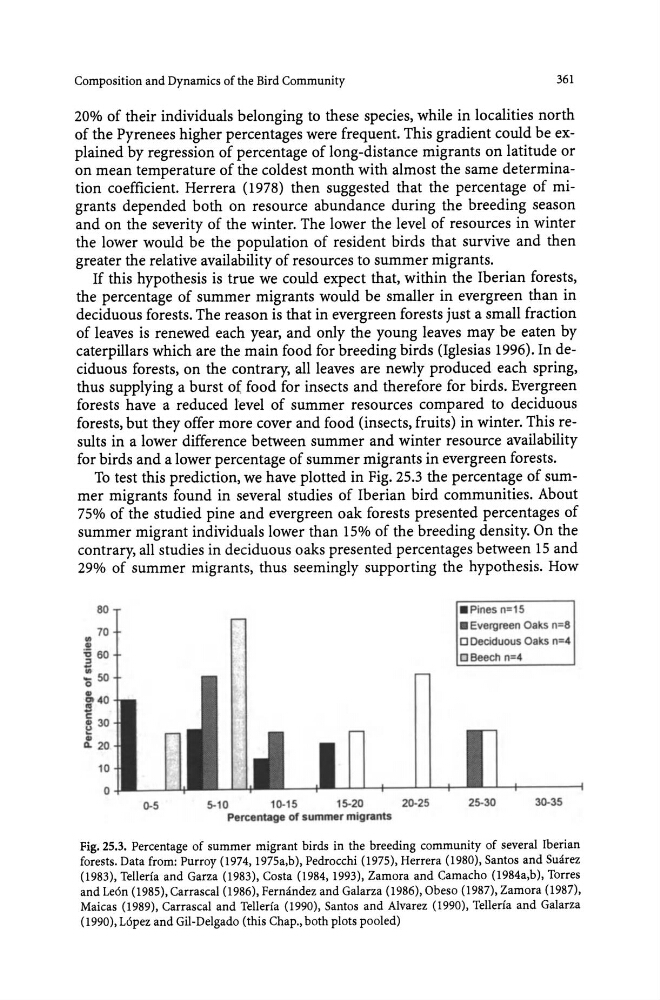
To test this prediction, we have plotted in Fig. 25.3 the percentage of summer migrants found in several studies of Iberian bird communities. About
75% of the studied pine and evergreen oak forests presented percentages of
summer migrant individuals lower than 15% of the breeding density. On the
contrary, all studies in deciduous oaks presented percentages between 15 and
29% of summer migrants, thus seemingly supporting the hypothesis. How
80
70
lit
..
:g 60
;;
'0 50
..
J40
c
~30
II
A, 20
10
0
0-5
5-10
10-15
15-20
20-25
Percentage of summer migrants
• Pines n=15
• Evergreen Oaks n=8
o Declduous Oaks n=4
DBeech n=4
25-30
30-35
Fig. 25.3. Percentage of summer migrant birds in the breeding community of several Iberian
forests. Data from: Purroy (1974, 1975a,b), Pedrocchi (1975), Herrera (1980), Santos and Suarez
(1983), Telleria and Garza (1983), Costa (1984, 1993), Zamora and Camacho (1984a,b), Torres
and Le6n (1985), Carrascal (1986), Fernandez and Galarza (1986), Obeso (1987), Zamora (1987),
Maicas (1989), Carrascal and Telleria (1990), Santos and Alvarez (1990), Telleria and Galarza
(1990), L6pez and Gil-Delgado (this Chap., both plots pooled)
361
20% of their individuals belonging to these species, while in localities north
of the Pyrenees higher percentages were frequent. This gradient could be explained by regression of percentage of long-distance migrants on latitude or
on mean temperature of the coldest month with almost the same determination coefficient. Herrera (1978) then suggested that the percentage of migrants depended both on resource abundance during the breeding season
and on the severity of the winter. The lower the level of resources in winter
the lower would be the population of resident birds that survive and then
greater the relative availability of resources to summer migrants.
If this hypothesis is true we could expect that, within the Iberian forests,
the percentage of summer migrants would be smaller in evergreen than in
deciduous forests. The reason is that in evergreen forests just a small fraction
of leaves is renewed each year, and only the young leaves may be eaten by
caterpillars which are the main food for breeding birds (Iglesias 1996). In deciduous forests, on the contrary, all leaves are newly produced each spring,
thus supplying a burst of food for insects and therefore for birds. Evergreen
forests have a reduced level of summer resources compared to deciduous
forests, but they offer more cover and food (insects, fruits) in winter. This results in a lower difference between summer and winter resource availability
for birds and a lower percentage of summer migrants in evergreen forests.
To test this prediction, we have plotted in Fig. 25.3 the percentage of summer migrants found in several studies of Iberian bird communities. About
75% of the studied pine and evergreen oak forests presented percentages of
summer migrant individuals lower than 15% of the breeding density. On the
contrary, all studies in deciduous oaks presented percentages between 15 and
29% of summer migrants, thus seemingly supporting the hypothesis. How
80
70
lit
..
:g 60
;;
'0 50
..
J40
c
~30
II
A, 20
10
0
0-5
5-10
10-15
15-20
20-25
Percentage of summer migrants
• Pines n=15
• Evergreen Oaks n=8
o Declduous Oaks n=4
DBeech n=4
25-30
30-35
Fig. 25.3. Percentage of summer migrant birds in the breeding community of several Iberian
forests. Data from: Purroy (1974, 1975a,b), Pedrocchi (1975), Herrera (1980), Santos and Suarez
(1983), Telleria and Garza (1983), Costa (1984, 1993), Zamora and Camacho (1984a,b), Torres
and Le6n (1985), Carrascal (1986), Fernandez and Galarza (1986), Obeso (1987), Zamora (1987),
Maicas (1989), Carrascal and Telleria (1990), Santos and Alvarez (1990), Telleria and Galarza
(1990), L6pez and Gil-Delgado (this Chap., both plots pooled)