

360
German L6pez-Iborra and Jose A. Gil-Delgado
Plot 1
Il> Individuals
1001l> ...:::----=-.."..--.------:::
801l>
601l>
4 Oil>
201l>
Oil> AM J J A SON 0 J F M A M J J A SON 0 J F M
"
I
86
I
86
I 87 I
CJ Constant Species _ Summer Species CJ Irregular Species
Plot 2
Il> Individuals
1001l>
801l>
601l>
4 Oil>
201l>
Oil> A M J J A SON 0 J F M A M J J A SON 0 J F M A
I
85
I
86
I 87 I
CJ Constant Species
Summer Species
CJ IrreQular Species
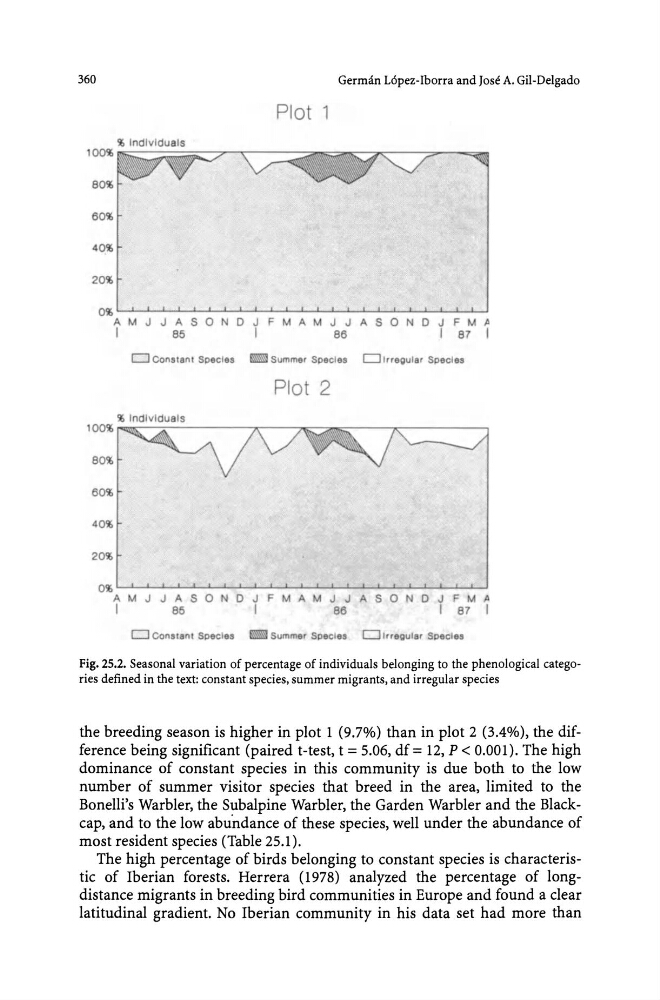
Fig. 25.2. Seasonal variation of percentage of individuals belonging to the phenological categories defined in the text: constant species, summer migrants, and irregular species
the breeding season is higher in plot 1 (9.7%) than in plot 2 (3.4%), the difference being significant (paired t-test, t = 5.06, df = 12, P < 0.001). The high
dominance of constant species in this community is due both to the low
number of summer visitor species that breed in the area, limited to the
Bonelli's Warbler, the Subalpine Warbler, the Garden Warbler and the Blackcap, and to the low abu' ndance of these species, well under the abundance of
most resident species (Table 25.1).
The high percentage of birds belonging to constant species is characteristic of Iberian forests. Herrera (1978) analyzed the percentage of longdistance migrants in breeding bird communities in Europe and found a clear
latitudinal gradient. No Iberian community in his data set had more than
German L6pez-Iborra and Jose A. Gil-Delgado
Plot 1
Il> Individuals
1001l> ...:::----=-.."..--.------:::
801l>
601l>
4 Oil>
201l>
Oil> AM J J A SON 0 J F M A M J J A SON 0 J F M
"
I
86
I
86
I 87 I
CJ Constant Species _ Summer Species CJ Irregular Species
Plot 2
Il> Individuals
1001l>
801l>
601l>
4 Oil>
201l>
Oil> A M J J A SON 0 J F M A M J J A SON 0 J F M A
I
85
I
86
I 87 I
CJ Constant Species
Summer Species
CJ IrreQular Species
Fig. 25.2. Seasonal variation of percentage of individuals belonging to the phenological categories defined in the text: constant species, summer migrants, and irregular species
the breeding season is higher in plot 1 (9.7%) than in plot 2 (3.4%), the difference being significant (paired t-test, t = 5.06, df = 12, P < 0.001). The high
dominance of constant species in this community is due both to the low
number of summer visitor species that breed in the area, limited to the
Bonelli's Warbler, the Subalpine Warbler, the Garden Warbler and the Blackcap, and to the low abu' ndance of these species, well under the abundance of
most resident species (Table 25.1).
The high percentage of birds belonging to constant species is characteristic of Iberian forests. Herrera (1978) analyzed the percentage of longdistance migrants in breeding bird communities in Europe and found a clear
latitudinal gradient. No Iberian community in his data set had more than