

348
Pilar Andres, Eduardo Mateos and Carlos Ascaso
mixed with the mineral soil. One year after the fire, plant cover recovered to
400/0, but during that year soil surface temperature in the burnt plot was
higher than in the control, and reached 60 DC in June. As a consequence of
the lack of plant protection and of the degradation of the soil structure, soil
water content was extremely variable.
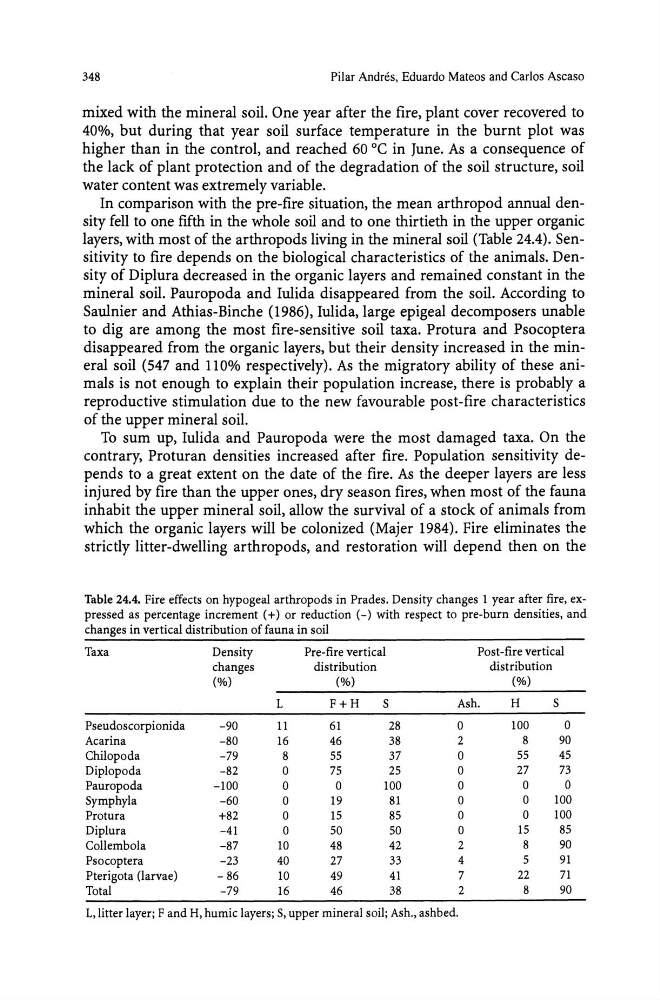
In comparison with the pre-fire situation, the mean arthropod annual density fell to one fifth in the whole soil and to one thirtieth in the upper organic
layers, with most of the arthropods living in the mineral soil (Table 24.4). Sensitivity to fire depends on the biological characteristics of the animals. Density of Diplura decreased in the organic layers and remained constant in the
mineral soil. Pauropoda and Iulida disappeared from the soil. According to
Saulnier and Athias-Binche (1986), Iulida, large epigeal decomposers unable
to dig are among the most fire-sensitive soil taxa. Protura and Psocoptera
disappeared from the organic layers, but their density increased in the mineral soil (547 and 110% respectively). As the migratory ability of these animals is not enough to explain their population increase, there is probably a
reproductive stimulation due to the new favourable post-fire characteristics
of the upper mineral soil.
To sum up, Iulida and Pauropoda were the most damaged taxa. On the
contrary, Proturan densities increased after fire. Population sensitivity depends to a great extent on the date of the fire. As the deeper layers are less
injured by fire than the upper ones, dry season fires, when most of the fauna
inhabit the upper mineral soil, allow the survival of a stock of animals from
which the organic layers will be colonized (Majer 1984). Fire eliminates the
strictly litter-dwelling arthropods, and restoration will depend then on the
Table 24.4. Fire effects on hypogeal arthropods in Prades. Density changes 1 year after fire, expressed as percentage increment (+) or reduction (-) with respect to pre-burn densities, and
changes in vertical distribution of fauna in soil
Taxa
Density
Pre-fire vertical
Post-fire vertical
changes
distribution
distribution
(%)
(%)
(%)
L
F+H
S
Ash.
H
S
Pseudoscorpionida
-90
11
61
28
0
100
0
Acarina
-80
16
46
38
2
8
90
Chilopoda
-79
8
55
37
0
55
45
Diplopoda
-82
0
75
25
0
27
73
Pauropoda
-100
0
0
100
0
0
0
Symphyla
-60
0
19
81
0
0
100
Protura
+82
0
15
85
0
0
100
Diplura
-41
0
50
50
0
15
85
Collembola
-87
10
48
42
2
8
90
Psocoptera
-23
40
27
33
4
5
91
Pterigota (larvae)
- 86
10
49
41
7
22
71
Total
-79
16
46
38
2
8
90
L, litter layer; F and H, humic layers; S, upper mineral soil; Ash., ashbed.
Pilar Andres, Eduardo Mateos and Carlos Ascaso
mixed with the mineral soil. One year after the fire, plant cover recovered to
400/0, but during that year soil surface temperature in the burnt plot was
higher than in the control, and reached 60 DC in June. As a consequence of
the lack of plant protection and of the degradation of the soil structure, soil
water content was extremely variable.
In comparison with the pre-fire situation, the mean arthropod annual density fell to one fifth in the whole soil and to one thirtieth in the upper organic
layers, with most of the arthropods living in the mineral soil (Table 24.4). Sensitivity to fire depends on the biological characteristics of the animals. Density of Diplura decreased in the organic layers and remained constant in the
mineral soil. Pauropoda and Iulida disappeared from the soil. According to
Saulnier and Athias-Binche (1986), Iulida, large epigeal decomposers unable
to dig are among the most fire-sensitive soil taxa. Protura and Psocoptera
disappeared from the organic layers, but their density increased in the mineral soil (547 and 110% respectively). As the migratory ability of these animals is not enough to explain their population increase, there is probably a
reproductive stimulation due to the new favourable post-fire characteristics
of the upper mineral soil.
To sum up, Iulida and Pauropoda were the most damaged taxa. On the
contrary, Proturan densities increased after fire. Population sensitivity depends to a great extent on the date of the fire. As the deeper layers are less
injured by fire than the upper ones, dry season fires, when most of the fauna
inhabit the upper mineral soil, allow the survival of a stock of animals from
which the organic layers will be colonized (Majer 1984). Fire eliminates the
strictly litter-dwelling arthropods, and restoration will depend then on the
Table 24.4. Fire effects on hypogeal arthropods in Prades. Density changes 1 year after fire, expressed as percentage increment (+) or reduction (-) with respect to pre-burn densities, and
changes in vertical distribution of fauna in soil
Taxa
Density
Pre-fire vertical
Post-fire vertical
changes
distribution
distribution
(%)
(%)
(%)
L
F+H
S
Ash.
H
S
Pseudoscorpionida
-90
11
61
28
0
100
0
Acarina
-80
16
46
38
2
8
90
Chilopoda
-79
8
55
37
0
55
45
Diplopoda
-82
0
75
25
0
27
73
Pauropoda
-100
0
0
100
0
0
0
Symphyla
-60
0
19
81
0
0
100
Protura
+82
0
15
85
0
0
100
Diplura
-41
0
50
50
0
15
85
Collembola
-87
10
48
42
2
8
90
Psocoptera
-23
40
27
33
4
5
91
Pterigota (larvae)
- 86
10
49
41
7
22
71
Total
-79
16
46
38
2
8
90
L, litter layer; F and H, humic layers; S, upper mineral soil; Ash., ashbed.