

Soil Arthropods
347
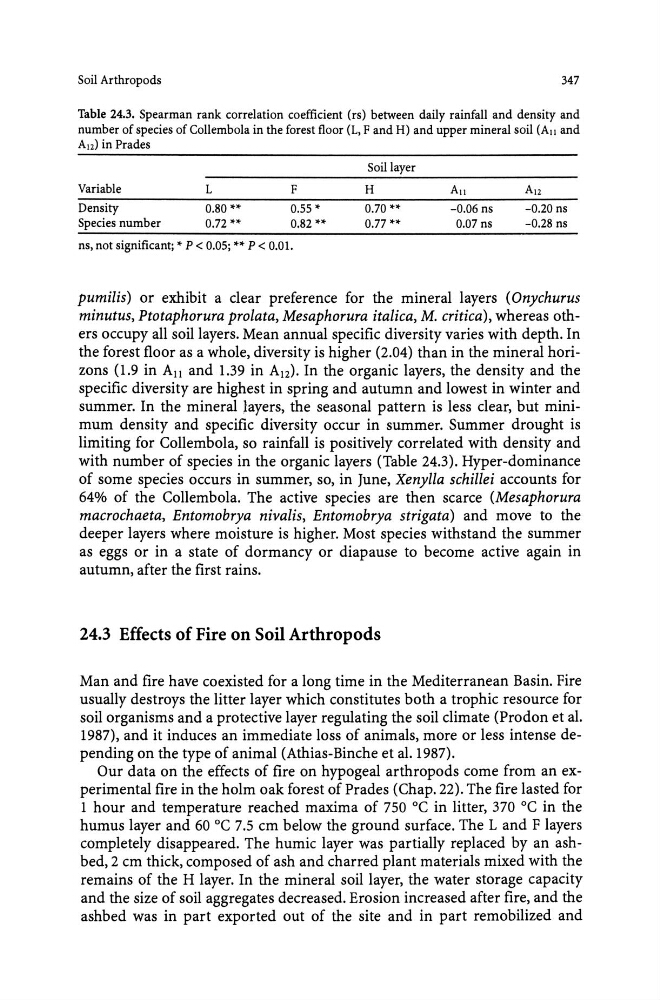
Table 24.3. Spearman rank correlation coefficient (rs) between daily rainfall and density and
number of species of Collembola in the forest floor (L, F and H) and upper mineral soil (All and
AlZ) in Prades
Variable
Density
Species number
L
0.80 .. ..
o.n .. ..
F
0.55 ..
0.82 ....
ns, not significant; .. P < 0.05; .... P < 0.01.
Soil layer
H
0.70 .. ..
0.77 .. ..
All
-0.06 ns
0.07ns
-0.20 ns
-0.28 ns
pumiIis} or exhibit a clear preference for the mineral layers (Onychurus
minutus, Ptotaphorura pro lata, Mesaphorura italica, M. critica), whereas others occupy all soil layers. Mean annual specific diversity varies with depth. In
the forest floor as a whole, diversity is higher (2.04) than in the mineral horizons (1.9 in All and 1.39 in AI2). In the organic layers, the density and the
specific diversity are highest in spring and autumn and lowest in winter and
summer. In the mineral )ayers, the seasonal pattern is less clear, but minimum density and specific diversity occur in summer. Summer drought is
limiting for Collembola, so rainfall is positively correlated with density and
with number of species in the organic layers (Table 24.3). Hyper-dominance
of some species occurs in summer, so, in June, Xenylla schillei accounts for
640/0 of the Collembola. The active species are then scarce (Mesaphorura
macrochaeta, Entomobrya nivalis, Entomobrya strigata) and move to the
deeper layers where moisture is higher. Most species withstand the summer
as eggs or in a state of dormancy or diapause to become active again in
autumn, after the first rains.
24.3 Effects of Fire on Soil Arthropods
Man and fire have coexisted for a long time in the Mediterranean Basin. Fire
usually destroys the litter layer which constitutes both a trophic resource for
soil organisms and a protective layer regulating the soil climate (Prodon et al.
1987), and it induces an immediate loss of animals, more or less intense depending on the type of animal (Athias-Binche et al.1987).
Our data on the effects of fire on hypogeal arthropods come from an experimental fire in the holm oak forest of Prades (Chap. 22). The fire lasted for
1 hour and temperature reached maxima of 750°C in litter, 370°C in the
humus layer and 60°C 7.5 cm below the ground surface. The Land F layers
completely disappeared. The humic layer was partially replaced by an ashbed, 2 cm thick, composed of ash and charred plant materials mixed with the
remains of the H layer. In the mineral soil layer, the water storage capacity
and the size of soil aggregates decreased. Erosion increased after fire, and the
ashbed was in part exported out of the site and in part remobilized and
347
Table 24.3. Spearman rank correlation coefficient (rs) between daily rainfall and density and
number of species of Collembola in the forest floor (L, F and H) and upper mineral soil (All and
AlZ) in Prades
Variable
Density
Species number
L
0.80 .. ..
o.n .. ..
F
0.55 ..
0.82 ....
ns, not significant; .. P < 0.05; .... P < 0.01.
Soil layer
H
0.70 .. ..
0.77 .. ..
All
-0.06 ns
0.07ns
-0.20 ns
-0.28 ns
pumiIis} or exhibit a clear preference for the mineral layers (Onychurus
minutus, Ptotaphorura pro lata, Mesaphorura italica, M. critica), whereas others occupy all soil layers. Mean annual specific diversity varies with depth. In
the forest floor as a whole, diversity is higher (2.04) than in the mineral horizons (1.9 in All and 1.39 in AI2). In the organic layers, the density and the
specific diversity are highest in spring and autumn and lowest in winter and
summer. In the mineral )ayers, the seasonal pattern is less clear, but minimum density and specific diversity occur in summer. Summer drought is
limiting for Collembola, so rainfall is positively correlated with density and
with number of species in the organic layers (Table 24.3). Hyper-dominance
of some species occurs in summer, so, in June, Xenylla schillei accounts for
640/0 of the Collembola. The active species are then scarce (Mesaphorura
macrochaeta, Entomobrya nivalis, Entomobrya strigata) and move to the
deeper layers where moisture is higher. Most species withstand the summer
as eggs or in a state of dormancy or diapause to become active again in
autumn, after the first rains.
24.3 Effects of Fire on Soil Arthropods
Man and fire have coexisted for a long time in the Mediterranean Basin. Fire
usually destroys the litter layer which constitutes both a trophic resource for
soil organisms and a protective layer regulating the soil climate (Prodon et al.
1987), and it induces an immediate loss of animals, more or less intense depending on the type of animal (Athias-Binche et al.1987).
Our data on the effects of fire on hypogeal arthropods come from an experimental fire in the holm oak forest of Prades (Chap. 22). The fire lasted for
1 hour and temperature reached maxima of 750°C in litter, 370°C in the
humus layer and 60°C 7.5 cm below the ground surface. The Land F layers
completely disappeared. The humic layer was partially replaced by an ashbed, 2 cm thick, composed of ash and charred plant materials mixed with the
remains of the H layer. In the mineral soil layer, the water storage capacity
and the size of soil aggregates decreased. Erosion increased after fire, and the
ashbed was in part exported out of the site and in part remobilized and