

286
Anna A vila, Juan Bellot and Josep Pinal
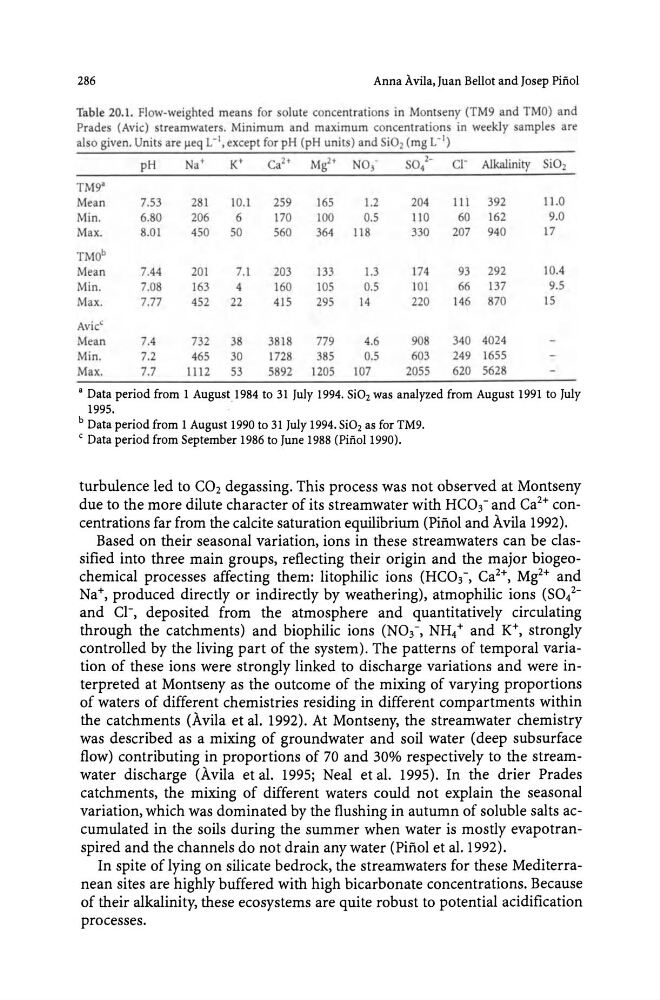
Table 20.1. Flow-weighted means for solute concentrations in Montseny (TM9 and TMO) and
Prades (Avic) streamwaters. Minimum and maximum concentrations in weekly samples are
also given. Units are Ileq L- I , except for pH (pH units) and iO z (mg L- I )
pH
Na+
K+
CaZ+
MgH
NO)ot Cl- Alkalinity iO z
TM9"
Mean
7.53
281
10.1
259
165
1.2
204
III
392
11.0
Min.
6.80
206
6
170
100
0.5
110
60
162
9.0
Max.
8.01
450
50
560
364
118
330
207
940
17
TMOb
Mean
7.44
201
7.1
203
133
1.3
174
93
292
10.4
Min.
7.08
163
4
160
105
0.5
101
66
137
9.5
Max.
7.77
452
22
415
295
14
220
146
870
15
Avice
Mean
7.4
732
38
3818
779
4.6
908
340 4024
Min.
7.2
465
30
1728
385
0.5
603
249 1655
Max.
7.7
1112
53
5892
1205
107
2055
620 5628
" Data period from I August1984 to 31 July 1994. Si02 was analyzed from August 1991 to July
1995.
b Data period from 1 August 1990 to 31 July 1994. Si02 as for TM9.
C Data period from September 1986 to June 1988 (PinoI1990).
turbulence led to CO2 degassing. This process was not observed at Montseny
due to the more dilute character of its streamwater with HC03 - and Ca 2 + concentrations far from the calcite saturation equilibrium (Pinol and Avila 1992).
Based on their seasonal variation, ions in these streamwaters can be classified into three main groups, reflecting their origin and the major biogeochemical processes affecting them: litophilic ions (HC03 -, Ca2+, Mg2+ and
Na+, produced directly or indirectly by weathering), atmophilic ions (SOland CI-, deposited from the atmosphere and quantitatively circulating
through the catchments) and biophilic ions (N03-, NH/ and K+, strongly
controlled by the living part of the system). The patterns of temporal variation of these ions were strongly linked to discharge variations and were interpreted at Montseny as the outcome of the mixing of varying proportions
of waters of different chemistries residing in different compartments within
the catchments (Avila et al. 1992). At Montseny, the streamwater chemistry
was described as a mixing of groundwater and soil water (deep subsurface
flow) contributing in proportions of 70 and 30% respectively to the streamwater discharge (Avila et al. 1995; Neal et al. 1995). In the drier Prades
catchments, the mixing of different waters could not explain the seasonal
variation, which was dominated by the flushing in autumn of soluble salts accumulated in the soils during the summer when water is mostly evapotranspired and the channels do not drain any water (Pinol et al. 1992).
In spite of lying on silicate bedrock, the streamwaters for these Mediterranean sites are highly buffered with high bicarbonate concentrations. Because
of their alkalinity, these ecosystems are quite robust to potential acidification
processes.
Anna A vila, Juan Bellot and Josep Pinal
Table 20.1. Flow-weighted means for solute concentrations in Montseny (TM9 and TMO) and
Prades (Avic) streamwaters. Minimum and maximum concentrations in weekly samples are
also given. Units are Ileq L- I , except for pH (pH units) and iO z (mg L- I )
pH
Na+
K+
CaZ+
MgH
NO)ot Cl- Alkalinity iO z
TM9"
Mean
7.53
281
10.1
259
165
1.2
204
III
392
11.0
Min.
6.80
206
6
170
100
0.5
110
60
162
9.0
Max.
8.01
450
50
560
364
118
330
207
940
17
TMOb
Mean
7.44
201
7.1
203
133
1.3
174
93
292
10.4
Min.
7.08
163
4
160
105
0.5
101
66
137
9.5
Max.
7.77
452
22
415
295
14
220
146
870
15
Avice
Mean
7.4
732
38
3818
779
4.6
908
340 4024
Min.
7.2
465
30
1728
385
0.5
603
249 1655
Max.
7.7
1112
53
5892
1205
107
2055
620 5628
" Data period from I August1984 to 31 July 1994. Si02 was analyzed from August 1991 to July
1995.
b Data period from 1 August 1990 to 31 July 1994. Si02 as for TM9.
C Data period from September 1986 to June 1988 (PinoI1990).
turbulence led to CO2 degassing. This process was not observed at Montseny
due to the more dilute character of its streamwater with HC03 - and Ca 2 + concentrations far from the calcite saturation equilibrium (Pinol and Avila 1992).
Based on their seasonal variation, ions in these streamwaters can be classified into three main groups, reflecting their origin and the major biogeochemical processes affecting them: litophilic ions (HC03 -, Ca2+, Mg2+ and
Na+, produced directly or indirectly by weathering), atmophilic ions (SOland CI-, deposited from the atmosphere and quantitatively circulating
through the catchments) and biophilic ions (N03-, NH/ and K+, strongly
controlled by the living part of the system). The patterns of temporal variation of these ions were strongly linked to discharge variations and were interpreted at Montseny as the outcome of the mixing of varying proportions
of waters of different chemistries residing in different compartments within
the catchments (Avila et al. 1992). At Montseny, the streamwater chemistry
was described as a mixing of groundwater and soil water (deep subsurface
flow) contributing in proportions of 70 and 30% respectively to the streamwater discharge (Avila et al. 1995; Neal et al. 1995). In the drier Prades
catchments, the mixing of different waters could not explain the seasonal
variation, which was dominated by the flushing in autumn of soluble salts accumulated in the soils during the summer when water is mostly evapotranspired and the channels do not drain any water (Pinol et al. 1992).
In spite of lying on silicate bedrock, the streamwaters for these Mediterranean sites are highly buffered with high bicarbonate concentrations. Because
of their alkalinity, these ecosystems are quite robust to potential acidification
processes.