

Nutrient Distribution and Cycling
Nitrogen
50
0::~ 40
~
~ 30
><
::I
C
20
E .,
·S 10
::I
Z
0
Prades
Montseny
Potassium
SO~--------~r----------.
~ 40
:i - 30
;1
C
20
C
u
'S 10
i o
Prades
Montseny
263
Phosphorus
5
0::>.
~
4
~
~
3
><
::I
C
2
C .,
·S
::I
Z
0
Prades
Montseny
calcium
80 .----------.-- - -------,
~ 70
~ :
~
40
c
c u
'S
::I
Z
30
20
10
o
Prades
Montseny
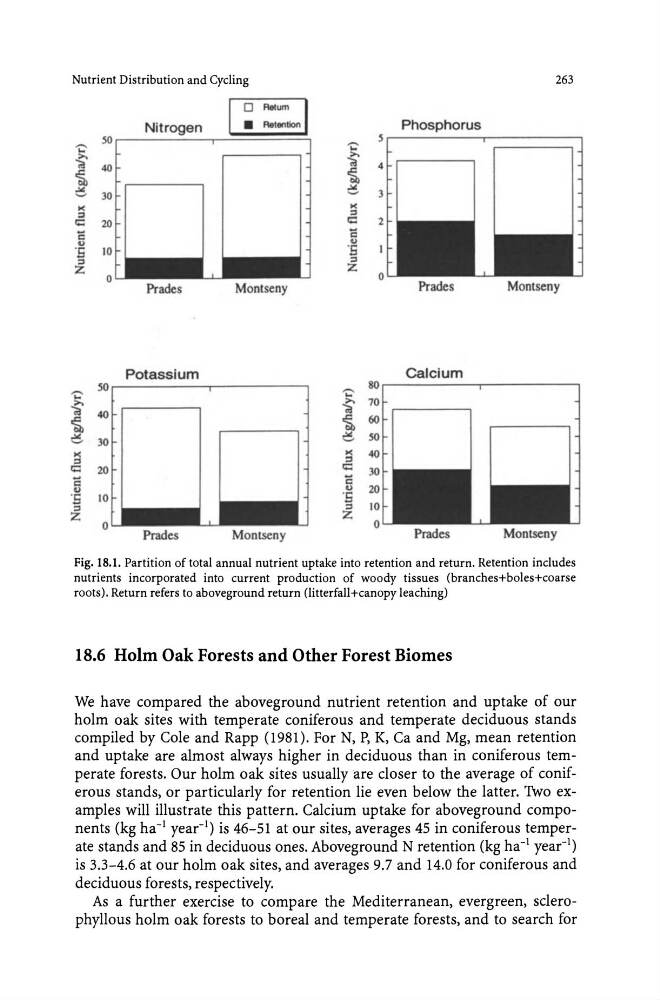
Fig. 18.1. Partition of total annual nutrient uptake into retention and return. Retention includes
nutrients incorporated into current production of woody tissues (branches+boles+coarse
roots). Return refers to aboveground return (iitterfall+canopy leaching)
18.6 Holm Oak Forests and Other Forest Biomes
We have compared the aboveground nutrient retention and uptake of our
holm oak sites with temperate coniferous and temperate deciduous stands
compiled by Cole and Rapp (1981). For N, P, K, Ca and Mg, mean retention
and uptake are almost always higher in deciduous than in coniferous temperate forests. Our holm oak sites usually are closer to the average of coniferous stands, or particularly for retention lie even below the latter. Two examples will illustrate this pattern. Calcium uptake for aboveground components (kg ha- I year-I) is 46-51 at our sites, averages 45 in coniferous temperate stands and 85 in deciduous ones. Aboveground N retention (kg ha- I year-I)
is 3.3-4.6 at our holm oak sites, and averages 9.7 and 14.0 for coniferous and
deciduous forests, respectively.
As a further exercise to compare the Mediterranean, evergreen, sclerophyllous holm oak forests to boreal and temperate forests, and to search for
Nitrogen
50
0::~ 40
~
~ 30
><
::I
C
20
E .,
·S 10
::I
Z
0
Prades
Montseny
Potassium
SO~--------~r----------.
~ 40
:i - 30
;1
C
20
C
u
'S 10
i o
Prades
Montseny
263
Phosphorus
5
0::>.
~
4
~
~
3
><
::I
C
2
C .,
·S
::I
Z
0
Prades
Montseny
calcium
80 .----------.-- - -------,
~ 70
~ :
~
40
c
c u
'S
::I
Z
30
20
10
o
Prades
Montseny
Fig. 18.1. Partition of total annual nutrient uptake into retention and return. Retention includes
nutrients incorporated into current production of woody tissues (branches+boles+coarse
roots). Return refers to aboveground return (iitterfall+canopy leaching)
18.6 Holm Oak Forests and Other Forest Biomes
We have compared the aboveground nutrient retention and uptake of our
holm oak sites with temperate coniferous and temperate deciduous stands
compiled by Cole and Rapp (1981). For N, P, K, Ca and Mg, mean retention
and uptake are almost always higher in deciduous than in coniferous temperate forests. Our holm oak sites usually are closer to the average of coniferous stands, or particularly for retention lie even below the latter. Two examples will illustrate this pattern. Calcium uptake for aboveground components (kg ha- I year-I) is 46-51 at our sites, averages 45 in coniferous temperate stands and 85 in deciduous ones. Aboveground N retention (kg ha- I year-I)
is 3.3-4.6 at our holm oak sites, and averages 9.7 and 14.0 for coniferous and
deciduous forests, respectively.
As a further exercise to compare the Mediterranean, evergreen, sclerophyllous holm oak forests to boreal and temperate forests, and to search for